Identifying risk in your client portfolio is a huge ongoing challenge, so one of the most critical questions Chief Compliance Officers (CCOs) must answer is whether to build or buy technological tools for negative news screening.
While building a tool from scratch gives an organisation total control over its development and use, it can become a burden on your time and resources. It demands specialist technical support, significant time for testing and deployment, and constant monitoring to keep it up to date with the latest technological advancements in AI and machine learning.
On the other hand, adopting a tool from a specialist vendor may reduce your level of control, but it offers technical expertise, ongoing support, and advanced, AI-led software that minimises disruption and boosts long-term efficiency.
Build: What are the limits of an in-house solution?
Many organisations will opt for an in-house solution. This provides the maximum level of control over the software, allowing firms to develop it according to exacting specifications.
But they also come with major limitations:
They can quickly become outdated with rapid technological advancements, especially surrounding artificial intelligence (AI) and machine learning, necessitating expensive and time-consuming ongoing development.
Solutions that fall behind in technology can produce overwhelming false positives, expensive backlogs, and poor client outcomes.
A lack of specialist in-house resources means tools may not perform optimally, such as with over-reliance on ‘fuzzy matching’, which often produces poor outcomes.
Sifting through false positives to account for non-optimal performance can be a lengthy task and a waste of precious human resources.
Organisations may lack the resources to promptly service an in-house system in case of an outage or other technical difficulty.
Buy: What are the advantages of an AI-led solution?
Sourcing an AI-led solution from a specialist vendor is the obvious alternative. Although many organisations may be wary of outsourcing a critical operation to a third party, they offer the kind of expertise and ongoing support some firms lack on their own.
An AI-led solution can:
Dramatically reduce false positives, provide intuitive and easy to understand analysis, and support a more robust screening capability.
Harness enormous amounts of unstructured data to produce new insights on customer risk, dramatically improve results, cut down on false positives, and overcome inefficiencies.
Give compliance teams complete oversight and control during investigations, cutting out the unnecessary middleman and ensuring more accountability, transparency, and efficiency.
Scale without necessarily needing to hire more staff members. This scalability means that AI-led tools have a positive return on investment, making the compliance function a growth enabler rather than a cost burden.
Remove redundancies and improve overall efficiency, allowing teams to focus on real instances of financial crime risk.
Furthermore, vendors specialising in AI-led technology for anti-financial crime have the resources and expertise to concentrate more effectively on technology advancements, specific regulatory requirements, and producing tools with a good and proven user interface. They also have clear roadmaps for improving their systems, often based on user feedback.
Screening Innovation: Labyrinth Screening, featuring AI Risk Profiles
CCOs must tackle a whole range of challenges when it comes to screening. Customer data can be limited and problematic, while media data can be noisy and imprecise. Many screening methods generate a large number of false positives, struggle to achieve accuracy at scale, and put a significant time burden on analysts.
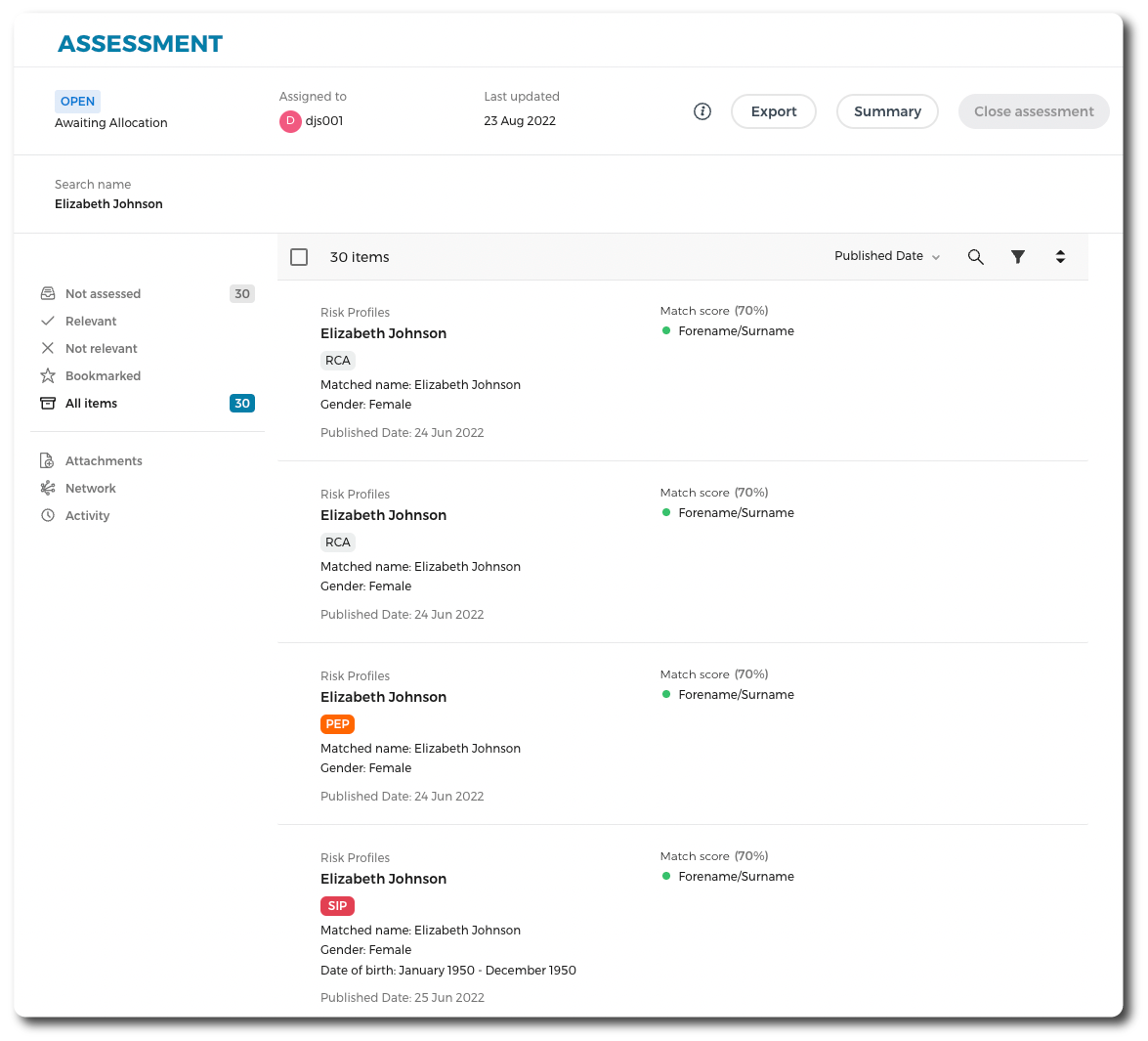
Ripjar’s screening solution features AI Risk Profiles which are designed to address these challenges directly, saving analysts time and increasing accuracy in customer screening.
Data from both structured and unstructured sources is reviewed to build individual profiles for people and organisations, with advanced natural language processing extracting the most relevant items necessary to give a clear and complete view of relevant risks as quickly as possible.
AI-powered multilingual name matching and entity resolution are used to overcome screening challenges such as common or high profile names, helping ensure your organisation’s regulatory compliance by identifying risks other screening methods might miss.
This approach also captures a huge number of secondary identifiers – such as dates of birth, nationalities, locations and roles – from unstructured text.
This vast expansion of context leads to richer data and better recall. Standard watchlists are also enriched with these additional properties, improving sanctions and PEP screening accuracy.
80% of AI Risk Profiles contain secondary identifiers, which is key to reducing false positives. Testing has shown that there can be as much as a 91% reduction in false positives alongside a 5% improvement in recall.
By aggregating these properties across millions of articles, Ripjar’s screening tool can assign identifiers to entities at a scale which is simply not possible in human-curated profiles, and at an accuracy not achievable with article-based risk evaluation.
In a financial landscape progressively embracing AI as a productivity tool, generative AI (GenAI) has the potential to be a game-changer for anti-money laundering (AML) compliance. GenAI screening tools are capable of detecting patterns and relationships within data which, in compliance contexts, means identifying and analysing unstructured data and delivering financial intelligence faster than conventional screening – without the same potential for costly false positive alerts.
However, GenAI also has its challenges. Some tools have been known to deliver unreliable results or fabricate results entirely as ‘hallucinations’, while developers are often unwilling to disclose how their platforms work, which is a problem for compliance investigations. Those issues have made many firms understandably reticent about integrating GenAI in compliance, despite its advantages.
With that in mind, the best approach to GenAI integration in compliance is one based on careful consideration of available data. Equipped with the right insight and expertise, firms will not only be able to integrate innovative new tools safely, but optimise them to deliver the best compliance results. If you’re ready to explore GenAI as part of your compliance solution, let’s look at some of the most important practical considerations of that process.
What are the possibilities of GenAI integration in compliance?
Many industry observers frame AI as a game-changer in the fight against financial crime. With the potential to reshape data management and analysis, the technology offers specific anti-money laundering compliance advantages, including:
Automated analysis of structured and unstructured risk data
Automated summaries of large volumes of data as concise prose paragraphs
Identification of trends, patterns and connections within and between data sets
Quality assurance and verification of human AML compliance decisions
The possibilities of GenAI are appealing, but it’s important that compliance teams understand its limitations, not least the potential for hallucinations, and the lack of insight into how it generates outputs. Those factors mean that risk-averse firms should take a slower approach than their peers, waiting for more industry data, and regulator guidance, before deploying new AI tools.
What do regulators think about GenAI compliance integration?
Regulatory perspectives on the use of AI in compliance vary. While some regulators are seeking to impose overarching new rules frameworks to account for the rapid uptake of the technology, others are taking more principles-based approaches. Most regulators, including the Financial Action Task Force (FATF) have acknowledged the potential for AI to make compliance both easier and cheaper, but have also urged caution, pointing specifically to the need for explainability and transparency if the technology is to have a meaningful compliance impact.
While few jurisdictions have made substantive progress towards AI-specific compliance regulation, the EU has stood out by passing the Artificial Intelligence (AI) Act in May 2024. Characterised as a landmark regulation, the AI Act will be industry-agnostic, classify AI systems by the amount of risk they present, and require proportional compliance measures. Aspects of the legislation will be implemented over the course of several years up to 2030.
Practical AI Compliance Tips
As regulators find their feet, it’s important that firms keep a perspective on the GenAI horizon and don’t miss out on opportunities, or fall behind competitors. With that in mind, CFOs and their compliance teams should think ahead about how they will integrate GenAI tools successfully within existing anti-financial crime (AFC) frameworks when the time is right.
Consider the following key practical AI adoption tips:
Think about your compliance needs
GenAI innovations hold undeniable potential, but they are not compliance silver bullets. The impact of GenAI will depend on numerous contextual factors, not least the need for firms to understand the technology’s capabilities and limitations.
GenAI tools are currently best suited to the analysis and summarisation of large amounts of data, such as the results of adverse media searches. On the other hand, the technology is not as effective at running and generating the results of adverse media searches – other AI techniques are better suited to this. That factor should inform decisions about GenAI possibilities within a given business infrastructure, and means that some firms should consider a low effort, high impact integration of GenAI, before iterating to broader applications.
Don’t rebuild from the ground up
It’s important to think about current GenAI technology as a way to enhance existing compliance systems, rather than replace them. In practice, this means that you shouldn’t be rebuilding your entire tech infrastructure from scratch to accommodate GenAI tools.
In fact, most GenAI solutions are conducive to a staged and layered approach to integration which enables firms to maintain existing AFC controls as they get used to the new technology, and before committing to new compliance strategies. This option is particularly useful for transaction monitoring processes, since firms often use both traditional, rules-based systems alongside AI overlays, running outputs through the AI tool to refine results and create better screening outcomes.
Focus on data
The principle ‘good data in, good data out’ is typically reliable in screening contexts. The higher the quality of adverse media inputs, for example, the more accurate the risk profiles that firms can create for their customers. This principle applies just as much to GenAI screening tools, meaning that firms should seek to train them on robust data sets with sufficient depth and quality.
However, it’s important to remember that screening data quality will never be ‘perfect’ and firms shouldn’t wait for it to reach that hypothetical standard before deciding to integrate GenAI innovations. Consider potential use cases for GenAI integrations and prioritise data sets that will enhance the impact of your GenAI tools. If your adverse media data quality is high, for example, focus on GenAI integrations within your adverse media screening solution, and work to optimise these.
Consider the cost of expertise
GenAI adoption represents a new cost metric which must be considered alongside the context of the wider compliance budget. While larger businesses may have the in-house resources to research and deploy GenAI tools, other firms may need to consider whether to recruit new expertise or find a partner who can help them handle the process.
The projected cost of GenAI adoption should account for the speed with which the technology is developing. Firms should think about whether in-house GenAI integration is something that can be sustained over time – an effort that will require ongoing software updates, expertise and governance refreshes, and technology upgrades.
Select an effective partner
Firms that choose a third party to help manage their GenAI adoption and integration must be confident that their partner understands their compliance needs and vision, and can grow with their business.
Given the complexity of the GenAI landscape, and its pace of change, it’s important that the partnership allows for collaboration and open dialogue. You should understand how your partner will approach the design and deployment of your GenAI tools, what training will be provided, how the technology will be managed day-to-day, and what kind of post-integration support will be available.
Validate and test
The relative unfamiliarity of GenAI as part of compliance solutions means that firms must factor the validation and testing of system outputs into the adoption and integration process. The timescale for validation and testing will vary for each individual firm but should serve to ensure that the results the new tools generate align with the needs of the business. Validation and testing will also strengthen employee skills with the new technology, build confidence, and importantly, identify problems and risks.
The validation and testing process should not be limited to the pre-adoption phase. Firms should implement an ongoing testing schedule to identify emerging problems.
Empower employees
While GenAI represents a step forward in compliance automation, human compliance employees will remain critical. Human expertise will be needed to not only validate the outputs of GenAI screening, for example, but to intervene to address problems and to explain results to third parties as part of law enforcement investigations.
With that in mind, GenAI adoption should include a focus on the training and skills of users. Effective training will not only optimise the impact of new GenAI tools but ensure that the compliance team can adapt to changes, including emergent risks and innovation opportunities.
Embrace GenAI Screening Power
It’s time for CFOs to start thinking about the possibilities of GenAI, and what integration might look like in their organisations – not just in terms of advancing compliance, but staying ahead of customer expectations. Adoption and integration of GenAI promises both opportunities and challenges but the right partner can ensure firms identify and address pain points quickly, and move forward with confidence.
Built with cutting-edge AI and machine learning technology, Ripjar’s Labyrinth Screening system has proven compliance impact, enabling firms to conduct real-time global name searches across thousands of data sources, in multiple foreign languages, and deliver financial intelligence in seconds. Enhanced with GenAI innovation, and designed with decades of industry expertise, Labyrinth extracts the most relevant information from vast unstructured data sets, and uses that information to generate deep, detailed customer risk profiles with concise prose summaries, so your team can make stronger, faster compliance decisions.
Since 2022, Western economic sanctions have limited the ongoing war in Ukraine by stifling the Russian economy and preventing the Russian government from acquiring goods and services for military end-use. Under that pressure, Russian president Vladmir Putin has increasingly relied on illicit means of importing military and other critical resources, including a so-called ‘dark fleet’ of ships willing to evade international trade restrictions at the risk of severe legal penalties.
With international shipping at the heart of its sanctions evasion strategy, the number of transportation and logistics companies actively engaged in Russia sanctions violations has increased dramatically. This has not only led to sanctions against these entities but sanctions against ships and vessels engaged in evasion strategies. Given the shift in the threat landscape, international businesses must be aware of the compliance risk they face when dealing with certain vessels and aircraft, and be able to spot sanctioned operators.
Why are Sanctions on Vessels and Aircraft Necessary?
Shipping entities pose a particularly high compliance risk because of their potential to operate in contravention of international sanctions rules. Many of those illegal activities involve the practical operation of vessels and aircraft themselves, in tandem with the manipulation of shipping practices and regulations. Putin’s shadow fleet has grown dramatically since 2022, with some estimates now putting it at over 1,000 tankers (and other vessels) owned and operated by persons willing to violate international law, and supply resources directly to Russia’s military.
These shadow vessels do not just pose regulatory risks but create legal and diplomatic issues, and even pose a threat of physical harm against other vessels and their crews. Their illegitimate operational status means they often have not acquired appropriate indemnity insurance and are typically older, poorly-maintained vessels that pose a significant health and safety risk to their crews and the crews of other vessels.
Key strategies that shadow vessels use to evade sanctions include:
Disabling automatic identification systems (AIS) to prevent tracking attempts.
Use of abnormal and potentially hazardous transportation routes.
Fraudulent or manipulated registration documentation.
‘Flag hopping’ or misrepresenting the flag under which the vessel operates.
Physically altering a vessel’s markings to thwart identification by authorities.
Ship-to-ship transfers, mid-route, in order to avoid customs controls.
Complex corporate ownership structures designed to hide the identity of the individuals behind the sanctions evasion crime.
In addition to financial penalties, when shadow vessels and aircraft are detected by authorities or customs officials, subsequent enforcement actions may result in significant jeopardy for crew members, who may not even be aware of the legal status of the goods they are transporting. Similarly, the consequences of any action by authorities may create or escalate diplomatic tensions, resulting in further financial costs and legal consequences.
Maritime Sanctions Impact
Western governments are addressing the sanctions threat posed by vessels and aircraft by implementing dedicated sanctions measures, such as the UK’s maritime shipping sanctions regulations, or the US Office of Foreign Asset Control’s (OFAC) blacklisting of specific shipowners, vessels, and aircraft that facilitate the transport of goods to sanctioned countries.
Maritime (and other) shipping sanctions vary by regime but typically restrict firms from engaging in business with specific vessels and aircraft. Measures and controls may include:
Designation of the vessel or aircraft registration on a sanctions list.
Seizure of the vessel or aircraft by authorities.
Seizure or freezing of assets of the vessel or aircraft’s controlling company.
Airspace restrictions and denial of access to ports and airports.
Vessel and Aircraft Sanctions: Recent Updates
In June 2024, the UK along with its G7 partners introduced a new round of Russia sanctions which included several targets within, or connected to, the Russian shadow fleet. The designations were made because the owners of the targeted vessels were found to be using shell companies as a means of concealing their involvement in the sanctions violations. The targets included:
Four vessels in the fleet itself:
Ocean AMZ (IMO 9394935)
Canis Power (IMO 9289520)
Robon (IMO 9144782)
NS Laguna (IMO 9339325)
Two vessels involved in the transportation of weapons to Russia:
Lady R (IMO 9161003)
Angara (IMO 9179842)
A ship manager:
One Moon Marine Services LLC
Combat Sanctions Risk with Effective Screening
The complexity of the sanctions risk landscape, and the impact of new sanctions against specific vessels and aircraft, represent a significant compliance challenge. With governments cracking down on sanctions evasion in jurisdictions around the world, firms must tighten their screening and monitoring solutions to ensure they keep pace with new risks.
In practice, this means that screening solutions must be able to detect ships and vessels currently designated under sanctions regimes with a high degree of accuracy, and react quickly when sanction lists are updated. That evolving data burden requires firms to implement powerful, continuous automated name screening, with global scope, in order to meaningfully contribute to the fight against sanctions evasion and, critically, avoid penalties.
Ripjar’s Labyrinth Screening platform is designed to deliver that kind of screening power, facilitating name searches of thousands of global sanctions lists and watchlists, in real time, and delivering actionable intelligence in seconds. Powered by next-generation AI technology, Labyrinth’s sanctions compliance support not only adds automated speed and accuracy to the screening process, but can add additional insight from adverse media to help compliance teams make better, faster decisions about potential sanctions risks in every corner of the world.
Fuzzy matching, traditionally used for name matching when undertaking customer screening, is a technique that identifies approximate matches rather than exact matches. It is particularly useful when dealing with data that may have inconsistencies, such as typographical errors, different spelling variations, or missing characters. By allowing for a certain degree of variation, fuzzy matching helps to find similar entries that are not identical.
How Fuzzy Matching Works
Fuzzy matching algorithms compare strings and determine how similar they are based on predefined criteria. These criteria can include the number of characters that need to be changed, added, or removed to turn one string into another. A common example is the Levenshtein distance, which measures the number of single-character edits required to change one word into another. Analysts can set a threshold to decide how close the match needs to be for it to be considered a valid match.
Challenges with Fuzzy Matching for Name Matching
Despite its usefulness in many scenarios, fuzzy matching presents significant challenges when it comes to name matching. The primary issue is the high number of false positives it generates. When the threshold for matching is set too low, many unrelated names may be flagged as potential matches, creating a considerable amount of work for analysts to sift through the irrelevant data. This is particularly problematic when dealing with large datasets.
Fuzzy matching also struggles with aliases and nicknames, such as “Ted” for “Edward” or “Maggie” for “Margaret.” These variations are not always phonetically or character-wise similar, making them difficult to detect using traditional fuzzy matching methods.
Cultural Limitations of Standard Algorithms
Standard fuzzy matching algorithms do not account for the likelihood of different variants or the cultural significance of certain name elements. For example, certain typographical errors are more likely than others, and accents on letters may be frequently missed.
Furthermore, some names do not have a standard English spelling, leading to multiple variations and further complicating the matching process. For example, the name “Mohammad” has numerous spellings due to the lack of vowels in Arabic. Similarly, different Latin languages will transcribe Cyrillic names differently. For example, German and English versions of the name “Vladimir Putin” may be spelled differently despite both being Latin languages.
The importance of effective transliteration, transcription and translation in customer name screening is also raised by The Wolfsberg Group in their 2022 Negative News Screening FAQs, which provide guidance on tackling different languages and scripts in the context of adverse media screening.
What is Ripjar’s Approach to Name Matching?
Unlike traditional fuzzy matching, our name variants approach is designed to minimise false positives and maximise recall, ensuring accurate and efficient name matching.
Rather than relying only on traditional fuzzy matching methods, we take a much more comprehensive, in-depth approach. Our advanced technology encompasses over 25 different techniques which work together to identify the most relevant and accurate matches based on different name variants. This can then be tuned to suit individual organisations.
Name Variants Database
Instead of relying solely on fuzzy matching, we undertake name screening in over 400 languages, scripts and dialects, and maintain an extensive database of over 1 million name variants, encompassing different spellings, translations, and truncations of names.
Ripjar offers a 94% improvement over fuzzy matching technology
International name matching expert
Our approach involves using multiple matching techniques simultaneously rather than relying on a single fuzzy matching algorithm. We consider a variety of factors, including character-based algorithms, phonetic matching, and real-life name variant patterns. By addressing all potential variations, we ensure that our system captures a comprehensive range of name possibilities.
For instance, while other systems might rely solely on the Levenshtein distance to measure character changes, we incorporate subtraction variants, spelling corrections, and database variants created from observed name representations in different countries. We also apply region-specific rules based on the origin of names, enhancing our ability to match names accurately across diverse datasets.
Additional data points such as date of birth, location, or other identifiers, are then used to help identify and discard mismatches.
Risk-Based Approach and Custom Tuning
We understand that there is no one-size-fits-all solution to name matching – it depends on the specific use case and the associated risk tolerance. That’s why we enable a risk-based approach, offering multiple different matching strategies out of the box. These can then be further refined to suit different scenarios and client needs, with 25+ name variant techniques to choose from.
Our Operational Data Science team works closely with customers to fine-tune these strategies, balancing the need for high recall with the minimisation of false positives. This collaboration ensures that the matching process is as efficient and accurate as possible. We can also tailor the matching strategies for smaller subsets of client data, or based on different types of risks, such as sanctions or adverse media, providing users with control over the balance between recall and the amount of manual review work required.
Data-Optimised Name Matching and Linguistic Matching
We leverage real data to optimise our matching processes, including analysing the frequencies of name occurrences. By understanding how often certain names appear on watchlists or in media, we can make informed decisions about which name versions to include or exclude, enhancing the overall performance of our matching engine.
Specifically for adverse media matching, we are also able to leverage the rarity of a name in a particular region to reduce the false positives arising from returning too many matches on common names.
In addition, we use linguistic techniques to understand the origin and structure of names, which allows us to identify and manage name variations more effectively. Having characterised the likely origin of a name, we use a rule-based name matching system to vary different parts of the matching to account for certain variations and name structures being more prevalent in certain cultures/languages. For example, we handle declensions in different languages, recognising them as legitimate variants rather than typographical errors. This level of linguistic sophistication enables us to accurately match names across different cultures and languages.
Our name variants approach also includes translations of corporate names in various languages, and their likely manipulations. For example, a corporate name in Chinese might have multiple international translations, and we include all plausible versions to ensure comprehensive coverage.
Conclusion
Fuzzy matching alone, while useful for finding approximate matches, falls short in the context of name matching due to its high rate of false positives and inability to account for cultural and linguistic nuances. Maintaining a comprehensive database of name variants and employing multiple matching techniques can provide more accurate and efficient results. Understanding the likely mistakes and variations specific to names is crucial for effective name matching, making it a complex task that goes beyond the capabilities of simple fuzzy matching algorithms.
Ripjar’s name matching system stands out from traditional fuzzy matching approaches by leveraging a combination of data science, linguistic techniques, and customised tuning. Our comprehensive name variants database ensures that we deliver accurate and efficient name matching for a wide range of use cases and enables a risk-based approach to be undertaken. By understanding the cultural and structural nuances of names, we provide a superior solution that meets the complex needs of global screening at scale, and consistently performs top in name matching tests.
Name screening is fundamental to anti-money laundering, enabling firms to more accurately capture the level of financial compliance risk that individual customers present, and then deploy appropriate mitigation measures.
Often a regulatory requirement, AML name screening is critical in the fight against financial crime but typically involves the collection and analysis of vast amounts of structured and unstructured data, and the accurate matching of that information to specific individuals. In contexts where firms struggle to meet those obligations or to manage the screening data burden, automation often provides an advantage – if integrated effectively.
Given the critical role it plays in combating money laundering, firms must understand how to implement effective name screening – and how to optimise their screening tools as part of a wider compliance solution.
What is AML Name Screening?
AML name screening is the process of searching customer names for their designation on official sanctions lists, PEP lists and watchlists, or in negative news (adverse media) stories, in order to accurately gauge the level of money laundering risk that they present.
When firms find customer names designated on relevant sanctions or watchlists, or in negative news media, that information should generate an alert, inform the customer’s risk profile, and ultimately help the compliance team take appropriate action. This may include declining their use of services, freezing transactions or forwarding information to the authorities.
Firms may take different approaches to AML name screening:
Manual Screening
A manual name screening process involves manually searching for names in lists and datasets, or using public search engines such as Google or Bing to search customer names with the aim of identifying potential risk. Manual screening may generate usable risk data but is limited in a number of important ways. For example, a search engine’s algorithm may deliver inconsistent or incomplete results, de-prioritise critical information, or block some results under regional data laws. Manual searches may also be time-consuming and vulnerable to human error, especially in cases where large numbers of names must be checked.
Automated Screening
Firms can automate their AML name screening with software tools that are capable of searching through vast amounts of structured and unstructured data with speed and accuracy, reducing the potential for human error. Automated name screening tools allow compliance teams to tailor their searches, review thousands of global data sources in seconds, and then categorise and analyse that data to facilitate stronger decision-making.
AML Risk Data Sources
The AML name screening process typically captures risk data from the following sources:
Economic sanctions lists featuring the names of individuals, organisations and countries subject to economic sanctions imposed by governments.
Politically exposed person (PEP) lists featuring the names of elected and unelected officials such as politicians, government officials, members of the military, and so on.
Government watchlists featuring the names of persons known to pose a financial criminal risk.
Adverse media sources including established news organisations, blogs, websites, forums, and social media posts.
Why is AML Name Screening Important?
Most jurisdictions set out risk-based AML compliance requirements, which makes name screening an essential part of an effective AML solution, and critical to avoiding costly regulatory penalties.
Beyond regulatory obligations, name screening has a significant and meaningful impact in the global fight against money laundering. The value of name screening lies in both the quantity and quality of risk data that it can provide. Vital risk information gained from sanctions lists, PEP lists and watchlists can be enhanced and given additional context from adverse media results. For example, a firm may discover a news story about a customer’s involvement in a foreign money laundering investigation, containing information that may not have been reported by domestic outlets, and which may not be officially confirmed for months. Informed by that screening data, firms can adjust the customer’s AML risk profile and take appropriate action to avoid a compliance violation.
Global Screening Challenges
Although it is an indispensable part of modern compliance, global AML name screening can present administrative and practical challenges. The most common include:
Data Volume
The sheer amount of data involved in AML name screening can be overwhelming. Firms must consider their search parameters carefully, taking into account the regions and languages in which searches should be conducted, and which watchlists or news publications they need to search. Certain searches may generate a huge amount of alerts, including false positives and redundant duplicate stories, all of which need remediation.
Data Quality
Not all risk data is equal. Information from low-credibility sources, such as blogs, forums, and social media posts, is typically less reliable than information from sanctions lists, PEP lists, watchlists, and established publications such as international news organisations. The distinction between low and high quality data may be more challenging for searches carried out in foreign languages.
Language, Spelling, and Naming
Global name searches may struggle to account for the nuances of foreign languages, including naming and spelling conventions. Some cultures reverse the first name-surname order, for example, use prefixes before names, or approximate English spelling translations. Similarly, some data sources may use non-Latinate characters, such as Cyrillic or Arabic.
Aliases, Nicknames and Similar Names
Searches may misidentify customers based on the use of aliases, nicknames, and similar or exact-match names. In searches of Western news stories, for example, the name “John Smith” would, without added contextual input, generate a huge amount of similar or exact-match name alerts, while customers that use nicknames or middle-names when signing up for services may also end up confusing search tools. On the other hand, criminals may actively try to evade searches by using aliases.
AML Name Screening Best Practices
AML name screening is challenging, but firms can streamline their process by applying the following best practices as they develop and use their search solutions.
Optimise CDD
Firms should apply robust customer due diligence (CDD) measures during onboarding to verify their customers’ identities, including collecting official identifying documents such as passports. Effective CDD enriches customer risk profiles with contextual information which can, in turn, help compliance teams clarify name screening data where ambiguities and false positives emerge.
Automate Where Possible
Automation allows firms to build speed and accuracy into their AML screening process, accomplishing in seconds what would have previously taken hours to complete, and without the same potential for human error. Automated screening tools offer an array of peripheral benefits – solutions can be tailored to a firm’s business needs and risk appetite, and scaled to accommodate business growth. Automated solutions can also integrate emerging innovations, and account for multi-language screening challenges.
Risk Categorisation
It is important to implement a screening solution capable of discerning different types of risk from the content it targets, and categorising that information accordingly. Customers involved in potential financial crimes (such as fraud) may pose a different level of money laundering risk than customers involved in narcotics offences, for example, and that nuance can help firms clarify, and deploy a more efficient compliance response.
Ongoing Monitoring
AML risk screening should not become a box-ticking exercise. Customer risk profiles can change quickly as a result of elections, regulatory changes, or geopolitical events such as the conflict in Ukraine, and firms must be ready to adapt to changes in that environment. Screening solutions should continuously monitor for changes, and firms should be proactive in seeking out and capturing new risk data.
Integrate AI
AI has become a powerful weapon in the fight against financial crime. The emergence of generative AI and large language models (LLMs) is particularly valuable for name screening since it enables firms to analyse unstructured data with unprecedented speed and accuracy, across numerous language systems. AI technology is also capable of discerning different levels of risk, identifying duplicate information, and recognising non-Western characters and other translation issues.
Next Generation Name Screening
Build next generation automated name screening into your AML solution with Ripjar’s Labyrinth Screening platform. Powered by AI technology, Labyrinth Screening is capable of searching thousands of global sanctions lists, PEP lists, watchlists and adverse media sources in seconds, to deliver actionable financial intelligence that enables firms to stay ahead of regulatory risk.
Labyrinth Screening is designed to supercharge the name screening process and dramatically reduce assessment times. The platform includes Ripjar’s AI Risk Profiles tool to help teams extract only the most risk-relevant information from large volumes of data, and AI Summaries, a generative AI tool that adds concise prose summaries of that data to each customer profile.
Labyrinth Screening now supports four new Nordic languages: Norwegian, Danish, Swedish and Finnish. This takes the total number of supported languages to 26.
Rather than using translations, Labyrinth Screening carries out multilingual screening, whereby all documents and articles are screened natively in the language in which they are published, removing the risk of nuance or context being lost. While the platform was already screening versions of Nordic news stories which had been published in English or other supported languages, this new language update will enable customer AI Risk Profiles to benefit from an even wider range of data sources.
Why does Labyrinth Screening’s Nordic language update matter?
Recent spikes in financial crime in Nordic countries have meant that the ability to screen natively in those languages has increased in importance in combatting financial crime risk and ensuring Nordic AML compliance.
The addition of the new Nordic languages to Labyrinth Screening means we can now use a broader set of data sources – both from web-scraping and formal sources of data – providing more data points and richer data to enhance our AI Risk Profiles and provide greater screening confidence.
Not only can new media articles be processed in Nordic languages, but Labyrinth Screening can now also reprocess older Nordic-language documents already held in the platform’s data store, and use the full range of analytics on them. By supplementing existing risk profiles with any additional risk data or context extracted from these sources, this new Nordic language capability enables Labyrinth Screening to add even more value to our customers.
Over 63 million articles have already been processed in Norwegian, Danish, Swedish and Finnish since implementing these languages within Labyrinth Screening, with hundreds of new articles being added every day.
Within Labyrinth Screening, all our analytics are carried out in the source language of each individual news article or document, so as not to lose the nuance of the original language. The addition of these extra languages into the platform is therefore hugely valuable to any of our customers who are screening Nordic entities, as it ensures no context is lost by translating first.
How is Ripjar’s name screening different?
While other platforms may translate articles and documents before screening them, Labyrinth Screening only processes documents in the language in which they were written, ensuring it provides the most accurate, reliable results, with no loss of context.
In addition to its multilingual name-matching capabilities, Labyrinth Screening is also an industry leader on multi-script language screening, with the ability to screen languages with non-Latinate characters, such as those using Cyrillic, Arabic or logographic alphabets. It can also undertake transcription between languages and transliterate customer names from their native script into Latin characters – including the potential name variations this creates – ensuring the best possible identity-matching.
For example, Finnish has a particularly complex system of declensions – changes to a name’s representation that indicate properties like gender or grammatical case – with 51 types of declension, each with seven different grammatical cases. A Finnish surname like “Hautamäki” could be represented as diversely as “Hautamäen”, “Hautamäelle”, or “Hautamäkeä”, depending on the context:
Labyrinth Screening provides extensive declension handling, allowing us to correctly infer the nominative case – the base form of the name – more than 90% of the time, covering all the major declension types in each of the seven cases. This is essential for effective adverse media screening, as people and organisations are regularly mentioned with different declensions of their names in the news.
What are Nordic adverse media screening requirements?
As part of their EU membership, Denmark, Sweden and Finland (and Norway, as part of the EEA) are required to comply with the EU’s Sixth Anti-Money Laundering Directive (6AMLD) as well as their own national AML regulations.
Regulatory compliance in the Nordics involves the implementation of customer due diligence processes, transaction monitoring, sanctions and watchlist screening, and adverse media screening. For example, Denmark’s financial regulator, the Danish Financial Supervisory Authority, has risk management guidelines which state, “It is essential that financial institutions include media screening of customers and beneficial owners in customer due diligence.”
Also referred to as negative news screening (NNS), adverse media screening forms a vital part of a risk-based approach to compliance, as news and other media sources often highlight potential risk relating to people and organisations before it is officially confirmed. This early detection of risk is valuable in many ways, from anticipating criminal activity to avoiding reputational damage.
The addition of Norwegian, Danish, Swedish and Finnish languages into Labyrinth Screening – and the resulting ability to screen natively in these languages – is therefore another vital way to ensure that Nordic adverse screening requirements are met as robustly as possible and with the greatest accuracy.
In September 2023, Ripjar’s latest Summit took place at Singapore’s Swissôtel The Stamford, overlooking the city’s scenic Marina Bay. Senior financial compliance professionals from around the world attended the Singapore Summit, which included an exclusive breakfast and networking event, followed by a discussion on the latest innovations, challenges, and trends in customer screening, and a demo of Ripjar’s AI Risk Profiles solution.
Panel Discussion
Ripjar Chief Product Officer Gabriel Hopkins moderated the panel discussion, which included industry tech, data, and compliance experts Josh Heiliczer (PWC Managing Director), Andrew Chow (Synpulse Senior Advisor), and Simon McClive (Ripjar General Manager of Labyrinth Screening).
The panel theme was ‘Innovation in Screening’ – here are some of the key highlights from the discussion.
How is customer screening changing?
Picking up the first discussion point, Andrew Chow highlighted the changing role of technology in driving fundamental change in modern screening strategies. He talked about the advent of public-private partnerships and the large data sets now available as part of those arrangements. Andrew spoke on the need to think about the accuracy of data and referenced the recent so-called Fujian gang scandal, which is now thought to involve at least $2.4 billion in laundered money. When the perpetrators of the scandal first arrived in Singapore, it is likely that the banks failed to accurately understand their links to China due to their nationalities.
Andrew provided an example from his own experience of carrying out a KYC check on a customer with a St Kitts and Nevis passport. After running the check, he later found out that the customer was a Chinese national, and had obtained a second passport. The incident highlighted the importance of data accuracy in customer screening.
Josh Heiliczer echoed the need for screening accuracy. He noted the importance of adverse media screening, as well as other public domain data sources, and even social media, in identifying the signals, and addressing the scale of international money laundering risk. He also noted that the accuracy problem may be attributed to an increase in false positives: compliance teams can reduce false positives by using secondary “identifiers”, and cross-script matching (which can also improve matching accuracy). Josh highlighted the need for firms to have a risk appetite framework in place, outlining which sources they are using to carry out effective screening. Those sources may vary depending on the customer’s region.
Simon McClive noted that firms increasingly have to deal with rapid changes in their compliance burdens, and used the example of recent Russia sanctions, which saw some organisations forced to upscale their screening solutions to accommodate thousands of new entities in a matter of weeks. Simon pointed out that firms need to have the processes and resources in place to cope with that kind of rapid change, all the while considering factors like new foreign language screening requirements and data quality, to ensure they’re building an accurate picture of the risks they face.
What lessons can we learn from recent money laundering scandals?
Andrew Chow stressed the importance of banks and financial institutions never assuming that they are “100% protected” from criminal risk. He added that those institutions must understand that new threats will always emerge. In the Fujian case, inflows appear to have come from other countries in Asia, and the banks involved had also not adequately identified the source of funds. He suggested that without the use of the latest technology, the scam may not have been discovered. Furthermore, the subsequent asset recovery effort currently stands at over $2 billion, which is significant by general standards.
Josh Heiliczer commented on the seizure of funds, contrasting the Fujin total with the estimated $275 billion that banks spend globally each year to tackle money laundering, and to the estimated $5 trillion of funds which are laundered. In summary, he suggested that the “cost of laundering is about 1.5% right now,” adding that “when I started in this business, it was 20-30%.”
Josh went on to talk about the way that money was moved across Asia, conducted on domestic payment networks despite being international funds transfers. For example, entities or individuals seeking to move funds outside of exchange controls such as $50,000 in China are often matched by laundering gangs with funds from a criminal origin (drugs, scams etc) to be moved into China. Once the criminal funds are in China they are “washed into goods” such as electronics for export and sale. Josh highlighted the value of bringing together transaction screening with adverse media and other data to get a complete picture of risk. CRS (Currency Reporting Standard) data can also add value to a balanced screening approach and Josh noted that “one of the things that clients don’t do well is looking back at client CRS data”. He forecast that there will be additional scrutiny of foreign exchange transactions in future.
Adding to those thoughts, Simon McClive raised the importance of native multi-language and multi-script screening capabilities in detecting international money laundering threats, including the need for solutions that operate across dialects and scripts, and deal with issues such as nicknames and aliases.
How do you get multi-script screening right?
Expanding on his previous points, Simon McClive suggested that firms should focus on the risk-based approach when implementing a multi-script screening solution. In practice, firms must consider how they can refine their adverse media searches in ways that provide value: for example, is it useful to screen in a manner that surfaces Latin American risk, when searching for Asian Pacific entities of interest? Firms should instead seek to balance their screening solutions in a way that provides meaningful, relevant data.
Josh Heiliczer noted that firms can also test their screening solutions based on certain risk perspectives. For example, a compliance team might take into account regional factors such as the presence of clients from a specific region of China, that might prompt a change in screening parameters in the future. Crucially, firms should set out their risk appetite and screening approach, and calibrate accordingly.
What is the role of AI in client screening, and how can people use it successfully?
Simon McClive noted that firms must be able to adapt to the changing capabilities of AI technology. For example, while generative AI is theoretically capable of pulling coherent information from vast amounts of unstructured data, its output is only ever going to be a probabilistic response, based on its predictive algorithm. Similarly, generative AI model responses are often inaccurate, biased, or fabricated – which limits the technology’s application in regulatory compliance contexts and means that firms must be aware of its risks.
With that in mind, Simon noted Ripjar’s use of generative AI as a fast, accurate means to summarise customer risk data and present a concise overview – in turn, supporting quick, accurate analyst decisions, and setting out the provenance of each claim within the summary. He stressed the importance of being able to explain the responses that AI tools generate to authorities and regulators, so that the results can be used in investigatory contexts.
Andrew Chow also raised the importance of explainability, noting that regulators typically don’t understand the probabilistic approach to customer data. Josh Heiliczer characterised the explainability problem as “significantly difficult” – and noted that firms might ultimately have to go through the “very complicated process” of understanding their data sets in order to be able to use them in regulatory actions.
Building on those sentiments, Simon McClive suggested that it might be the responsibility of vendors to “lift the lid” on the AI space as a way to promote safe use of the technology. AI innovation is moving rapidly, and firms might be able to avoid some challenges and pitfalls by putting certain controls in place sooner rather than later. Simon remarked that, while AI is currently very useful at showing analysts what they should care about in a given data set, compliance decisions are ultimately still made by human compliance employees. Ripjar’s latest experiments highlight the ways in which new technology is increasingly capable of automating decision-making as part of a process that is likely initially validated by analysts.
What are the big challenges for AI in adverse media screening?
Simon McClive listed the reliability of adverse media sources as a critical challenge for AI models – and warned specifically about the increasing volume of content created by generative AI models. With this in mind, firms need to be much more discerning about the sources they use as inputs for their screening solutions, and consider how far they trust that content.
Josh Heiliczer stressed that firms need a way of effectively identifying entities within adverse media sources as a way to manage large volumes of false positive alerts. He emphasised the need for both high quality internal and external data coverage as a means to improve those false positive rates. Expanding on the question of quality that Josh raised, Andrew Chow noted the importance of adding context to certain critical data points as a way to facilitate more effective risk-based decision making.
Presentation: AI Risk Profiles
The summit also included a presentation on AI Risk Profile technology: an innovative addition to Ripjar’s Labyrinth Screening solution that enhances the depth and detail of risk data, and helps firms make stronger compliance decisions.
Why do we need AI Risk Profiles?
Opening the presentation, Gabriel Hopkins highlighted a number of issues and difficulties related to adverse media screening. He started by echoing the panellists’ earlier warnings about the challenge of false positive alerts – which can make finding true risk like searching for a needle in a haystack. Gabriel also pointed to the need to obtain “the right data” on subject entities, uncovering not just financial risk but, where demanded, other types of risk (such as ESG), without becoming overwhelmed with false positive hits in the process.
At a global scale, regulators are also beginning to expect more systematic adverse media checks. Jurisdictions like Singapore and the EU already have adverse media screening requirements in place for banks and other institutions, while the US and Canada are not far behind. International AML organisations are helping to build that regulatory momentum, with the Wolfsberg Group addressing adverse media screening specifically in its 2022 Negative News FAQs.
As the adverse media landscape shifts, firms will need to integrate solutions capable of matching criminal threats, and satisfying regulatory responsibilities.
How do AI Risk Profiles work?
AI Risk Profiles offer firms a way of surfacing risk on entities quickly and effectively – both in terms of structured data from sanctions, PEPs and watchlists, and from unstructured data in the form of news articles. Integrating machine learning algorithms, AI Risk Profiles technology is capable of extracting only the most relevant risk data for a given entity, across 26 languages, even selecting the more important and recent news stories to present a comprehensive up-to-date picture of risk.
Once collected, the data is presented as part of a unique entity profile. The latest addition to AI Risk Profiles – about to be launched in beta – will see a short, large language model (LLM) generated summary of risk (including citations) added to screening responses. The LLM-generated summary will provide a clear, concise, but comprehensive overview of the associated risks, complete with links to the relevant news stories to ensure the explainability of that information.
AI Risk Profiles in Action
The presentation included demonstrations of profiles for a number of Singaporeans involved in recent money laundering scandals. In one example, the AI Risk Profiles surfaced articles as far back as February 2019, highlighting the risk well before the subject was charged and before a watchlist entry was produced in August 2022.
Ripjar’s Labyrinth Screening draws on around 6 billion news articles from multiple premium providers and, based on that content, identifies the important stories that contain information relevant to subject entities. With so much data to sort through, AI Risk Profiles works to cluster the relevant information, separating out individual entities (with similar or matched names, for example) in order to simplify analyst review. Relevant data points are assigned to specific profiles in order to add depth and detail, and build a clearer picture of risk.
The demonstration included an example search for the name “David Cameron”. Using AI Risk Profiles technology, firms can utilise rich profiles for entities with a specific name (in this case David Cameron), where searches might previously have been overwhelmed with stories about the UK’s ex-Prime Minister. In the demonstration example, AI Risk Profiles used contextual information to build a profile for a convicted UK drug dealer named David Cameron, surfacing contextual data such as the subject’s birthdate, his place of residence, his brother, and the name of his convicting judge. By contrast, the profile for the UK Prime Minister included stories about politics, association with current Prime Minister Rishi Sunak, involvement in the Greensill scandal, and so on.
In practice, should a firm deal with a customer named “David Cameron”, AI Risk Profiles would be capable of generating a series of relevant profiles, built out with contextual information, with the risk-relevant stories clearly surfaced.
The Advantage of AI Risk Profiles
AI Risk Profiles help firms conduct their adverse media screening process with enhanced speed, accuracy, and confidence. In a real world case study, a bank set out to identify 75 confirmed identities, and using AI Risk Profiles, managed to massively improve its screening review process. Historically the bank would have looked at around 82,000 articles and would have identified 85% of the expected matches as part of their screening process. With AI Risk Profiles they had to review only 685 profiles and surfaced 90% of the expected matches. Elsewhere, a US investment bank integrated AI Risk Profiles as part of its onboarding process, reducing onboarding time from around 14 minutes to around 3 minutes.
In future, and as generative AI evolves as a technology, it may be possible to take AI Risk Profiles further, having the platform make suggestions about how risk decisions might be made – based on the information available on subject entities.
To learn more about Ripjar’s AI-powered adverse media screening technology, get in touch today
In June 2023, Ripjar brought together senior compliance professionals from banks and financial institutions operating in France and around the world, for an event at the Peninsula Hotel in Paris. Situated in the heart of the French capital, the second Ripjar Summit included a luxury networking breakfast, live demo of Ripjar’s new AI Risk Profiles solution, and an expert panel discussion of current screening challenges and trends.
The panel discussion involved international compliance and financial technology experts, with a focus on customer and counterparty screening challenges, and on how screening and compliance will change in the future. The panellists included Jérôme Grelier (Partner Manager Director at Accenture Consulting), Vera Akiotu (Director of Financial Crime Compliance Proposition at Dow Jones), Bertrand Bouquet (Head of Process Leader for Screening & Filtering at BNPP), and Simon McClive (General Manager of Labyrinth Screening at Ripjar). The discussion was moderated by Ripjar’s Chief Product Officer, Gabriel Hopkins.
Let’s explore some of the key points and insights from the Ripjar Paris Summit panel discussion:
What regulatory changes are we seeing in screening frameworks in Europe and around the world?
Bertrand Bouquet opened the discussion with a European perspective on recent regulatory screening changes. He pointed out that the fundamental customer screening regulations have broadly stayed the same in recent years, with regulators maintaining a high expectation for technical compliance. Bouquet pointed out that efficiency is key to managing regulatory change in this environment – a challenge which can quickly add to a firm’s administrative burden. He stressed that firms must be deeply invested in, and consistent with, their screening compliance efforts in order to achieve the required level of efficiency, and adapt to new challenges.
Adding to Bouquet’s thoughts, Jérôme Grelier mentioned the EU’s new Anti-Money Laundering Authority (AMLA), which will begin operations in 2024. Grelier characterised AMLA as the “beginning of a new era” and suggested that while the regulator would not necessarily make drastic new regulatory provisions, it would focus on tackling the anonymity of financial criminals as part of its approach to screening, targeting in particular beneficial owners, and the use of digital assets such as cryptocurrencies.
Grelier noted that one of AMLA’s objectives will be the further harmonisation of regulations across Europe as a way of addressing compliance weaknesses, raising compliance standards, and making data sharing and collaboration easier.
How has the invasion of Ukraine changed attitudes to customer screening, and how have institutions responded?
Vera Akiotu pointed out that the conflict in Ukraine has created an unprecedented challenge for compliance teams around the world, thanks mainly to the sheer volume and frequency of new sanctions, and the coordination with sanctioning bodies. Akiotu highlighted the particular challenge of identifying Russian shell companies, and the administrative burden of dealing with the multitude of sanctions not only against the Russian state, but against Russian individuals.
Simon McClive characterised the Russian invasion of Ukraine as a “step change” which had generated an enormous amount of work for financial institutions. He cited an example bank that previously had to screen around 180 Russian individuals and 53 Russian organisations prior to the invasion, but that now had to screen over 1,500 individuals and over 200 organisations. McClive noted that the speed and intensity of the new Russia sanctions had forced a collective mindset shift in financial institutions, which had to find ways to deal with an influx of new names and entities, and a spike in false positive alerts.
The Ukraine situation has also prompted financial institutions to think about the wider geopolitical landscape. McClive mentioned China and Taiwan as an area of growing concern, and the need for firms to gauge their preparedness for new sanctions in event of future conflict. In this environment, firms should think carefully about how to prioritise sanctions compliance resources, and rely on technology to mitigate unexpected burdens.
What new sanctions screening considerations might emerge in the next couple of years?
Reiterating the prospect of a China-Taiwan conflict as a significant sanctions concern, Simon McClive pointed to the significant exposure of Western firms to supply chain and wealth management risks. He highlighted the production of semiconductors across China as a likely sanctions target – an issue that has led many firms to begin sourcing the technology in the US and Europe.
Vera Akiotu noted that Russia sanctions aren’t going away and, in fact, are likely to expand in the future. She suggested that India and Singapore are territories to watch, as a result of their connections to the Chinese economy, but that these countries have also demonstrated a desire to build connections with the West. Akiotu also mentioned the particular danger of sanctions evasion in countries like Kyrgyzstan in the CIS region.
What role does AI play in compliance?
Jérôme Grelier noted that AI can play a variety of compliance roles but highlighted the technology’s potential for enhancing customer screening processes, and reducing false positive ratios, by helping to identify and extract the most relevant information from data. Grelier pointed out that AI tools could be used to fully automate low level screening tasks (such as data collection), and to allocate AML/CFT alerts to the right teams quickly and efficiently.
Bertrand Bouquet also acknowledged AI’s potential to improve screening, but stressed the importance of understanding how to deploy AI across a compliance infrastructure, and of building the right team, with the right skills, to manage it. Bouquet pointed out that financial institutions must apply scrutiny when selecting AI use cases, to ensure “progressive and adequate mastering of those solutions”. He noted that AI solutions must remain under control at all times, be reactively configurable, and be “explainable” to regulators in compliance contexts, especially with regards to sanctions programmes.
Vera Akiotu echoed this sentiment, noting that “AI can’t achieve everything on its own. It’s bringing in that human expertise with AI and automated solutions that gives the true output that organisations can rely on.”
How should financial institutions balance AI tools such as Chat GPT with customer screening processes?
Simon McClive referenced “explainability” as a critical factor in the integration of AI in customer screening. He highlighted the phenomenon of “hallucination” in which generative AIs such as ChatGPT create false data points that “look plausible” (such as customer dates of birth) but that are seemingly manufactured by the predictive language model the tool is using.
While that kind of output is undesirable, McClive pointed out that AI tools are particularly effective at digesting and summarising large amounts of information. He noted specifically the importance of training AI models extensively on large volumes of high quality data while considering the types of issues that might affect language models, especially in terms of addressing regional risks. By bringing together rich, relevant datasets with Large Language Models, McClive suggested it would be possible to generate highly accurate, succinct summaries of risk that could revolutionise the way banks and other organisations conduct their screening. Bertrand Bouquet echoed that sentiment, characterising the potential impact of the technology of AI as “a matter of training and monitoring”.
Jérôme Grelier cited the capability to read any type of documents as one of AI’s most disruptive applications in compliance contexts, especially if tools could be tasked with reading and understanding human language. That capability could provide a huge efficiency boost for screening, and be used, for example, to pre-generate forms and customer profiles.
Using AI Risk Profiles in Adverse Media Screening
In addition to the panel discussion, Ripjar’s Head of Operational Data Science Abhijith Rajan gave a presentation on the Labyrinth Screening platform and the potential impact of AI Risk Profiles technology in adverse media screening.
In an increasingly complex compliance environment, many regulators are pressuring firms to integrate adverse media into their screening solutions as a way to better capture risk and enhance the quality of financial intelligence. Labyrinth’s AI Risk Profiles technology has been developed to help firms step up and meet these new challenges, even as the landscape evolves.
Extracting Relevant Data
Adverse media searches take in potentially billions of data sources, across different language systems, and with varying degrees of credibility. In developing Labyrinth Screening, Ripjar realised that firms needed a way of resolving entities from the vast amounts of collected data: for example, if an article had information on 5 people and 2 organisations, an adverse media search would ideally be able to identify each entity – and produce relevant data for searches concerning a given individual. The sheer volume of similar stories relating to a particular entity can also be a challenge: customer name searches might generate tens of thousands of articles, (especially for common names), and so add a significant amount of work to the compliance burden.
A Step Forward
To address the challenges of adverse media searches, Ripjar took a step forward by developing AI Risk Profiles. Rather than solely looking for media articles, AI Risk Profiles reverse the process to search for the people in those articles. As Abhijith Rajan described it: “We’ve pivoted away from presenting news media and we’ve now generated entities that are linked to this unstructured data.”
By building AI Risk Profiles for particular entities, firms can bring together a range of data sources, including watchlists, media stories, and private networks, and even connect the profile with other organisations and risk factors. Abhijith Rajan used the example of the name ‘Richard Ferrand’, referring to both a US citizen involved in an armed confrontation, and the former president of the French National Assembly. The AI Risk Profiles solution was able to set out the risk factors associated with each individual. For the French Richard Ferrand, the entity profile included his politically exposed person (PEP) status, relevant watchlist information, and his network connections, including friends and relations. Each profile includes links to relevant media stories, organised by the most recent involving the specific individual.
Reducing the Compliance Burden
The ability of Ripjar’s AI Risk Profiles to vastly simplify the search for risk brings significant operational benefits. Rajan used a real-world case of a company that conducted an evaluation of the solution. They set out to compare the experience of searching for risk for 77 different identities in AI Risk Profiles to the same search conducted in an article-based system where the Risk Profiles technology was not used.
Without AI Risk Profiles, searching for the chosen identities produced just under 83,000 individual news articles. Analysts reviewed the articles to identify risk and were able to find 85% of the expected identity-risk combinations.
Adding the AI Risk Profile technology was a game changer. Searching for the same identities returned 685 profiles and a subsequent review of the profiles highlighted 90% of expected identity-risk combinations.
While all the risks had been present in both experiments, analysts were simply unable to find the needle in a haystack when presented with the non-profile result set – providing an increase in effective recall (a mathematical measure of success) of 5% while reducing the volume of results that analysts had to review by over 99%.
The evaluation demonstrated the effectiveness of AI Risk Profiles technology, which surfaced risk data that would otherwise have been missed in an article-based name search.
Exploring Risk Profiles
Abhijith Rajan showcased a range of risk profiles generated for challenging names, and used the example of former UK Prime Minister David Cameron – both a famous and a common name. On review, the profile for the former Prime Minister himself included names of friends and close associates (such as current Prime Minister Rishi Sunak), and referenced thousands of relevant media stories.
The demonstration then set out profiles of other examples of individuals named ‘David Cameron’ from around the world. These profiles were distinct from the former Prime Minister’s, including only risk data relevant to those individuals, rather than the thousands of media stories relating to the British politician.
Using an example of a banking unit in the US, Rajan pointed out that Ripjar’s AI Risk Profiles is saving around 2.6 million minutes of analyst time per year – equivalent to the work of around 21 full-time employees.
Discover Labyrinth Screening
As the global risk landscape changes, Labyrinth gives you the power to meet screening challenges as they emerge. The Labyrinth Screening platform enables firms to search thousands of watchlists, news stories and other data sources, in over 20 foreign languages, and generate accurate, actionable intelligence in seconds. Ripjar’s AI Risk Profiles help your team extract the most relevant AML data from a crowded, complex landscape, and make strong, effective compliance decisions for every customer.
To learn more about how Ripjar can help you manage compliance challenges, get in touch today
The Ripjar Summit 2023 took place on 25 April 2023 at The Shard in London. The exclusive event saw senior compliance and fintech professionals from some of the world’s most prestigious banks and financial institutions participate in a discussion of the industry’s most pressing regulatory challenges, with a focus on the ways in which technological innovation delivers advantages in an evolving risk landscape.
Hosted by Ripjar’s Chief Product Officer Gabriel Hopkins, the expert panel included FINTRAIL Managing Director Maya Braine, Kharon Vice President of Sales Chris McDonagh, and Ripjar’s General Manager of Labyrinth Screening Simon McClive. The panel discussion was followed by a presentation from Ripjar’s Head of Analytics Simon Smith, on the application of AI Risk Profiles as part of an adverse media screening solution.
Let’s explore some of the highlights of the 2023 panel discussion.
What changes are we seeing in regulatory frameworks around screening?
In the context of screening challenges, the panellists pointed out that global regulators are converging around consistent messaging about the integration of technology and automation, including the sharing of AML/CFT data.
While the direction to use technology is sometimes featured in regulatory detail, the panel suggested that it was more often included in guidance and messaging from regulators, such as “Dear CEO” letters, and from enforcement actions, all of which offer clear signals about screening expectations. Panellists referenced a number of recent regulator publications that emphasised the importance of new AML technologies, including papers from the Financial Action Task Force (FATF), and the Wolfsberg Group. They also highlighted adverse media screening as an AML/CFT technology requirement in a growing number of jurisdictions – including the EU, the UK, Singapore and Australia.
How should organisations balance the use of adverse media in their screening process?
One panellist stressed the need to minimise false positives during the adverse media screening process, and avoid overwhelming compliance teams with information. With that in mind, it was suggested that adverse media screening could be made more efficient in conjunction with digital onboarding processes, which allow AML/CFT solutions to digest and distribute data quickly across a network, and to fine tune algorithms to increase the accuracy of their results.
Another panellist talked about the need to work with clients to develop the quality of the datasets they collect from adverse media screening. The better the quality of data, the more valuable it is for compliance teams, and the less likely it is to generate false positives. Essentially, firms should think less about volume and more about getting “good data, good technology, and then demonstrating a return on investment”.
Are we seeing innovation in specific regulatory areas?
One member of the panel raised adverse media screening as a particular focus for AML/CFT innovation. As banks trend away from high risk customers and towards services for retail customers, the panellist pointed out that adverse media screening becomes more challenging since it necessarily involves a higher volume of names and greater use of common names – both factors that typically generate resource-sapping false positive alerts. With that in mind, many institutions are seeking ways to leverage technology to meet their increased administrative burden and maximise compliance efficiency.
What kind of sanctions challenges can we expect in the future?
On the invasion of Ukraine, one member of the panel noted that a number of firms were caught off-guard by the speed with which the Russia sanctions landscape changed throughout 2022, and felt “blind” as a result of a lack of data. They spoke about the need to not only collect data but to understand it – so that it can be turned into actionable financial intelligence. Part of the challenge is to conduct effective horizon scanning, and for firms to think about their risk exposure in the event of certain geopolitical events. The panellist cited the tension between China and Taiwan as an area of increasing concern, and suggested that firms should use data from the implementation of current Russia sanctions programmes to anticipate potential pain points should new sanctions emerge.
Echoing those sentiments, another panel member noted that horizon scanning often poses a greater challenge for smaller organisations that may be forced to engage in a level of “geopolitical analysis” that they never anticipated. They suggested that external sanctions support, such as screening technology, can be a huge advantage for smaller firms in this context – as long as they are able to source sufficient risk data on their customers.
A third panellist referenced the need for timely data as a sanctions priority, especially in the fast-moving Russia-Ukraine space, pointing out that “UK sanctions grew from 150 people and 50 organisations, to around 1,500 people being sanctioned within 12 months”. In such a crowded landscape, firms must be able to make rapid decisions, taking into account language and transcription discrepancies, supply chain risks, and the possibility of future sanctions changes.
Following a series of massive sanctions fines in 2022, what are the lessons that banks should learn?
On the topic of AML/CFT failures, and subsequent investigations and enforcement actions, one panel member noted that “most of the time… banks are failing at the basics”. They cited failures of banks to perform rigorous KYC checks, internal compliance tests, audits, and quality assurance, as examples of some of the compliance fundamentals that institutions struggle with – and eventually result in violations and costly penalties. It was stated that it’s better to tackle these foundational problems from the ground up “as opposed to playing whack-a-mole, just dealing with the last thing flagged by a regulator”.
The importance of getting the compliance balance right was emphasised: “Greater use of data and tech is what’s going to solve this. You can’t keep throwing people at the problem. Ultimately, it’s going to be technology, automation, and using your data in a more intelligent manner.”
Another panellist also called on financial institutions to integrate technology to meet their basic compliance requirements, and to ensure they have adequate data to generate valuable positive outcomes. In this sense, it was stated that compliance should not be viewed as a “cost” but as a means of “actively protecting the business”.
Do generative AI tools such as ChatGPT have an important role to play in compliance?
Acknowledging the dramatic growth of generative language AI platforms over 2022 and 2023, the panel pointed out that the technology has strengths and weaknesses. While generative platforms are “very, very good” at summarising large volumes of information, and providing plausible responses to prompts, they are not always accurate or even factual. In screening contexts where there is an absence of facts, for example, it was suggested that generative AIs sometimes make incorrect assumptions – a trend that inevitably leads to false positive alerts. One panellist also pointed out that training AI models is a long and expensive process, often costing millions of dollars. The training process must include foreign languages, and must be constantly updated to account for new trends and risks.
Despite those drawbacks, it was emphasised that generative AI has clear, game-changing potential – for helping compliance teams digest huge volumes of data and to “identify risk in a way that isn’t just keyword driven”.
Another panellist pointed out that AI tools have “proven very useful” in compliance contexts for decades. In particular, they cited AI tools’ effectiveness in combating fraud, and running credit risk assessments and claims management processes. It was suggested that the significant challenge of generative AI is “explainability”: since users “do not know why it is saying what it is”, it cannot be tested, its results cannot be checked for accuracy, and it can’t be explained to regulators. That issue currently precludes generative AI from being used widely in screening contexts.
AI Risk Profiles in Adverse Media Screening
Following the Ripjar Summit’s panel discussion, Ripjar’s Simon Smith gave a presentation on the advantages of using AI technology to enhance adverse media searches.
Understanding AI Risk Profiles
In a crowded adverse media landscape, Simon Smith emphasised the need to reduce noise, especially in situations where “thousands, or potentially millions” of articles cover a single story. Simon suggested that firms need to be able to “pivot that article view of the world” into an “entity focus” and noted that Ripjar is achieving that objective by launching technology capable of creating “risk profiles” of individual customers.
He explained how Ripjar’s AI Risk Profiles pull together the most relevant data from different financial risk topics, including sanctions list and watchlist data, to map out an entity’s risk exposure much more efficiently than searches of thousands of adverse media stories.
Creating a Risk Profile
Simon demonstrated the AI Risk Profile technology with a profile for Belarussian president Alexander Lukashenko. In creating the profile, the system identified relevant information, from news articles and other media, that linked to specific risks, including sanctions risks and financial risks, in order to build out a comprehensive, accurate risk profile. The profile integrated Lukashenko’s relatives and close associates, and set out the reasons why he was considered to be high risk, including connections to money laundering and voter fraud activities.
The Advantages of AI Risk Profiles
Ripjar’s AI Risk Profile technology essentially allows firms to take huge volumes of data and then automatically resolve that data around a single profile in order to “make it easy to surface the risks”. Simon referenced firms using article-based adverse media screening and generating unmanageable volumes of results from their searches, reaching into the tens of thousands, but then only finding a relatively low number of genuine risks. By contrast, AI Risk Profile technology significantly reduces the false positive alert rate, by up to 99% in some cases, while increasing the number of accurately identified risks.
Simon used the example of a criminal with the name “David Hugh Cameron” – a close name match to the previous UK prime minister. Article-based searches for the target name were swamped with results relating to the former prime minister, but with Ripjar’s AI Risk Profiles, firms are able to explore a list of the relevant individuals, with specific risk data integrated into each profile. Simon characterised the new approach as a “holistic view” of risk that captured a range of meaningful negative news signals about an individual in order to deliver a truer profile.
Discover Labyrinth Screening
What was clear from the Ripjar Summit is that the global risk landscape is changing, and organisations need to be prepared to meet their compliance challenges as soon as they emerge. With that goal in mind, Ripjar’s Labyrinth Screening platform is capable of searching thousands of global data sources including watchlists, sanctions lists and news stories, in over 20 foreign languages, and delivering quality, actionable intelligence in seconds. Powered by cutting edge machine learning technology, Labyrinth enables you to extract the most relevant AML data, in order to minimise noise and false positives, and build more accurate, meaningful risk profiles for every customer.
To learn more about how Ripjar can help you manage compliance challenges, get in touch today
Adverse media screening helps financial institutions around the world understand the criminal risks they face in a complex regulatory landscape. In a compliance context, the value of adverse media is directly connected to the effectiveness of the customer screening – and the quality of the data that it generates: firms must ensure they are able to find the relevant information quickly, and apply it accurately, in order to prevent financial crimes such as money laundering.
Ripjar and 1LoD recently hosted a roundtable discussion with experts and professionals from UK banks and financial institutions, on the importance of adverse media screening for compliance and anti-money laundering (AML) procedures. We wanted to explore the ways that UK organisations currently use adverse media screening as a means of establishing customer risk, along with the challenges that entails, such as the need to cut through the administrative noise of the search process.
We’ve put together a report on the results of the adverse media screening roundtable – in the meantime, read on to discover some of the key discussion points which it covers.
Getting Core Screening Right
Most banks and financial institutions use third party providers to handle core adverse media screening on their behalf. Typically, a bank submits a list of customer names to their provider, which then searches each entry against a range of negative news articles (and other media), according to search parameters, and returns a list of matches. Our roundtable discussed a range of important core screening principles, including:
Finding an effective technology solution to handle core screening processes.
Categorising adverse media stories by type (AML predicate crimes, labour rights, data privacy, etc) in order to determine the significance of risk.
Scheduling name searches to run periodically – for example, more frequent searches for higher risk stories.
Adjusting the scope of customer screening to account for risk – for example, screening against a larger number of news sources during onboarding.
Balancing Coverage and Quality
The quantity of adverse media screening results does not necessarily translate to quality AML data. In fact, our roundtable revealed that standard keyword searches of larger volumes of news articles often generate more administrative noise, and increase the probability of false positive AML alerts.
Roundtable participants stressed the need for a balance between data coverage and quality, and the importance of the risk based approach to adverse media screening. However, even with a risk based approach, many banks still struggled with high volumes of alerts – which included both false positives and, worse, false negatives.
Enhancing Customer Searches
Numerous factors contribute to screening noise, not least the accuracy of the name matching process, the reliability of news sources, and issues such as regional spelling variations or the use of non-Latinate characters. Picking up on those issues, roundtable participants set out ways to improve the screening process with “meaningful” data – by adopting strategies such as enhancing the search models and search parameters set by banks, and refining the datasets produced by data aggregators.
Integrating New Technology
In the face of customer screening challenges, the roundtable highlighted the potential of new technologies, specifically machine learning systems, to make the process more effective.
Powered by artificial intelligence, machine learning tools such as Ripjar’s Labyrinth Screening platform, effectively read global negative news stories autonomously, with the capability to discern specific data points such as mentions of “money laundering” or predicate crimes. Machine learning brings a greater analytic depth to the customer screening process, increasing search accuracy, and reducing false positives, by intuitively removing duplicate articles, or threading reprints of the same story together.
Machine learning tools also help organisations identify specific features of their customers’ involvement in negative stories, and use that information to build even more accurate risk profiles. Enhanced risk profiles offer plenty of advantages, including enabling compliance analysts to identify meaningful stories faster, and streamline the alert remediation process.
The value of new technology goes beyond screening customers at onboarding. The roundtable also brought up the flexibility that machine learning tools provide, which can help organisations screen on a continuing basis, spot changes in customer behaviour, address new criminal methodologies, and adapt to new regulations as they are introduced.
Banks and financial institutions need all the help they can get to stay ahead of global criminal threats such as money laundering and terrorism financing. In an evolving financial landscape, customer screening represents the best way to achieve anti-money laundering (AML) and counter-financing of terrorism (CFT) goals, enabling firms to build accurate, up to date risk profiles, and then deploy the appropriate compliance measures to deal with any alerts.
Effective customer screening should be more than just a simple name search process, and it will be necessary to think carefully about your solution in order to optimise compliance outcomes. In practice, this means implementing a rigorous screening process with expansive, global scope, and then analysing the collected data accurately and efficiently, minimising administrative friction for both compliance employees and customers.
To get the most out of your customer screening, let’s take a closer look at 5 key ways to improve the process.
1. Find a reliable data provider
The reliability of your data provider is a critical AML/CFT concern. While it’s important that a provider delivers enough data to build out a customer risk profile, the quality of that data should also be a priority. Poor quality data that omits certain risk characteristics or customer attributes, is likely to prevent you from zeroing in on customer identities efficiently. This increases the possibility of false positive AML/CFT alerts, inevitably slowing down the subsequent remediation process.
The timeliness of customer screening data is also critical. Make sure your provider is delivering current information, regularly and reliably updated with the latest adverse media, sanctions, and watchlist data. Outdated risk data represents a significant compliance risk as it increases the chance of missing true positive alerts which may expose your firm to criminal liability.
2. Enhance customer experiences
Your customer screening process needs to be robust enough to detect a spectrum of risks, and to ensure you meet your regulatory obligations. However, the greater the level of scrutiny during onboarding (and throughout the business relationship) the greater the potential friction customers will experience when using your products and services – as a result of false positive alerts, delays, and administrative requests.
One of the most effective ways to reduce screening friction is to prepare customer screening data properly. In practice, this means organising and categorising data, and identifying data anomalies or discrepancies (even in official sanctions lists) which might reduce screening accuracy. Technology offers a huge advantage for data preparation: in addition to speed and accuracy, AI screening software can help intuitively identify relevant data points for easier AML categorisation and analysis, and so create smoother experiences for customers on the front-end.
3. Manage unstructured data
Effective customer screening requires the collection and analysis of large amounts of unstructured data. As opposed to the highly organised data available from official sources (such as sanctions lists), unstructured data is unformatted, often extremely text-heavy, and located across multiple sources. Adverse media, for example, in the form of news stories, websites, social media posts, and more, represents a valuable unstructured data source. However, that lack of structure complicates the adverse media screening process: firms may generate significant noise during searches of common names, leading to an increase in false positive alerts.
To manage unstructured data, firms must integrate technology capable of identifying and organising relevant data points and managing the level of ambient noise that the process generates. This means integrating software capable of making or at least facilitating intuitive decisions about data: in the case of adverse media, that means being capable of dealing with multiple language systems, non-Latinate characters, variations in spellings, duplications, and other translation and transliteration challenges.
4. Conduct effective risk assessments
Following Financial Action Task Force (FATF) guidelines, most regulators require firms to take a risk-based approach to AML/CFT as a way to balance compliance budgets and resources with regulatory obligations. In this context, ‘risk-based’ means that compliance processes, such as customer screening, should be deployed in proportion to the risks that a company faces, with higher risk customers subject to greater AML/CFT scrutiny. The inherent challenge of the risk-based approach is accurately determining individual customers’ risk levels, which requires firms to perform a risk assessment during onboarding.
In addition to static, identity-focused customer due diligence (CDD) data such as names, addresses and business locations, customer screening helps firms conduct ‘real time’ risk assessment, incorporating the latest relevant information. Customers may recently have been designated on sanctions lists, elected to political positions, or become involved in criminal investigations as reported by domestic or foreign news organisations. Customer screening offers a way to make that data available for risk assessments, and on an ongoing basis throughout a business relationship.
5. Integrate technology solutions
The pace of the modern financial landscape effectively rules out the possibility of manual customer screening, but finding a suitable technology solution that fits your firm’s unique business needs, and risk appetite, can be daunting. Your solution needs to be flexible enough to accommodate changes in regulation and emerging criminal methodologies, and at the same time, robust enough to manage vast amounts of data and achieve satisfactory levels of compliance performance.
With that challenge in mind, Ripjar’s Labyrinth Screening platform was developed with the power to undertake global data screening tailored to your firm’s risk environment. Labyrinth screens customer names against thousands of data sources, in real time, delivering up-to-date, actionable intelligence in seconds. In a complex and changing risk environment, Labyrinth Screening uses cutting-edge machine learning technology to build risk profiles from structured and unstructured data sources, including name searches in over 20 foreign languages, and natural language processing tools to deal with translation and transliteration challenges.
Discover what compliance professionals in UK banks and financial institutions are saying about adverse media screening: download the report
Revolutionise your customer screening with the latest release of Ripjar’s Labyrinth Screening platform, featuring ground-breaking new AI Risk Profiles.
This game-changing development uses sophisticated machine learning, natural language processing and graph analytics to generate person and company-specific risk profiles for significantly improved accuracy, effectiveness and efficiency in the fight against financial crime.
With 80% of the AI Risk Profiles also enriched with additional secondary identifiers, Labyrinth Screening now offers unparalleled accuracy and reduced false positives, including across standard watchlists.
Read on to learn more about how Ripjar’s new AI Risk Profiles can benefit your organisation.
What are AI Risk Profiles?
Labyrinth Screening’s new AI Risk Profiles have been developed to save analysts time and increase accuracy when screening for adverse media, watchlists, sanctions and PEPs.
This industry-leading innovation reviews all relevant data from both structured and unstructured sources to build discrete profiles for individuals and organisations, reducing false positives and significantly improving analyst efficiency.
Rather than showing every news article, advanced natural language processing is used to extract the most relevant items necessary to give a clear and complete view of relevant risks as quickly as possible.
How can your organisation benefit from AI Risk Profiles?
Identifying risk in your client portfolio is a huge challenge. Customer data can be limited and problematic, while media data can be noisy and imprecise. Many screening methods generate a large number of false positives, struggle to achieve accuracy at scale, and put a significant time burden on analysts.
AI Risk Profiles are designed to address these challenges directly, and offer a number of benefits which will help improve your screening accuracy and operational efficiency.
Identify risks you might otherwise miss
AI Risk Profiles help ensure your organisation’s regulatory compliance by identifying risks other screening methods might miss. AI-powered multi-lingual name matching and entity resolution are used to overcome screening challenges such as common or high profile names.
Powered by the Ripjar Knowledge Graph, this latest version of Labyrinth Screening provides global, multi-jurisdictional screening which adds unprecedented additional context to profiles.
By separating out the matches into distinct profiles, analysts can quickly assess if the risky person or company in the news is their new or existing customer. Importantly, once an analyst has marked a specific profile as not being relevant, new alerts will not be generated unless there is a significant change to the client match, eliminating significant operational costs.
Common Names
Clients with common names can be incredibly difficult to screen reliably due to the frequency with which their names appear and the resulting volume of non-relevant data. Traditionally, screening such names requires searching through huge quantities of data and can feel like looking for a needle in a haystack. Risks are missed as a direct result.
With AI Risk Profiles, analysts can identify potential matching profiles from a condensed set, and then quickly review those items marked as a priority, cutting through the noise to access the relevant information.
High Profile Names
Individuals such as politically exposed persons (PEPs) can generate enormous quantities of news, obscuring data on those with similar or identical names. Because AI Risk Profiles segment out recognisable entities, risk associated with customers who share high profile names can easily be differentiated and understood.
Imagine you have a client called David Cameron, who is not the former British Prime Minister. This is a common name, and also a famous person and PEP, making it hard to assess risk in the noise of articles that will be overwhelmingly about the politician. With Ripjar’s AI Risk Profiles, you’ll find a list of different David Cameron profiles with whom risk is associated, making it quicker and easier to identify and assess the correct one.
Achieve accuracy at scale with more secondary identifiers
Ripjar already leads the article-based screening market with unparalleled data classification and entity resolution. The new AI Risk Profiles add an extra technology layer on top of this, combining data together in a way that makes it even more useful to your organisation.
This latest evolution of Labyrinth Screening captures a huge number of secondary identifiers – such as dates of birth, nationalities, locations and roles – from unstructured text. This vast expansion of context around entities leads to richer data and better recall. Standard watchlists are also enriched with these additional properties, improving sanctions and PEP screening accuracy.
80% of AI Risk Profiles contain secondary identifiers, which is key to reducing false positives. Testing has shown that there can be as much as a 91% reduction in false positives alongside a 5% improvement in recall.
By aggregating these properties across millions of articles, Labyrinth Screening enables identifiers to be assigned to entities at a scale which is simply not possible in human-curated profiles, and at an accuracy not achievable with article-based risk evaluation.
AI Risk Profiles assemble all this information into single 360o profile views for people and companies, identifying areas of relevant risk across adverse media, sanctions lists and watchlists and PEPs.
Improve efficiency and reduce analyst workload
AI Risk Profiles offer clear benefits compared to human-curated profiles or article-based review approaches. For example, having a material risk in the 200th article in an alert is not helpful if there is only time to read the first 20. And even if an analyst reads them all, it’s still likely that information will be missed.
With many financial institutions limited on the time – and associated cost – they can spend on screening each client, AI Risk Profiles offer a much faster, more efficient option. They have been shown to decrease analyst workloads by up to 10x, resulting in less operational overhead alongside improved accuracy.
As well as being quick and easy to navigate, these individual summaries deliver more targeted, relevant information to enable analysts to effectively assess risk. Intelligent classification prioritises and pinpoints the most relevant articles to review, reducing analyst workload and reducing the requirement to invest huge quantities of time.
Get in touch to learn more about AI Risk Profiles and request a demo
LONDON, 6 September 2022 – Ripjar, the trusted provider for tackling financial crime, today announces the launch of its updated Labyrinth Screening Platform with the addition of AI Risk Profiles. Financial compliance analysts will now have a more streamlined experience generating discrete profiles from watchlists, sanctions, adverse media data, and PEPs (politically exposed persons), leveraging AI to tackle the large volumes of alerts they have to review.
This game-changing development uses sophisticated machine learning, natural language processing and graph analytics to generate person and company-specific risk profiles. It reviews all relevant data from both structured and unstructured sources to build discrete profiles for individuals and organisations for significantly improved accuracy, effectiveness and efficiency in the fight against financial crime.
Testing of the solution has shown that there can be as much as a 91% reduction in false positives whilst benefiting from a 5% improvement in valid matches found.
Pressures are mounting on financial compliance teams
According to Thomson Reuters, while 74% of financial services companies expect their regulatory burden to increase in the next year, 61% believe their teams will not grow in size, as recruitment needs are called into question. Ultimately, financial compliance teams will be forced to pick up more work without the necessary headcount. Having the right technology to support those extra work loads will be critical.
Identifying risk in a customer portfolio remains a huge challenge thanks to limited and often problematic customer and media data. Many screening methods still rely heavily on manual and time consuming processes, which can generate a large number of false positives, struggle to achieve accuracy at scale, and put a significant time burden on analysts.
Ripjar’s AI Risk Profiles uses AI-powered multi-lingual name matching and entity resolution to overcome those screening challenges such as common or high profile names. The technology automatically separates out the matches into distinct profiles, so analysts can quickly assess if the risky person or company in the news or on a sanctions list is their new or existing customer. Importantly, once an analyst has marked a specific profile as not being relevant, new alerts will not be generated unless there is a significant change to the client match, eliminating operational costs.
This latest evolution of Labyrinth Screening, AI Risk Profiles, captures a large number of secondary identifiers – such as dates of birth, nationalities, locations and roles – from unstructured text. This expansion of context leads to richer data and better recall. Standard watchlists are also enriched with these additional properties, improving sanctions and PEP screening accuracy. 80% of profiles now contain secondary identifiers, which is key to reducing false positives.
“Ripjar’s innovative approach to solving real market challenges, based on advanced technology and analytics capabilities, makes it an exciting player in the name screening space,” said Nick Vitchev, Research Director at Chartis.
Jeremy Annis, CEO at Ripjar: “Financial institutions are coming under increasing cost and time pressures when it comes to compliance and regulation when screening their clients. Ripjar’s new AI Risk Profiles solution within the Labyrinth Screening Platform offers a much faster, more efficient option for financial compliance analysts. They have been shown to decrease analyst workloads by up to 10x, resulting in less operational overhead alongside improved accuracy. With AI, analysts can be confident in the profiles they screen and be a reliable source for tackling financial crime.”