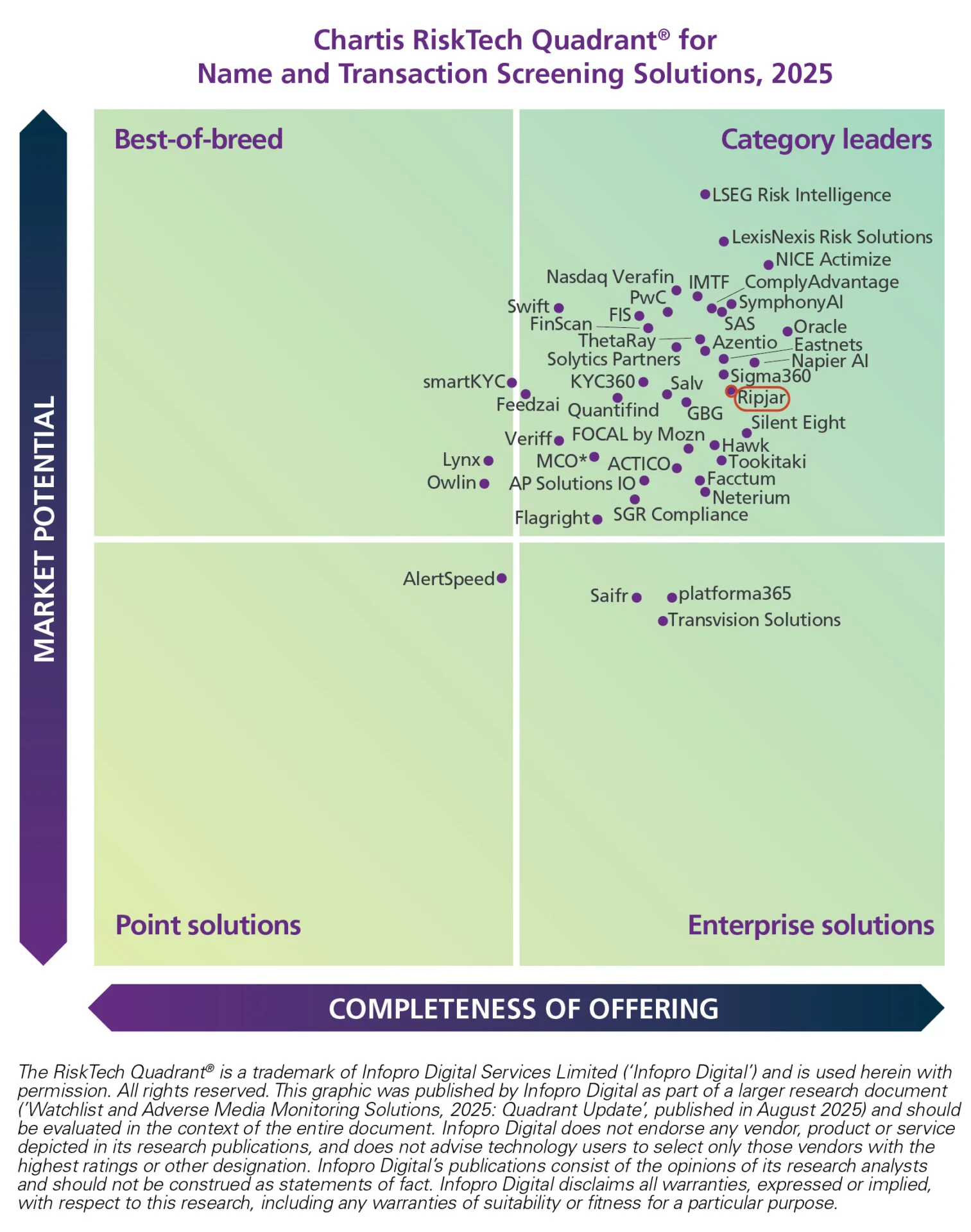
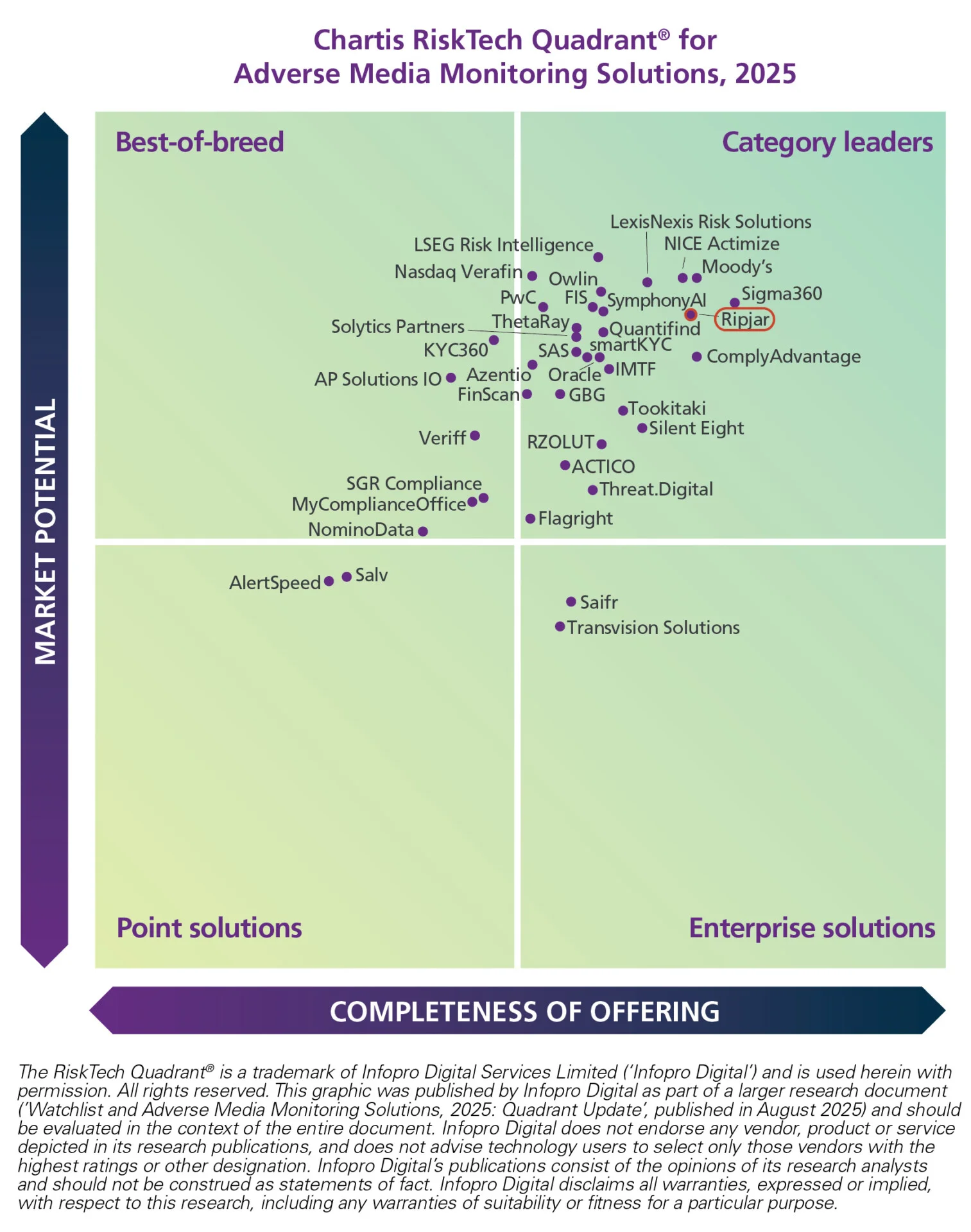
Having recently been included in the Chartis RiskTechAI50, we’re proud to announce that Ripjar has also been recognised as a Category Leader in two Chartis RiskTech Quadrants for 2025:
Name & Transaction Screening Solutions
Adverse Media Monitoring Solutions
Chartis defines Category Leaders as exhibiting “strength across the broadest set of capabilities in the segment, showing a clear execution of core strategy and innovation”.
Assessments were based on a number of criteria, and we’re delighted to have scored consistently highly across the board, reflecting our dedication to building the most advanced products to help our customers stay ahead of financial crime risks.
Our success in this quadrant came from having a high-performing, scalable infrastructure, with robust integrations and global data coverage. Our flexible deployment model also put us at an advantage in this space.
Ripjar scored highly across all criteria for name and transaction screening, with particular recognition for our data methodology, and reporting and auditing capability.
Adverse media monitoring
For the adverse media monitoring quadrant, success factors included effectively using GenAI to improve results, removing ambiguity through the use of sentiment and contextual analytics, and the ability to integrate a wide range of data sets and provide high quality multilingual name matching and screening.
Ripjar performed strongly across all adverse media capabilities, with significant strengths identified in data methodology and packaging. Our use of advanced disambiguation techniques to provide clear, accurate screening results also set us apart.
Ripjar’s position in the rankings reflects the strength of its proprietary analytics, particularly its matching methodology. Ripjar has also built full workflow and automation capabilities around its analytical, matching and data capabilities, enhancing the usability of its solution.
We’re proud to have been included in the Chartis RiskTechAI50 2025 – a ranking of the world’s most influential AI vendors in risk management technology for financial services.
The RiskTechAI50 is an annual benchmark undertaken by Chartis Research, the leading provider of research, advice and in-depth analysis on the global risk technology market. The ranking evaluates companies’ solutions based on impact, deployment, strategy and innovation. These four scoring criteria focus specifically on the application of AI to meet the evolving demands of risk and compliance in financial services.
Ripjar’s placing in our RiskTech AI 50 ranking reflects several key capabilities. Foremost among these are the company’s state of the art and foundational AI tools, which power its robust screening and investigation capabilities.
Sid Dash, Chief Researcher at Chartis
Ripjar’s placement in this year’s list reflects our continued leadership in AI-driven AML risk management, with particular emphasis on how our solutions provide automated workflows and continuous risk profiling powered by advanced AI, as well as enhancing screening with networking capabilities to identify hidden risks and connections.
“At Ripjar, we believe that AI should do more than power new features – it should transform how organisations fight financial crime, manage risk, and serve their customers. This recognition from Chartis validates our strategic focus on embedding scalable, efficient AI into operational contexts where it delivers meaningful outcomes for our customers.”Tom Obermaier, CEO, Ripjar
When assessing ranking criteria, Chartis focused on AI solutions that deliver “measurable, real-world benefits” while providing effective, proportionate solutions to customer challenges. Low-latency and scalability were also highlighted as key factors in highly ranked solutions – both of which are core to Ripjar’s product development approach.
We’re honoured to be included among the most forward-thinking firms in AI and risk management, and we remain committed to helping our customers tackle their toughest challenges with the most innovative use of trusted AI technology.
London, UK, 2 December 2024 – Ripjar, a leading provider for monitoring and investigating threats, risks and criminal activity, has today launched new research which reveals that over 60% of compliance teams anticipate widespread adoption of Generative AI (GenAI) for customer Anti-Money Laundering (AML) screening and monitoring within their organisation in the next two years. This trend highlights a significant shift in the industry to draw on more advanced technologies enhancing compliance processes and addressing challenges in financial crime prevention.
The findings highlight many benefits to the increased usage of GenAI in compliance teams. Looking ahead, an eye-catching 98% of compliance leaders anticipate a significant reduction in false positives due to GenAI, underpinning its potential to enhance accuracy and efficiency in compliance processes.
The most prominent application of GenAI in customer screening and monitoring, according to the research, is case management and decision support (37%), closely followed by contextual analysis of names (35%). Similarly, 35% of compliance teams use, or want to use it, to support investigations. The range of applications demonstrates the versatility of GenAI in addressing complex compliance challenges.
In addition, Ripjar identified several key benefits of using GenAI in compliance for sanction screening, adverse media and PEP checks. Half of compliance (50%) teams emphasised increased efficiency as a main benefit and improved accuracy (48%) and enhanced risk discovery (47%) closely followed. Notably, 44% of participants also highlighted cost reduction and 50% cited significant time saving, demonstrating that the advantages of GenAI extend beyond just speed and ease of work.
Gabriel Hopkins, Chief Product Officer at Ripjar says: “While there are structural issues to navigate, it is fantastic to see such broad consensus that GenAI offers a transformative opportunity for many areas in compliance, particularly in the fight against money laundering and terrorist financing. With its ability to enhance efficiency, improve accuracy, and reduce false positives, GenAI is poised to change how compliance teams approach critical tasks such as extended customer due diligence. With the right support, these new technologies promise a future for compliance that is both more efficient – consuming fewer resources – and more effective – uncovering more true risk.
“We will encounter challenges as banks and financial organisations grapple with the best approach to adoption, particularly due to concerns about predictability and explainability in regulated environments. Further clarity from regulators will help to support organisations on the journey. Savvy organisations are planning now for how they can leverage the latest techniques to transform their approaches to compliance. The best solutions will combine different AI and machine learning techniques with the finely honed capabilities of traditional human-led compliance teams, ensuring a balanced and responsible approach.”
About Ripjar
Ripjar is a data intelligence platform company whose mission is to help organisations and governments automate the detection, investigation, and monitoring of threats from criminal activity. Founded by former members of the UK’s Government Communications Headquarters (GCHQ), Ripjar develops software products that combine automation, artificial intelligence, and data visualisation to help companies solve the most complex risk and security management problems at scale. For more information, visit stg-ripjarproduction-preprod.kinsta.cloud and follow @Ripjar on LinkedIn.
We’re proud to have been recognised as Category Leaders in the Chartis RiskTech Quadrant for KYC Solutions 2024.
Completeness of offering was assessed through criteria including KYC risk scoring, reporting and dashboarding, customer profile enrichment, customer onboarding and customer maintenance.
With an increasing industry focus on more sophisticated data use in KYC processes, the ability to integrate and fuse disparate data sources while maintaining strict data security controls was a key differentiator for Ripjar, alongside our advanced data analytics.
We were also identified as having best-in-class capabilities for enriching customer profiles with additional data, which is an area in which our screening solution adds significant value to our customers.
“Ripjar’s category leader placing in Chartis’ KYC Solutions quadrant reflects several initiatives, including expanding on its strong analytical foundations with graph analytics, artificial intelligence and more comprehensive risk profiles,” said Phil Mackenzie, Research Principal at Chartis. “In addition to this expansion, Ripjar has increased the scale and complexity of its deployments in tier one financial institutions, grown its corporate business and maintained a strong partnership strategy.”
Chartis RiskTech100 2025
The KYC Solutions quadrant isn’t our only recent recognition by Chartis. We’re delighted to be included once again in the Chartis RiskTech100, which ranks the world’s top companies in risk and compliance technology.
Our continued inclusion in the RiskTech100 is testament to our ongoing commitment to screening innovation and helping our customers meet their increasingly complex compliance responsibilities and evolving regulations.
“We’re delighted to have been recognised in Chartis’ research. Our goal is to help our customers transform the data available to them so they can efficiently and effectively take a broad view of risk. Chartis has taken the time to understand the challenges our customers face with unprecedented regulatory requirements, as well as the ways in which technology can be used to transform their screening operations,” said Gabriel Hopkins, Ripjar’s Chief Product Officer.
Today marks IDAHOBIT (International Day Against Homophobia, Biphobia and Transphobia), so we’ve been celebrating Pride in our Cheltenham, London, Bristol and Canberra offices this week!
How have we been celebrating?
Throughout our UK and Australian offices, staff brought in an array of delicious Pride-themed bakes to enjoy together. We also launched our new Ripjar Pride badges which all Ripjar staff can choose to wear as a visible sign of our support for the LGBTQ+ community. And our remote workers weren’t forgotten either – badges are currently winging their way through the post to Ripjar staff worldwide!
“Ripjar’s new Pride badges are a symbol of our company’s commitment to diversity and inclusion. I’m looking forward to wearing my badge at both internal and external events, including meetups that involve recruitment, to broadcast this commitment.” Dan Saunders, Data Science Team Lead
Our Diversity & Inclusion Group have worked hard to put together a new internal resource which includes a brief history of Pride, tips on how to be an ally in the workplace, a glossary of different terminology, plus links to additional resources for year-round learning, such as LGBTQ+ books, films and news sources.
“Pride might be celebrated just once a year, but our commitment to being a welcoming, supportive place for LGBTQ+ staff exists year round. Our new internal resource hub reflects that by enabling Ripar staff to learn and share ideas anytime.” Kate Brewer, Diversity & Inclusion Group Lead
For those who enjoy learning by doing, we also had Pride-inspired cake and biscuit decorating, Pride history and flag quizzes, as well as a craft session making bead bracelets based on the colours of different Pride flags.
“We had a great time making our Pride flag bracelets, chatting through the meanings behind the different colours and learning more about some of the flags that are less widely known. And it meant I aced the Pride flag quiz later in the day too..!” Caz Coker, Content Marketing Manager
How is Ripjar supporting LGBTQ+ inclusion?
Our last annual Diversity Survey found that our LGBTQ+ staff numbers are in line with the industry average, and we’re delighted to be able to say that this number has been rising consistently. The survey also told us that LGBTQ+ staff have a positive experience of working at Ripjar, which is always good to hear!
We place a huge amount of value in having a diverse team, and always seek to do more to improve this. In line with this ongoing commitment, we’re active members of the Tech Talent Charter which aims to increase diversity in the tech industry.
“The Ripjar team have done an amazing job with all our Pride activities this week. I’d like to say well done to everyone involved. By supporting Pride, we not only celebrate diversity but also reaffirm our commitment to fostering an inclusive culture where everyone feels valued and empowered to thrive.” Jeremy Annis, CEO
As part of celebrating Pride at Ripjar this year, we’ve also reviewed our diversity, maternity, paternity and adoption policies, and updated them where needed, to ensure they are inclusive for our whole workforce.
“The People team at Ripjar understand that our differences are what make us stronger and it’s essential that we celebrate and champion them. It isn’t just about adapting, but evolving to ensure that our policies reflect the different needs that define our workforce and drive our success.” Maria Cox, Head of People Operations
Ripjar hosted its London Summit on 12 March 2024, welcoming senior compliance professionals to an exclusive networking breakfast in the heart of the City. The Summit focused on the future of AI in compliance, with a panel discussion of the current challenges and opportunities presented by the technology, and a demonstration of Ripjar’s latest AI-powered screening technology.
Following an introduction by Ripjar’s CEO Jeremy Annis, the expert panel discussion was hosted by Gabriel Hopkins, Ripjar’s Chief Product Officer. This involved contributions from Dow Jones Executive Vice President and General Manager of Risk and Research Joel Lange, Fidelity Deputy MLRO and UK Head of FCC Advisory Brian Swainston, FINTRAIL Managing Director Maya Braine, and Ripjar General Manager of Labyrinth Screening Simon McClive.
Panel Discussion: Key Highlights
What worries you and your customers about screening and compliance?
Maya Braine pointed out that while most organisations know what they need to do, and what they need to do better, in terms of compliance, they often fall short simply because they don’t have the time, budget, or employee availability to push beyond business as usual. That problem extends to improving screening solutions with technology and automation, and the effort required to research and adopt possible new integrations. Maya also referenced the incoming Authorised Push Payment (APP) fraud regulations, framing them as a significant compliance consideration that many companies are currently scrambling to address.
Brian Swainston mentioned a recent Financial Conduct Authority (FCA) “Dear Compliance Officer” (DCO) letter sent to all retail banks, that warned about weaknesses in anti-money laundering (AML) compliance measures. He noted that these official letters typically give firms an opportunity to review their own AML solutions, with a focus on drilling down and identifying weaknesses before regulators start pointing them out.
Simon McClive brought up the issue of geopolitical upheaval, not least the “fast-paced sanctions” activity occurring around Russia’s invasion of Ukraine and Chinese regional developments. Simon talked about the emergence of secondary sanctions and sectoral sanctions (such as those targeting microchip development), which require firms to move very fast to achieve compliance.
Joel Lange echoed Simon’s point about global sanctions screening, but also noted the speed with which a firm’s compliance burden could change. He referenced the invasion of Ukraine and the death of Alexei Navalny as examples of catalysts for rapid change in the sanctions landscape, and pointed to the frequency of important elections (“56 this year”) that would significantly affect financial services firms’ politically exposed person (PEP) screening burden. Joel suggested that the introduction of strict data protection laws, especially in Europe, would further complicate that screening challenge.
What should firms make of recent AML penalty actions, such as the $4.3 billion Binance fine?
Joel and Maya both pointed to the behaviour of cryptocurrency firms as a significant new regulator focus, and the seeming inevitability of new crypto compliance rules. Maya mentioned the possible impact of enforcement actions that do not involve a fine, using the example of a recent sanctions breach by Wise Payments in which the Office of Financial Sanctions Implementation (OFSI) named and shamed the organisation rather than issuing a financial penalty.
What do you make of the industry’s reaction to recent developments in AI technology?
With the emergence of Large Language Model (LLM) platforms, such as ChatGPT, over the past two years, Maya suggested that public and business perception of AI has evolved from a notion that it would “completely change the world” to a realisation that it’s “not going to replace and change what we do”. She pointed to a smaller scale adoption of AI tools for specific use cases such as tools for fraud detection and transaction monitoring.
While advances in generative AI have been impressive, Brian stressed the importance of firms understanding what they “need to do in the background” to get the most out of their new tools, including feeding those tools with high quality data. Applied correctly, he suggested that AI could make a substantial difference in the fight against money laundering and financial crime.
Where are the challenges of using generative AI in compliance?
While 2023 was “the year of generative AI”, Simon McClive noted the importance of applying the technology in coordination with other, more traditional AI solutions – and with an understanding of collective strengths and weaknesses. He highlighted specific applications of generative AI, including risk identification and content summarisation, but also warned of ‘hallucination’ issues which see AI platforms fabricate facts and provide false information, and of the ongoing difficulty of distinguishing between similar or exact match names. Simon suggested that, in order to be effective in compliance, generative AI tools need to be tailored to their firm’s needs and need to be “explainable” in the sense that compliance teams understand how their data is generated.
While generative AI offers dramatic efficiency gains, Joel said that many firms were wary of its potential liabilities and limitations including, for example, the need for proper attribution and provenance. In financial crime contexts, attribution of data is critical since firms must be able to explain to the authorities how they arrived at their compliance decisions.
Joel took this point further, referencing recent exploratory efforts by global news organisations to use LLMs in content production. He linked the potential value of LLM integration to the compliance community, who could leverage the technology to create new efficiencies when screening for adverse media, but also warned of the potential for LLM-generated content to be riddled with inaccurate or even false information. Joel suggested that solving the attribution and accuracy problems of LLM-generated content would benefit everyone, since provenance will ultimately be critical in the context of financial crime investigations.
Echoing Joel’s point, Brian took the perspective of front line compliance teams, working under pressure in complex systems, to assess risk and remediate alerts. In that context, the introduction of a new AI compliance tool is often disruptive and, with that in mind, many firms may currently be waiting for a first-mover to emerge, or may only be willing to move slowly or incrementally in integrating new tech.
How are regulators reacting to the introduction of AI in compliance?
Maya noted that there is currently no single, clear regulatory stance on the application of AI in compliance but those regulators that had taken positions had been “broadly positive”. She referenced both the FCA and the Monetary Authority of Singapore (MAS) as examples of regulators that were using AI in fraud and money laundering detection contexts, but said that there was no clear trend of authorities directing financial services firms to use AI in compliance solutions.
With an eye on the horizon, Maya suggested that the EU was probably closest to deploying an AI regulatory framework, following the proposal of the EU AI Law, which was agreed in December 2023. The EU law is principles-based and industry-agnostic, but is more robust than current regulations in the UK which are risk-based and often only reveal their substance after someone is found to have done something wrong.
Joel agreed that regulator enforcement actions remained the most useful way for firms to learn how to deploy AI in compliance, but noted that many regulators have also set up sandbox programmes and published guidance that firms can use to get on the right track. He suggested that many firms should seek to integrate AI as a way to augment their compliance decision-making systems, rather than replace components of it.
How should firms think about AI model governance?
Simon stressed the importance of good AI model governance, not least in helping firms answer questions like “how is this technology being applied to my data?”, “how is it helping me make decisions?” and “how is it performing over time?” He noted that good AI governance is not just about verifying that the AI technology is doing what its users think it’s doing, but being able to explain its application to authorities, and justify its deployment to stakeholders.
Maya pointed back to the issue of resources as a critical AI governance consideration. Firms should ensure that they have the means to ensure the continued functioning and efficacy of their AI tools or, if they’re using a third party tool, ensure they have ongoing access to SMEs, and support and testing, rather than being directed to a sales team.
How should firms manage the increased compliance focus on adverse media?
Joel described a recent shift in expectations around adverse media screening, with regulators taking “a more overt, specific, and prescriptive approach”. He suggested that firms should pay close attention to both the detail of the guidance issued by regulators and to the subsequent enforcement actions taken. He used the example of guidance released by MAS in 2023, which directed firms to go beyond the use of databases or search engines for adverse media, and take a more rigorous approach to customer name screening. Similarly, he pointed to recent enforcement actions in France, and in the US in relation to the Jeffrey Epstein scandal, suggesting that regulators want firms to retain an audit trail for their adverse media data, in addition to its discovery.
Simon returned focus to the Binance case, suggesting that the dramatic fine has prompted many organisations to reconsider the effectiveness of their own adverse media screening solutions, and the kind of criminal risks they are exposed to. He suggested that the adverse media risk should involve the third parties that clients do business with, and that firms should seek to expand the diversity of their adverse media solutions to better capture that risk, or find risk that they wouldn’t otherwise have spotted.
What are your predictions for AI in compliance in 2024 and beyond?
Looking forward to the next 12 months, Maya suggested continued regulatory developments in both the EU and the US would go a long way in helping firms adopt AI technology as part of their compliance solutions. That trend would include the incremental adoption of “smaller, simpler AI tools”, and a focus on streamlining screening processes, including adverse media screening.
Brian raised the possibility of an early-adopter integrating some specific AI tool into their AML compliance solutions – a move that could push the entire industry forward. He also pointed to an increased need for employees with developed understanding of, and skill in, AI technology, and mentioned the broadening range of free and cheap AI educational resources, including the UK government’s initiatives to up-skill workers.
Simon predicted an increased number of “practical innovations” on the AI markets and the continued development and refinement of LLMs. As part of that trend, he suggested that, at some point in 2024, we might see the emergence of “small, domain-specific” LLMs, that could drive real value and efficiency for businesses.
Looking back at the increasing sophistication of LLMs, and the recent dramatic impact that the technology has already had across the world in fields such as physics and biology, Joel suggested that generative AI could issue in a paradigm shift in the next few years – with the compliance industry surely set for huge advancements and significant change.
Presentation: AI Compliance Innovations in Action
In an increasingly complex global risk landscape, firms need every advantage in meeting their adverse media screening challenges. With that challenge in mind, Ripjar CTO Joe Whitfield-Seed gave a presentation on Ripjar’s cutting-edge Labyrinth Screening platform, and the capabilities of its AI Risk Profiles, AI Summaries, and new Compliance Copilot.
AI Risk Profiles
One of the most common challenges associated with adverse media screening is the sheer amount of data that name searches can generate. The analysis of that data is typically time-consuming, while common and similar-sounding names elevate the risk of false positive alerts.
Part of the Labyrinth Screening platform, AI Risk Profiles is designed to address the efficiency challenges of adverse media screening. AI Risk Profiles blends adverse media screening with structured name screening, to bring together critical AML risks including sanctions and PEPs.
Joe used an example of a name search for “Ali Jaafar”, noting there were at least two individuals by that name living in the US and involved in different financial crimes. The name is also extremely common globally and one with lots of similar-sounding near-matches and close spelling variations – which means that adverse media searches typically can generate tens of thousands of articles, many with no relevance to the target, or with redundant information.
Built using different AI models, AI Risk Profiles captures contextual information in order to extract only the most relevant data points about a search target – such as Ali Jaafar – and then uses that information to create individual risk profiles complete with relationships and connections to other profiles. That profile is then built out with new information as that becomes available, while automatically discounting irrelevant or duplicate stories. AI Risk Profiles offers compliance teams a significant efficiency advantage, reducing the amount of data necessary to review by up to 99%, and providing an increase of effective recall of 5% or more.
AI Summaries
Layered on top of AI Risk Profiles is Labyrinth’s AI Summaries, which uses Ripjar’s generative AI model, Risk GPT, to create a clear, concise summary of a specific customer’s adverse media risk. With AI Risk Profiles as a trusted foundation, AI Summaries avoids the hallucination and fabrication issues that affect other LLMs, to ensure accuracy and efficiency during the screening process – and significantly reduce assessments times.
Compliance Copilot
Newly launched at the London Summit, Compliance Copilot is also built on Ripjar’s RiskGPT LLM, and layered on AI Risk Profiles.
Harnessing an ensemble of machine learning and AI techniques, including generative AI, Compliance Copilot is fine-tuned to evaluate identity and risk matches in a way that off-the-shelf LLMs cannot. Sitting alongside human compliance teams as a first line of defence, Compliance Copilot uses Ripjar’s best-in-class identity-matching technology and a vast amount of additional data signals to automatically assess customer screening results – escalating risks and discounting false positives in order to make the compliance journey significantly more efficient and more effective.
Compliance Copilot’s potential is getting results. In a test involving an assessment of over 7,000 profile-evidence pairs, a team of 23 human compliance analysts correctly identified 87% of all risks, while discounting 90% of false positives. By comparison, Compliance Copilot found 97% of all risks while discounting 77% of false positives – in a fraction of the time. The results demonstrate the dramatic potential of AI-powered compliance technology – surpassing humans in some areas – and its game-changing potential when deployed in conjunction with human expertise.
We’re proud to have been placed as a category leader in the Chartis RiskTech Quadrant for KYC Solutions, 2023.
Chartis Research is the leading provider of research and analysis on the global risk technology market, providing in-depth analysis and advice on all aspects of risk and compliance technology. As part of this, Chartis produces reports on risk management solutions for financial crime, including Know Your Customer (KYC) solutions.
Currently, the global KYC and anti-money laundering (AML) landscape is shifting, with increasing sanctions and regulations affecting all sectors, and particularly the global supply chain. This is leading to organisations implementing more rigorous screening methods to improve due diligence processes.
In the US, for example, recent regulation changes – such as new sanctions relating to the Russia/Ukraine war, FinCEN’s final rule on beneficial ownership information, and the US Treasury’s National Strategy for Combating Terrorist and Other Illicit Financing – have had a significant impact on due diligence requirements. When combined with increasingly complex supply chains and transactions, the number of companies needing to implement more robust KYC solutions is increasing.
The Chartis KYC Solutions quadrant assesses against capabilities such as customer onboarding, reporting and dashboarding, and customer profile enrichment with additional data – an area in which Ripjar’s industry-leading AI Risk Profiles excels.
With solutions assessed on the completeness of their offering and their market potential, Ripjar’s high score in both areas has placed us as a category leader.
Chartis RiskTech100 2024
Also announced this week, Ripjar has once again been included in the Chartis RiskTech100 – a ranking of the world’s 100 most important players in risk and compliance technology. In the 2024 rankings, we’re proud to have risen a further 10 places from last year, demonstrating our ongoing commitment to innovation and helping our customers stay ahead of the threat.
Discover how Labyrinth Screening can help ensure your AML Compliance
We’re delighted to announce that Ripjar has been placed as a category leader in the Chartis RiskTech Quadrant for Entity Management and Analytics Solutions.
Chartis Research is the leading provider of research and analysis on the global risk technology market, providing in-depth analysis and advice on all aspects of risk and compliance technology. As part of this, Chartis produces reports on financial crime risk management solutions, including entity management and analytics solutions.
As financial institutions have been focusing on the changing risk landscape, such as the implementation of Russian sanctions in the last year, organisations are finding that they need to consider a wider range of operational risks, and that addressing AML challenges requires a more holistic approach.
Capabilities such as entity resolution and data analysis are increasingly vital for financial institutions to gain valuable insight from both internal and external data, so the adoption of advanced, AI-powered entity management and analytics systems is a priority for many organisations to ensure regulatory compliance.
The Chartis RiskTech Entity Management and Analytics Solutions segment assesses against criteria including each solution’s coverage and scalability, depth and breadth of data, and ability to enrich data with additional information.
Solutions are assessed on the completeness of their offering and their market potential. Ripjar is ranked as a category leader, scoring highly in both areas.
“Ripjar’s category leader rating in Chartis’ inaugural entity management quadrant reflects its strong breadth of coverage across data enrichment and sources, neatly tied together with its entity management capability,” said Nick Vitchev, Research Director at Chartis. “Its solution provides advanced analytics capabilities in key areas such as data ingestion and processing, demonstrating an ability to view entities through a variety of innovative lenses with strong investigation and audit-trail functionality.”
Why is Ripjar’s Labyrinth Screening solution a category leader?
Ripjar’s Labyrinth platform is designed for advanced data analytics, and is capable of screening vast amounts of structured, unstructured and semi-structured data. Its AI-powered multi-lingual name matching and entity resolution enable the solution to offer market-leading screening accuracy, efficiency and effectiveness. In addition, over 80% of the platform’s innovative new AI Risk Profiles are enriched with secondary identifiers, which is key to reducing false positives within the data.
Discover how Labyrinth Screening can help ensure your AML Compliance
We’re proud to share that Ripjar has been recognised as a category leader in the 2022 Chartis RiskTech Quadrant for Name Screening.
Chartis Research is the leading provider of research and analysis for the global risk technology market. As part of their mission to provide in-depth analysis and advice on all aspects of risk technology, they produce reports on watchlist screening and monitoring solutions, including name screening.
The name screening segment considers a number of criteria, including each solution’s ability to handle naming convention challenges, enrich data with additional information, screen large data volumes, and its speed and efficiency.
Solutions are assessed on the completeness of their offering and their market potential. Scoring highly in both areas, Ripjar has been ranked as a category leader.
“Ripjar’s innovative approach to solving real market challenges, based on advanced technology and analytics capabilities, makes it an exciting player in the name screening space,” said Nick Vitchev, Research Director at Chartis. “Its focus on tackling highly complex client challenges with an effective tech-first approach is reflected in its category leader status in Chartis’ 2022 name screening quadrant.”
About Ripjar’s Labyrinth Screening Platform
With global events resulting in a rapidly-evolving sanctions environment, and regulatory compliance increasingly requiring adverse media screening, comprehensive name screening is more important than ever.
The latest release of Ripjar’s Labyrinth Screening platform includes innovative new AI Risk Profiles. This feature enables organisations to screen across vast amounts of structured and unstructured data with increased accuracy, efficiency and effectiveness. It reviews sanctions list, watchlist, PEP and adverse media data to build enriched, discrete profiles for individuals and organisations, reducing false positives and significantly reducing analyst workloads.
A version of this interview was first published on Cyber News on 6 March 2022.
To discuss the current environment, existing risks for organisations, and their prevention methods, we interviewed Gabriel Hopkins, the Chief Product Officer of Ripjar – a company that designs products for detecting risk and preventing financial crime.
Ripjar’s Background
Let’s go back to the very beginning of Ripjar. How did this project come about, and what has your journey been like since?
The five founders of Ripjar met while working at the United Kingdom’s Government Communications Headquarters – the intelligence and security organisation known as GCHQ. Collectively they spent many decades in that environment and built up a huge amount of technical expertise in the process, including exposure to a wide range of technologies that can be used to make sense of structured and unstructured data.
Initially, Ripjar helped private and public organisations make sense of social media data, understanding political, intelligence, and commercial signals in vast quantities of data. Over time, the company diversified and started supporting many types of clients. Today Ripjar helps banks and other large enterprises around the world leverage complex data to understand risk and identify crime.
Challenges and Solutions
Can you tell us a little bit about what you do? What are the main challenges you help navigate?
Our mission is to help governments and organisations automate the detection, investigation, and monitoring of criminal activity. We have two main products – Labyrinth Screening and Labyrinth Intelligence.
With Labyrinth Screening, we absorb structured watchlists and sanctions data alongside large quantities of unstructured news and media data – generally over 3 million articles every day. We use advanced analytic and machine learning techniques to make sense of all the data and help counter financial crime.
Our clients want to know when their customers match against a watchlist or when there is media that highlights criminal or other problematic activity. For example, when onboarding a new customer – either an individual or a company – there might be found that there is a report of bribery.
Labyrinth Intelligence is our solution for data fusion and analysis, and it gets used for a huge variety of applications – from law enforcement to cyber security investigations. There are several key capabilities that make the solution powerful. Our clients often have data in 10s or even 100s of different systems. We’re able to help them pull data in or access it in a place with all those sources. Then, a range of analytics, tools, and flexible workflows are available to explore, investigate patterns in the data, and provide meaningful outputs.
Our Labyrinth Intelligence clients are searching for patterns and connections in their data. Using powerful search techniques, entity link charts, maps, and other visualisations, they can surface the pertinent facts about suspects in a criminal investigation, transactions related to money laundering, or data compromises after a cyber incident. Clients working with the system supplement the inferences and knowledge from their investigations which are then encoded within the system’s object store to support further investigations.
The system can deal with different classifications of data and air-gapped low and high-side systems, which is essential for many of our customers.
What technology do you use to detect and analyse criminal activity?
There is a range of tools and technologies within the product to address different requirements. To make sense of unstructured data, we utilise machine learning classifiers trained on data from over 20 different languages.
Our entity and identity resolution are critical across all our solutions. Having reviewed the available tools, we determined that we needed to build out our technology which avoids a lot of the pitfalls of legacy approaches and enables us to match across scripts and colloquial name variations, such as Robert, Rob & Bob, in a wide range of languages.
Similarly, Ripjar has created proprietary object linking and graphing technology used to discover and encode knowledge within the system. The technology is used to automatically derive summaries of people and entities within the latest version of our screening solution, which massively simplifies the task of analysts reviewing matches.
What are the most common problems companies can run into if appropriate data intelligence solutions are not in place?
Amazingly, we often find ourselves using the common Donald Rumsfeld phrase “unknown unknowns” to talk about those things which an organisation doesn’t know but could be critical for them. In practice, there are many missed opportunities to detect, disrupt, and respond to criminal and national security threats.
The equation can be complex, but what we’ve seen over the last ten years is organisations accumulating large quantities of often siloed data that go unused because of inadequate technology and a related loss of corporate knowledge through failing to capture and share information in a structured way.
From a banking perspective, we see “unknown unknowns” surfacing regularly, often accompanied by weighty fines. In the UK, the fines amounted to about £500M in 2021. In many of the fines, the organisations had the information they needed, but they were not seeing it clearly. By identifying risky counterparties early – both with new and existing customers – and by pulling together data from across a bank, screening, and intelligence tools turn “unknown unknowns” to “known knowns” and making it simpler for them to do good business.
Outside of banking, the risks can be even more severe, and again, the ability to connect existing data together in the right way shines a light on where policing and governmental organisations should focus their attention.
The Future
Would you like to share some of the key takeaways from your recently published guide on adverse media?
The guide is intended to fill in the gaps for those interested in adverse media but would like to know more. Companies everywhere are trying to figure out how to use modern technology and massive quantities of data to understand business risks as they emerge. The guide explains exactly how to do that.
We’ve partnered with Ray Blake from The Dark Money Files – an organisation dedicated to fighting against money laundering and financial crime through education, awareness, and frequent enthralling storytelling.
The result is a simple-to-read, comprehensive overview of everything you need to know – why you should screen against adverse media, which media to use, how to interpret the results, how to use automation, and much more.
And finally, what’s next for Ripjar?
Nothing quite beats in-person meetings, and we’re very excited to see the world opening up again. We were able to see some of our mainland Europe clients face-to-face late last year, and we are looking forward to visiting with clients further afield.
Ripjar’s history so far has been built on innovation, and we know that we need to continue to innovate to provide next-generation capabilities to clients. We are working on some exciting new developments in both our Screening and Intelligence products which will super-charge both solutions and empower the analysts that use them.
As the pandemic hopefully ends, we’re looking forward to the chance to help clients across all sectors – and particularly in banking – to combine and make sense of their own data and other data sources to control risk and fight criminal activity.
The tech industry has a problem. With only 5% of women in leadership roles, there’s a real lack of female role models. There are of course some great counter examples out there, but not enough. How many famous men in tech can you name? And how many women?
At Ripjar, we’re not immune to the industry trend. We know there’s still more we can do to build a more gender-balanced workplace, and it’s something we’re working hard on. In the last 12 months, with a number of focussed initiatives in place, we’ve seen improvements, and addressing the balance remains an important goal for us as a company.
Stepping into the (Gender) Gap
To celebrate International Women’s Day, we were hoping to write about some of our female members of staff and the professional role models they’ve worked with who are women. Unfortunately, we quickly found that it was difficult for many of the team to think of any examples. In fact, we discovered that some of our female team have never worked alongside women leaders or direct colleagues in their previous roles.
So we decided to turn our idea on its head.
We interviewed three members of the Ripjar team about their roles and asked what advice they’d give to girls or other women looking to work in their chosen careers. Meet your new role models: Kate, Cece, and Beth.
Kate Brewer – Head of User Success
What does your role involve?
My role involves making sure that users know how to get the most value and best experience from our software.
What’s the best thing about your job?
I love learning about the exciting developments coming from data science, and how they keep finding new ways to solve real world problems. I also get a lot of satisfaction from knowing I made someone’s day better when I showed them how they could use our tech to remove a pain point they had been experiencing in their job.
What’s your top tip for women entering the world of tech?
It’s unfortunately still the case that sometimes your opinion won’t, by default, be taken as seriously as that of the men around you. In addition, women have often been taught to be cautious, and carefully caveat their thoughts. You need to speak with at least as much confidence as you feel, as you can be sure that other people are!
What advice do you wish you’d received when first starting out in your career?
There is very rarely a ‘right’ way to do things and you have a lot more flexibility than you think in how you do your job. If you have an idea that you think is good, or a way of doing things that gets good results for you, go for it with confidence and everyone will accept and appreciate it.
Cece Wisniewska – Software Engineer
What’s your job in a nutshell?
I’m a software engineer, which involves me using a range of technologies to develop features to meet customer requirements.
What’s it like being a Software Engineer at Ripjar?
I’ve not been working here long but I already feel like I’ve settled well into the small development team I’m in. I had a big learning curve when I joined because the tech stack used in my current role is completely different from what I’ve used in previous jobs. However, I believe that if you have a passion for technology and are open to learning new things, then this is not a hurdle necessarily, but an opportunity to challenge yourself and to learn with a fresh mind from people who are highly skilled in those areas that are new to you. I’ve experienced this so far in my role at Ripjar – everyone is willing to help out and I feel like I’ve learned a lot from others on my team already!
Who do you look up to in the tech industry?
One of my role models is Joy Buolamwini who is both a computer scientist and a digital activist. Her work involves identifying bias in algorithms and developing practices for accountability during their design – she coined the term “coded gaze” to refer to this bias in coding algorithms. This was an aspect of AI I was unaware of until I watched her TED talk on it. I think it’s inspiring how Joy has made such an impact so early on in her career by bringing to light a previously overlooked, but undoubtedly important aspect of AI.
What advice would you give to girls or women interested in software engineering as a career?
I remember when entering the world of work I was shocked at how few women there were in software engineering and other tech based roles. I came to realise that as women we should not feel discouraged to pursue a career in tech just because we are a minority. In fact, this should motivate us more because we are shifting the statistic, and we have the potential to inspire other women to do the same.
Beth Shaw – Head of Support
What does your job involve?
My job is to lead the Support offering for our Labyrinth Screening product. My main responsibility is to make sure we can respond to customer issues within agreed contractual service level agreements and that our customer relationship benefits as a result.
What do you enjoy about your job?
I love the fact that I can solve customer issues by bridging the gap between engineering and customers for production questions and issues. It’s especially rewarding to me to see the reduction of impact on the engineering team, which helps them focus on new development and therefore new growth in our product. I also really love being close to the technology and having a good knowledge of our product.
Have you faced any challenges in your career?
The main challenge I faced is when I stopped to have a child. I was a developer previously in my career. Being away from the technology made it very hard to jump back in and start where I left off. I found this very frustrating, and in the end, I moved away from development and into technical management roles. I don’t regret these decisions; they are just a change in trajectory for my career and I felt I could be more effective given the experiences I had had over my career. My advice for other women would be to not always expect to do the same thing over your entire career. You will find your greatest strengths and should not be afraid to employ them more directly.
How would you increase the number of women in tech?
Certainly, females can succeed in technical careers, and I’ve seen many successful women in technical roles throughout my career. I would like to see more work done earlier during the formative educational years to make technology a field where females can flourish. I personally believe social media has had a detrimental effect, especially on girls who might have otherwise been drawn into tech.
Ripjar is absolutely thrilled to have been recognised by Chartis in their latest RiskTech ranking of the 100 most important global players in Risk and Compliance Management.
Ripjar’s commitment to innovation in compliance has led us to re-imagine all components in the screening journey. Demanding top tier banks and corporates are recognising our industry-beating performance.
Phil Mackenzie, Research Principal at Chartis commented, “We have been impressed by Ripjar’s approach to complex challenges in counter-party monitoring and beyond, and are delighted to welcome Ripjar to the Chartis RiskTech100.”
Jeremy Annis commented, “I’m delighted to see the hard work and dedication of our engineers and data scientists recognised by Chartis. We look forward to continuing to work closely with Chartis while we continue to invest in innovations which provide our customers with the next generation of compliance solutions.”
30% of financial services employees polled do not believe modern slavery is something which happens in the UK. Worse, 45% of board/director level employees believe the same. I’m not sure that I’m in either group, I knew that Modern Slavery and Human Trafficking (MSHT) took place here.
However, I had not stopped to think about all of the connections to the fraud and financial crime which I’ve spent many years of my life trying to tackle. The very best estimates suggest that there are more than 130,000 victims of modern slavery in the UK today and maybe many more. Globally, it’s estimated that on any day 40 million people are trapped. What does modern slavery look like? Fear and desperation are what keep people enslaved in the modern world. That might be though some sort of debt bondage, fear of deportation or threats to family.
What can we do about it? Education is key. As with so much criminal activity, it is only worth committing if you can syphon off the proceeds. So we all need to aware of the warning signs of MSHT and know how to report suspicions. Likewise, we need to continue to be vigilant to identify financial crime of all types. Specifically, MSHT is a predicate or contributory crime to money laundering. (For more on this: read our blog here)
We should never trivialize the complexity of the battle against money laundering, but understanding the connections is a first step, and it seems that investors and clients are increasingly putting pressure on their banks and other financial organisations to do more. If you are interested in learning more details, I’d highly recommend this report put together by Themis.
I started learning about MSHT due to the Tribe Freedom Foundation and an amazing decision by Darren Innes at Nasdaq. Darren put a team together to run across Scotland to raise money for Tribe and suggested Ripjar do the same. Later this week our adventure begins. Alina Akindele, Anthony Birley, Conor Hickey, Dean Jones, Nick Wright, Sharon Turner, Tom Garnett and I will meander our way from Helensburgh to Dunbar running throughout the night and covering 218 KM (136 miles) with total 2,400m of vertical ascent. The forecast looks ok. The strong insect repellent is packed. The head-torches are charged. And any training we’ve not yet done is now just wishful thinking.
Thank you to everyone who has sponsored us so far. If you haven’t and you would like to contribute to a truly worthy cause, you can do so quickly and easily on our fundraising page below – for the overall team or a specific runner. https://www.justgiving.com/team/ripjar