“Third-party risk is both daunting and kaleidoscopic.“
In global businesses, an endless stream of parties must be assessed, from payment counterparties to the value chain of suppliers and distributors. Furthermore, each party is examined for a growing list of risks, including compliance, ethical, reputational and prudential.
More than ever, businesses need a comprehensive and flexible risk management tool that scales up and down as needed to assure a consistent risk process and a singular library of all third-party risk. Welcome to Ripjar 3P60.
Different risks, different challenges
There are four key categories of third-party risk, each presenting distinct operational challenges:
Compliance risk
Legal obligations to comply with sanctions, restricted party classifications and export controls all bring compliance risks. Businesses typically assess this risk through simple screening tools in a low latency environment, such as customer onboarding or counterparty payments. False positives proliferate here due to difficulties with name matching and entity resolution.
Potential headline risk associated with customers, suppliers, distributors or other third parties can impact your reputation. In recent years, this type of risk has taken on a life of its own, especially in relation to forced labour, child labour or human trafficking. But risk coverage goes beyond these disturbing topics to cover areas including corruption, fraud, non-delivery and potential criminal wrongdoing.
Risk assessment here involves screening against wrongdoer lists and adverse media. False positives abound, due largely to ineffective entity resolution, especially among commonly used names.
Prudential risk
How well do you know your value chain? That indispensable group of suppliers and distributors? Do you know who controls them? Do you know all beneficial owners? Do you know their reputation in the market? Do you know their performance history? Do you know what political, corruption and sovereign currency risks may affect them?
Corporate entities tend to manage this risk through a largely manual process of researching, mapping and assessment. Ownership structures are identified and assessed. Political risk environments and supply routes are identified and assessed. These assessments, plus reputational risk gauging, are brought together and scored. The process is incredibly complex, heavily manual and needs to be continuously updated. In short, it is very expensive to fully implement.
Ethical risk
Do the parties you deal with share your values? Do they, or will they, follow your ethical policies and procedures? Often, risk is managed here through the use of certifications. Businesses will require suppliers and distributors to certify – usually annually – that they follow the firm’s ethical policies or procedures, or at least follow similar ones of their own. This annual certification process is tedious, time-consuming and full of manual tracking processes.
Risk strategy vs business reality
While the types of third-party risks are straightforward, the methods businesses use to assess these risks are anything but. Not every firm believes managing all these risks is prudent or commercially reasonable. No two businesses face the exact same risks, while risk tolerances – or “acceptable loss norms” as they are more broadly known – differ widely.
Some firms, therefore, make the commercially reasonable decision not to incur management expense related to particular risks, such as hiring personnel to manage the process, eliminate false positives and update results accordingly. And, even those that manage all four types of risk across the board rarely do so in a similar manner. Certain risks receive substantial management attention, while others are relegated to a “compliance only” status.
“Clearly, this is a market where one size does not fit all.”
You need a tool that fits your specific risk tolerance and enables you to scale up and down as needed. All risks and risk parties potentially need to be covered, even if you address each in your own bespoke way. You need a single, consistent and configurable way to assess and view risk, as well as an easily accessible central library providing single risk panes for all parties.
The good news is that current technology makes all this possible. A single, scalable platform is much more achievable now, and the latest AI has substantially lowered investment costs, as the number of employees required to run your system is a fraction of what it used to be.
Welcome to Ripjar 3P60
Ripjar 3P60 is the only tool on the market to afford you this convenience. The tool comes in three variations, each sharing configurable workflows which can be tailored specifically to your organisation, a common risk assessment schema, and an AI-powered Digital Assistant to double check your team’s work, reduce false positives, and constantly update your results.
“Thoroughness, consistency, flexibility, efficiency and tailoring is what you need.”
Ripjar 3P60 comes in three options to suit different third-party risk management requirements:
Ripjar 3P60 Screen
This dual low and high latency screening engine enables you to satisfy your regulatory compliance obligations. Screening against a potentially limitless group of sanctions, restricted party and export control lists, Ripjar 3P60 Screen utilises the latest in probability-driven entity resolution and AI digital assistant technology to significantly reduce false positives and work to avoid all false negatives. Its configurable scoring matrix allows you to customise your risk assessments to meet your needs, enabling all results to be scored properly and consistently.
Ripjar 3P60 Assess
This option meets your compliance and reputational risk needs as well as covering baseline prudential risk management. Screen all counterparties for compliance purposes, screen all suppliers and distributors (and potentially some or all customers) for reputational risk concerns, and identify all beneficial owners and control persons across your value chain.
Ripjar 3P60 Assess is backed by the same technology and features as Ripjar3P60 Screen, while enabling you to cast the net wider to assess a broader range of risks. Your AI-powered Digital Assistant will continuously monitor and update records, scores and approvals as needed, and will create the building blocks to establish your global value chain map.
Ripjar 3P60 Intelligence
This comprehensive solution covers all your third-party risk management needs. Everything in Ripar 3P60 Screen and Assess is included, plus a full value chain map listing vulnerabilities from political, sovereign and transport route risks. All parties are thoroughly vetted and assessed, with your Digital Assistant working continuously in the background and supporting your team to avoid false negatives and positives.
Your Digital Assistant ensures that all work is up to date and properly assessed according to your configured scoring rules. Furthermore, our ethical certification engine configures certifications for your needs, with Ripjar’s Digital Assistant constantly tracking and ensuring compliance across your supplier and distribution chains.
This is what every compliance officer says when talking about screening today. Little to nothing has changed on the technology and data front, despite ever increasing demands placed on compliance professionals.
This once simple compliance process is now anything but. Sanctions screening has grown beyond simple Latin alphabet name matching to include multi-alphabet and street address matching, not to mention the newer regulatory requirement to identify related and “network” members. Politically exposed person (PEP) identification has moved well beyond matching against established third party lists, to include potential unrelated and non-network “close associates”. Adverse media screening, once destined for the privileged few, is increasingly being demanded across all client segments.
Despite this changing landscape, regtech providers haven’t budged. “Static” data providers continue to generate lists based on their own assessments of who is important, and who isn’t, regardless of your risk tolerance. Or, worse, they provide media feeds of literally billions of articles, asking you to filter relevance. Screening tech firms are even worse, employing “fuzzy logic” (lots of fuzz, little logic) ostensibly to show their solutions’ ability to reduce false positives, even though regulators, from the beginning, primarily emphasise avoiding false negatives.
But from a risk perspective, the situation is even worse.Screening occurs on many levels – clients, payments and counterparties. The risk demands are similar across all levels, however the regtech solutions produce at times materially different outcomes. Screening at each level differs, as name matching and risk scoring typologies differ markedly. Similar risks are treated differently, causing frustration for any risk manager.
All this changes today.
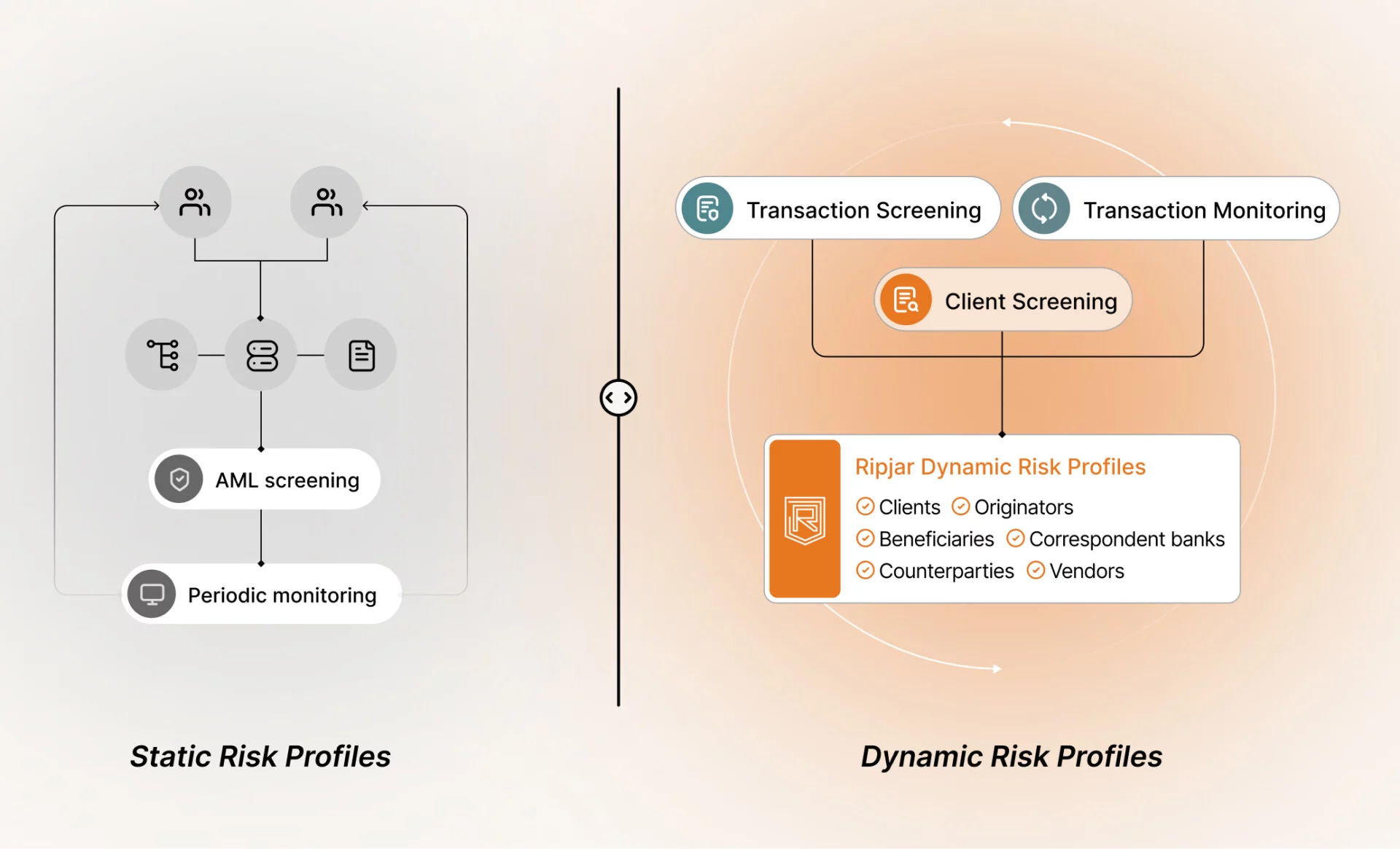
It’s time to move to a 21st century solution and embrace the latest in technology from advanced data science, probabilistic programming and AI, all brought together in Ripjar’s powerful tech. Combine all your static data, including third party lists from sanctions, PEP and adverse media providers, as well as your own lists such as Do Not Do Business (DNDB), Approved Counterparties, and “Reported”. Then integrate this with your dynamic information, such as payment and account transaction data, to create a single “risk brain” – a holistic assessment process that produces the far too elusive “one pane of glass” for all clients, counterparties, originators, beneficiaries and, even, vendors.
Ripjar One
Unlimited data integrations
Enhanced with UBO data and transaction monitoring
Continuous live risk scoring with Dynamic Risk Profiles
Networking and advanced workflow capabilities
Backed by Ripjar’s powerful Digital Assistant
Welcome to the Ripjar One family of products
Ripjar One’s product family uses dynamic risk profiling to give compliance officers the power to achieve in today’s environment. Rather than relying on static risk profiles judgmentally created by third parties, dynamic risk profiling creates your own unique profile for each of your clients, counterparties, and even payment originators and beneficiaries. Powered by the latest AI technology, each profile is live, constantly checked in accordance with your rules, scored against your risk appetite, and continuously updated for new developments from both the outside world (such as sanctions or adverse media) and the inside (such as a new transaction monitoring alert or DNDB designation).
How dynamic risk profiling works
Centralise: Combine all your client name screening activities into one engine, regardless of whether the data is structured (by a third-party or your firm) or unstructured. This is then all searched as one, powered by the latest probabilistic-based name matching capability, and expandable to incorporate the results of your transaction screening and transaction monitoring systems’ outputs.
Unify: Subject all your processes to a single risk scoring methodology, completely configurable to meet your needs. All your screening risks will be treated not just in a similar, but the same manner.
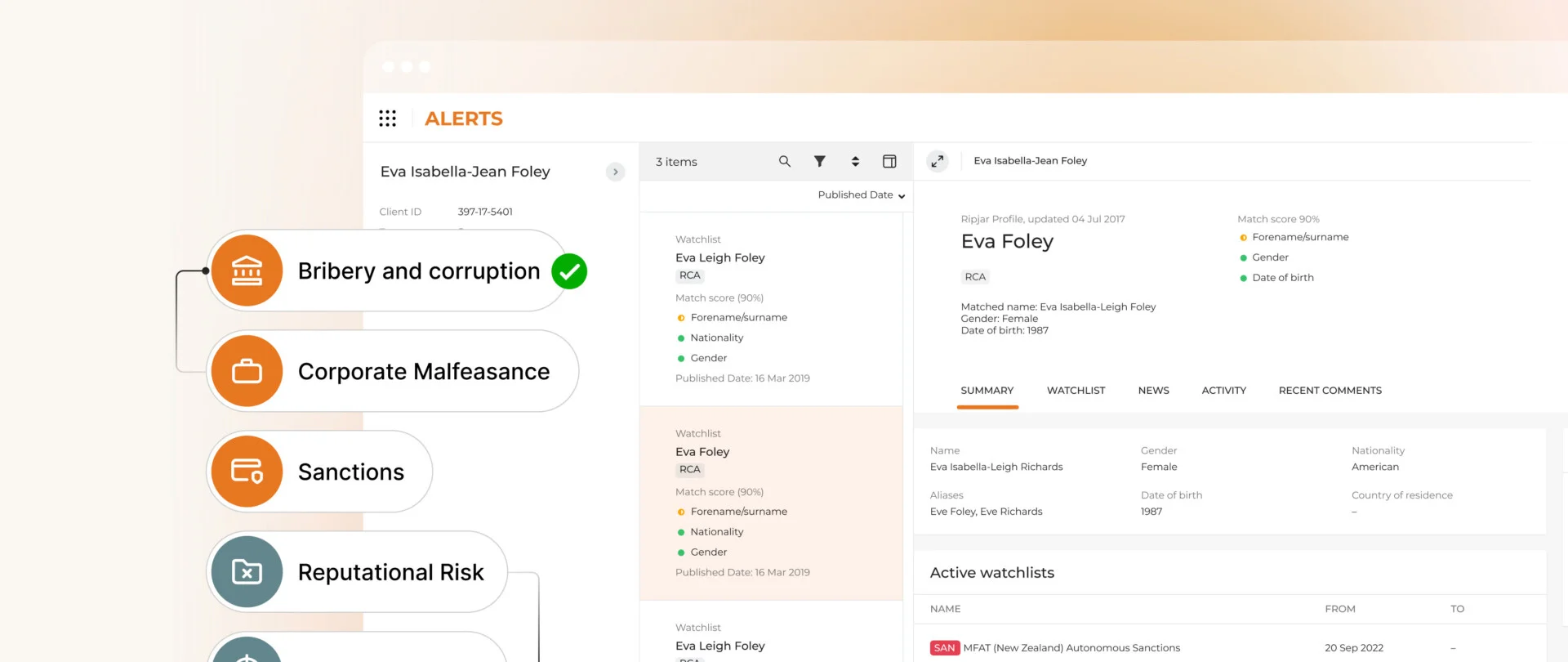
Clarify: Build your own profile for every client and counterparty. Relevant output from your third party and internal sources is blended into your very own curated, dynamic risk profile. The profile is AI-generated, summarising the critical data points, and even highlighting links with other related and unrelated parties. The profile has a unique ID so it can be easily retrieved in milliseconds. The profile is the alert, sent to your team for review. And your Digital Assistant double checks your team’s work, notifying you of potential discrepancies.
Monitor and update: Your Digital Assistant works in the background constantly to update profiles when material changes occur and alerting you when necessary. These changes are highlighted to expedite review.
The benefits are numerous
One risk profile from all systems transforms static data into a dynamic answer, constantly updated, giving you the most complete risk picture.
One system eliminates redundant work arising from running multiple systems and processes, substantially increasing productivity.
False negative risk is substantially reduced through consolidating different characterisations from different lists into a uniform whole and having your Digital Assistant work as a “sixth pair of eyes” to double check your screening team’s work.
False positives are nearly eliminated from the use of a mathematically-driven probability matching schema and AI assessed alerting which prioritises alerts for review according to your rules, providing exponential ROI.
Identify hidden relationships and networksto significantly improve your compliance efforts.
Our industry-leading AI Risk Profiles now offer the option of new AI Summaries, providing a short, clear overview of the relevant adverse media risks associated with a profile.
What are AI Summaries?
AI Summaries are now available within our industry-leading AI Risk Profiles. While the profiles provide you with a holistic view of a customer’s risk across sanctions lists, watchlists, adverse media and PEPs, new AI Summaries make the adverse media risks quicker and easier to understand. Taking the most relevant media articles highlighted in the AI Risk Profiles, AI Summaries provide you with a short, clear summary of the risks, capturing everything you need to know in order to make a decision.
How do AI Summaries Help Analysts?
AI Summaries have been designed to help compliance teams in a number of ways:
Review Adverse Media Risk Quickly and With Confidence
To fully understand risk, analysts need to review potential matches against vast quantities of data. This is particularly challenging when it comes to adverse media – also known as negative news – where identification of risk is further complicated by varying data availability and reporting standards between different languages and jurisdictions.
AI Risk Profiles already tackle this challenge by analysing millions of adverse media articles to identify those which contain the most useful, relevant risk information. New AI Summaries then use generative AI to produce concise, easy-to-read summaries of the risk highlighted in these key articles, written in a clear, chronological format. This enables analysts to gain a fast, accurate picture of the risk and to make decisions quickly and with confidence.
When used together, AI Risk Profiles and AI Summaries reduce the average time to assess new and existing customers by over 90%. By reading a profile summary, analysts save up to eight minutes compared to reviewing significant media extracts, and even more time compared to reading the articles in full.
Ensure Nothing is Missed
One of the greatest challenges with adverse media screening is ensuring you don’t miss vital risk indicators in the vast amount of adverse media data available – the larger the quantity of data, the more likely key evidence will be missed. Pinpointing relevant risks can be like finding a needle in a haystack. AI Risk Profiles have already been doing this incredibly well, improving screening accuracy and recall while reducing false positives.
New AI Summaries build on this existing industry-leading technology and help surface relevant risk even faster, by distilling the facts down into a well-written narrative summary for analysts to review. This not only increases analyst efficiency but also improves effectiveness by reducing the risk of you missing a small but vital piece of information when reviewing multiple articles.
Explainable AI Technology for Regulatory Compliance
AI Risk Profiles and AI Summaries work together to redefine compliance and customer screening best practices. AI Risk Profiles are built on established AI technology, which we have developed to meet complex screening requirements. AI Summaries then enhance this by harnessing newer generative AI technology to achieve the most effective summarisation.
It is the combination of these two different AI technologies that achieves the best screening results and helps you comply with adverse media screening regulations as efficiently and effectively as possible.
The newer AI technology used to generate the summaries has been specifically developed to help you comply with adverse media screening requirements, and our large language model has been rigorously tested to ensure accurate output. Sitting within our AI Risk Profiles, AI Summaries provide you with a trusted, fully explainable solution using the latest generative AI technology bound by clear constraints to ensure maximum reliability.
Unlike general purpose generative AI and large language models, our AI Summaries technology has been specifically designed for this purpose, and provides full traceability, with links back to all sources used in each summary. In addition, it has been thoroughly tested and validated to ensure risk is not missed or misrepresented in the output.
What’s Next?
AI Summaries forms part of Ripjar’s wider RiskGPT offering which will be launched over the next few months. With several exciting new features in development, we’re continuing to work on combining the latest generative AI technology with proven machine learning techniques to revolutionise customer screening and drive further improvements in efficiency and effectiveness.
Set to launch in early 2024, our next addition will utilise large language model technology to better support analysts in reviewing and dispositioning financial crime alerts, with further innovations set to launch soon after.
Discover more about Ripjar’s AI Risk Profiles, now featuring AI Summaries
Labyrinth Screening now supports four new Nordic languages: Norwegian, Danish, Swedish and Finnish. This takes the total number of supported languages to 26.
Rather than using translations, Labyrinth Screening carries out multilingual screening, whereby all documents and articles are screened natively in the language in which they are published, removing the risk of nuance or context being lost. While the platform was already screening versions of Nordic news stories which had been published in English or other supported languages, this new language update will enable customer AI Risk Profiles to benefit from an even wider range of data sources.
Why does Labyrinth Screening’s Nordic language update matter?
Recent spikes in financial crime in Nordic countries have meant that the ability to screen natively in those languages has increased in importance in combatting financial crime risk and ensuring Nordic AML compliance.
The addition of the new Nordic languages to Labyrinth Screening means we can now use a broader set of data sources – both from web-scraping and formal sources of data – providing more data points and richer data to enhance our AI Risk Profiles and provide greater screening confidence.
Not only can new media articles be processed in Nordic languages, but Labyrinth Screening can now also reprocess older Nordic-language documents already held in the platform’s data store, and use the full range of analytics on them. By supplementing existing risk profiles with any additional risk data or context extracted from these sources, this new Nordic language capability enables Labyrinth Screening to add even more value to our customers.
Over 63 million articles have already been processed in Norwegian, Danish, Swedish and Finnish since implementing these languages within Labyrinth Screening, with hundreds of new articles being added every day.
Within Labyrinth Screening, all our analytics are carried out in the source language of each individual news article or document, so as not to lose the nuance of the original language. The addition of these extra languages into the platform is therefore hugely valuable to any of our customers who are screening Nordic entities, as it ensures no context is lost by translating first.
How is Ripjar’s name screening different?
While other platforms may translate articles and documents before screening them, Labyrinth Screening only processes documents in the language in which they were written, ensuring it provides the most accurate, reliable results, with no loss of context.
In addition to its multilingual name-matching capabilities, Labyrinth Screening is also an industry leader on multi-script language screening, with the ability to screen languages with non-Latinate characters, such as those using Cyrillic, Arabic or logographic alphabets. It can also undertake transcription between languages and transliterate customer names from their native script into Latin characters – including the potential name variations this creates – ensuring the best possible identity-matching.
For example, Finnish has a particularly complex system of declensions – changes to a name’s representation that indicate properties like gender or grammatical case – with 51 types of declension, each with seven different grammatical cases. A Finnish surname like “Hautamäki” could be represented as diversely as “Hautamäen”, “Hautamäelle”, or “Hautamäkeä”, depending on the context:
Labyrinth Screening provides extensive declension handling, allowing us to correctly infer the nominative case – the base form of the name – more than 90% of the time, covering all the major declension types in each of the seven cases. This is essential for effective adverse media screening, as people and organisations are regularly mentioned with different declensions of their names in the news.
What are Nordic adverse media screening requirements?
As part of their EU membership, Denmark, Sweden and Finland (and Norway, as part of the EEA) are required to comply with the EU’s Sixth Anti-Money Laundering Directive (6AMLD) as well as their own national AML regulations.
Regulatory compliance in the Nordics involves the implementation of customer due diligence processes, transaction monitoring, sanctions and watchlist screening, and adverse media screening. For example, Denmark’s financial regulator, the Danish Financial Supervisory Authority, has risk management guidelines which state, “It is essential that financial institutions include media screening of customers and beneficial owners in customer due diligence.”
Also referred to as negative news screening (NNS), adverse media screening forms a vital part of a risk-based approach to compliance, as news and other media sources often highlight potential risk relating to people and organisations before it is officially confirmed. This early detection of risk is valuable in many ways, from anticipating criminal activity to avoiding reputational damage.
The addition of Norwegian, Danish, Swedish and Finnish languages into Labyrinth Screening – and the resulting ability to screen natively in these languages – is therefore another vital way to ensure that Nordic adverse screening requirements are met as robustly as possible and with the greatest accuracy.
Adverse media screening helps financial institutions around the world understand the criminal risks they face in a complex regulatory landscape. In a compliance context, the value of adverse media is directly connected to the effectiveness of the customer screening – and the quality of the data that it generates: firms must ensure they are able to find the relevant information quickly, and apply it accurately, in order to prevent financial crimes such as money laundering.
Ripjar and 1LoD recently hosted a roundtable discussion with experts and professionals from UK banks and financial institutions, on the importance of adverse media screening for compliance and anti-money laundering (AML) procedures. We wanted to explore the ways that UK organisations currently use adverse media screening as a means of establishing customer risk, along with the challenges that entails, such as the need to cut through the administrative noise of the search process.
We’ve put together a report on the results of the adverse media screening roundtable – in the meantime, read on to discover some of the key discussion points which it covers.
Getting Core Screening Right
Most banks and financial institutions use third party providers to handle core adverse media screening on their behalf. Typically, a bank submits a list of customer names to their provider, which then searches each entry against a range of negative news articles (and other media), according to search parameters, and returns a list of matches. Our roundtable discussed a range of important core screening principles, including:
Finding an effective technology solution to handle core screening processes.
Categorising adverse media stories by type (AML predicate crimes, labour rights, data privacy, etc) in order to determine the significance of risk.
Scheduling name searches to run periodically – for example, more frequent searches for higher risk stories.
Adjusting the scope of customer screening to account for risk – for example, screening against a larger number of news sources during onboarding.
Balancing Coverage and Quality
The quantity of adverse media screening results does not necessarily translate to quality AML data. In fact, our roundtable revealed that standard keyword searches of larger volumes of news articles often generate more administrative noise, and increase the probability of false positive AML alerts.
Roundtable participants stressed the need for a balance between data coverage and quality, and the importance of the risk based approach to adverse media screening. However, even with a risk based approach, many banks still struggled with high volumes of alerts – which included both false positives and, worse, false negatives.
Enhancing Customer Searches
Numerous factors contribute to screening noise, not least the accuracy of the name matching process, the reliability of news sources, and issues such as regional spelling variations or the use of non-Latinate characters. Picking up on those issues, roundtable participants set out ways to improve the screening process with “meaningful” data – by adopting strategies such as enhancing the search models and search parameters set by banks, and refining the datasets produced by data aggregators.
Integrating New Technology
In the face of customer screening challenges, the roundtable highlighted the potential of new technologies, specifically machine learning systems, to make the process more effective.
Powered by artificial intelligence, machine learning tools such as Ripjar’s Labyrinth Screening platform, effectively read global negative news stories autonomously, with the capability to discern specific data points such as mentions of “money laundering” or predicate crimes. Machine learning brings a greater analytic depth to the customer screening process, increasing search accuracy, and reducing false positives, by intuitively removing duplicate articles, or threading reprints of the same story together.
Machine learning tools also help organisations identify specific features of their customers’ involvement in negative stories, and use that information to build even more accurate risk profiles. Enhanced risk profiles offer plenty of advantages, including enabling compliance analysts to identify meaningful stories faster, and streamline the alert remediation process.
The value of new technology goes beyond screening customers at onboarding. The roundtable also brought up the flexibility that machine learning tools provide, which can help organisations screen on a continuing basis, spot changes in customer behaviour, address new criminal methodologies, and adapt to new regulations as they are introduced.
Revolutionise your customer screening with the latest release of Ripjar’s Labyrinth Screening platform, featuring ground-breaking new AI Risk Profiles.
This game-changing development uses sophisticated machine learning, natural language processing and graph analytics to generate person and company-specific risk profiles for significantly improved accuracy, effectiveness and efficiency in the fight against financial crime.
With 80% of the AI Risk Profiles also enriched with additional secondary identifiers, Labyrinth Screening now offers unparalleled accuracy and reduced false positives, including across standard watchlists.
Read on to learn more about how Ripjar’s new AI Risk Profiles can benefit your organisation.
What are AI Risk Profiles?
Labyrinth Screening’s new AI Risk Profiles have been developed to save analysts time and increase accuracy when screening for adverse media, watchlists, sanctions and PEPs.
This industry-leading innovation reviews all relevant data from both structured and unstructured sources to build discrete profiles for individuals and organisations, reducing false positives and significantly improving analyst efficiency.
Rather than showing every news article, advanced natural language processing is used to extract the most relevant items necessary to give a clear and complete view of relevant risks as quickly as possible.
How can your organisation benefit from AI Risk Profiles?
Identifying risk in your client portfolio is a huge challenge. Customer data can be limited and problematic, while media data can be noisy and imprecise. Many screening methods generate a large number of false positives, struggle to achieve accuracy at scale, and put a significant time burden on analysts.
AI Risk Profiles are designed to address these challenges directly, and offer a number of benefits which will help improve your screening accuracy and operational efficiency.
Identify risks you might otherwise miss
AI Risk Profiles help ensure your organisation’s regulatory compliance by identifying risks other screening methods might miss. AI-powered multi-lingual name matching and entity resolution are used to overcome screening challenges such as common or high profile names.
Powered by the Ripjar Knowledge Graph, this latest version of Labyrinth Screening provides global, multi-jurisdictional screening which adds unprecedented additional context to profiles.
By separating out the matches into distinct profiles, analysts can quickly assess if the risky person or company in the news is their new or existing customer. Importantly, once an analyst has marked a specific profile as not being relevant, new alerts will not be generated unless there is a significant change to the client match, eliminating significant operational costs.
Common Names
Clients with common names can be incredibly difficult to screen reliably due to the frequency with which their names appear and the resulting volume of non-relevant data. Traditionally, screening such names requires searching through huge quantities of data and can feel like looking for a needle in a haystack. Risks are missed as a direct result.
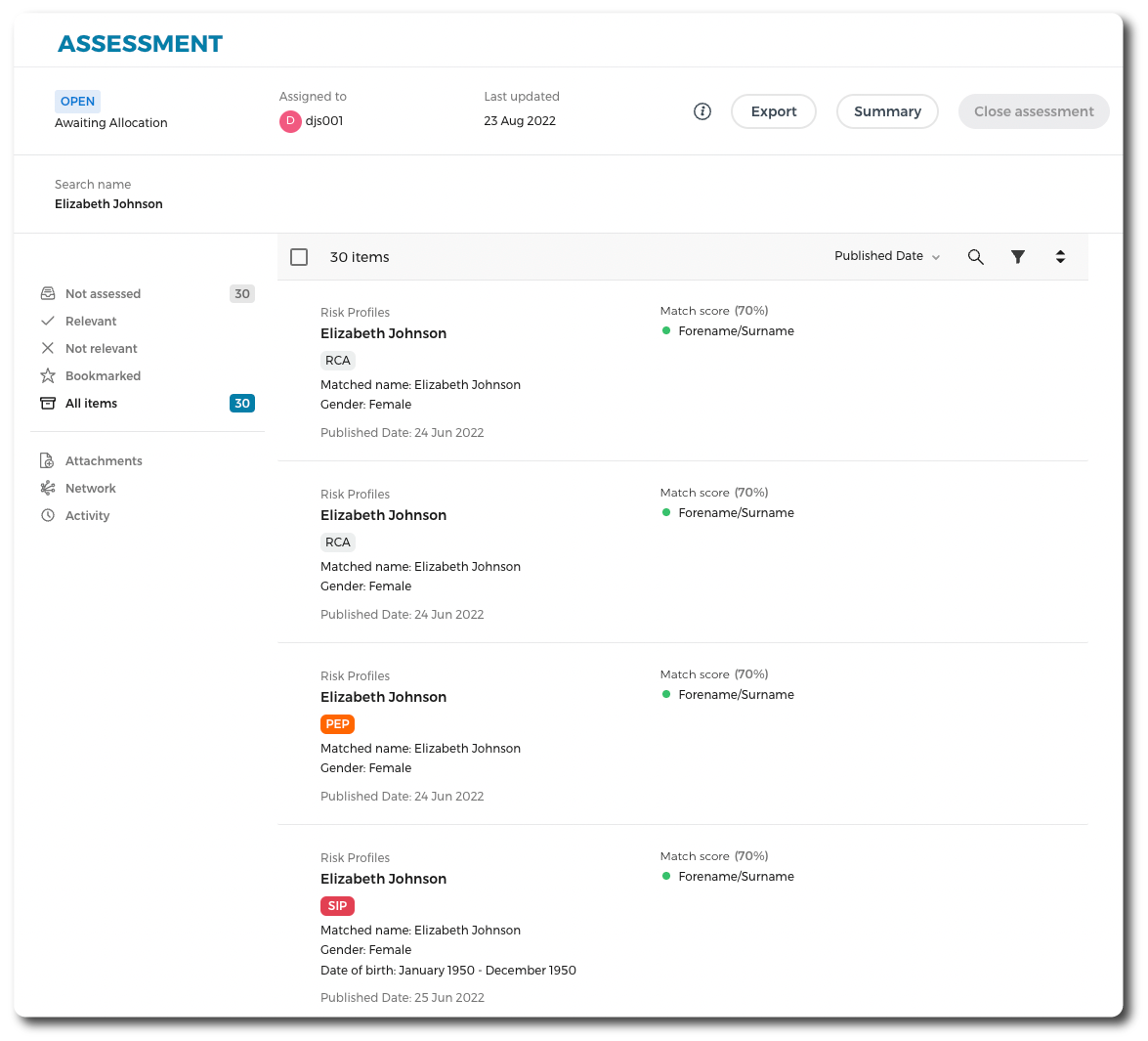
With AI Risk Profiles, analysts can identify potential matching profiles from a condensed set, and then quickly review those items marked as a priority, cutting through the noise to access the relevant information.
High Profile Names
Individuals such as politically exposed persons (PEPs) can generate enormous quantities of news, obscuring data on those with similar or identical names. Because AI Risk Profiles segment out recognisable entities, risk associated with customers who share high profile names can easily be differentiated and understood.
Imagine you have a client called David Cameron, who is not the former British Prime Minister. This is a common name, and also a famous person and PEP, making it hard to assess risk in the noise of articles that will be overwhelmingly about the politician. With Ripjar’s AI Risk Profiles, you’ll find a list of different David Cameron profiles with whom risk is associated, making it quicker and easier to identify and assess the correct one.
Achieve accuracy at scale with more secondary identifiers
Ripjar already leads the article-based screening market with unparalleled data classification and entity resolution. The new AI Risk Profiles add an extra technology layer on top of this, combining data together in a way that makes it even more useful to your organisation.
This latest evolution of Labyrinth Screening captures a huge number of secondary identifiers – such as dates of birth, nationalities, locations and roles – from unstructured text. This vast expansion of context around entities leads to richer data and better recall. Standard watchlists are also enriched with these additional properties, improving sanctions and PEP screening accuracy.
80% of AI Risk Profiles contain secondary identifiers, which is key to reducing false positives. Testing has shown that there can be as much as a 91% reduction in false positives alongside a 5% improvement in recall.
By aggregating these properties across millions of articles, Labyrinth Screening enables identifiers to be assigned to entities at a scale which is simply not possible in human-curated profiles, and at an accuracy not achievable with article-based risk evaluation.
AI Risk Profiles assemble all this information into single 360o profile views for people and companies, identifying areas of relevant risk across adverse media, sanctions lists and watchlists and PEPs.
Improve efficiency and reduce analyst workload
AI Risk Profiles offer clear benefits compared to human-curated profiles or article-based review approaches. For example, having a material risk in the 200th article in an alert is not helpful if there is only time to read the first 20. And even if an analyst reads them all, it’s still likely that information will be missed.
With many financial institutions limited on the time – and associated cost – they can spend on screening each client, AI Risk Profiles offer a much faster, more efficient option. They have been shown to decrease analyst workloads by up to 10x, resulting in less operational overhead alongside improved accuracy.
As well as being quick and easy to navigate, these individual summaries deliver more targeted, relevant information to enable analysts to effectively assess risk. Intelligent classification prioritises and pinpoints the most relevant articles to review, reducing analyst workload and reducing the requirement to invest huge quantities of time.
Get in touch to learn more about AI Risk Profiles and request a demo
LONDON, 6 September 2022 – Ripjar, the trusted provider for tackling financial crime, today announces the launch of its updated Labyrinth Screening Platform with the addition of AI Risk Profiles. Financial compliance analysts will now have a more streamlined experience generating discrete profiles from watchlists, sanctions, adverse media data, and PEPs (politically exposed persons), leveraging AI to tackle the large volumes of alerts they have to review.
This game-changing development uses sophisticated machine learning, natural language processing and graph analytics to generate person and company-specific risk profiles. It reviews all relevant data from both structured and unstructured sources to build discrete profiles for individuals and organisations for significantly improved accuracy, effectiveness and efficiency in the fight against financial crime.
Testing of the solution has shown that there can be as much as a 91% reduction in false positives whilst benefiting from a 5% improvement in valid matches found.
Pressures are mounting on financial compliance teams
According to Thomson Reuters, while 74% of financial services companies expect their regulatory burden to increase in the next year, 61% believe their teams will not grow in size, as recruitment needs are called into question. Ultimately, financial compliance teams will be forced to pick up more work without the necessary headcount. Having the right technology to support those extra work loads will be critical.
Identifying risk in a customer portfolio remains a huge challenge thanks to limited and often problematic customer and media data. Many screening methods still rely heavily on manual and time consuming processes, which can generate a large number of false positives, struggle to achieve accuracy at scale, and put a significant time burden on analysts.
Ripjar’s AI Risk Profiles uses AI-powered multi-lingual name matching and entity resolution to overcome those screening challenges such as common or high profile names. The technology automatically separates out the matches into distinct profiles, so analysts can quickly assess if the risky person or company in the news or on a sanctions list is their new or existing customer. Importantly, once an analyst has marked a specific profile as not being relevant, new alerts will not be generated unless there is a significant change to the client match, eliminating operational costs.
This latest evolution of Labyrinth Screening, AI Risk Profiles, captures a large number of secondary identifiers – such as dates of birth, nationalities, locations and roles – from unstructured text. This expansion of context leads to richer data and better recall. Standard watchlists are also enriched with these additional properties, improving sanctions and PEP screening accuracy. 80% of profiles now contain secondary identifiers, which is key to reducing false positives.
“Ripjar’s innovative approach to solving real market challenges, based on advanced technology and analytics capabilities, makes it an exciting player in the name screening space,” said Nick Vitchev, Research Director at Chartis.
Jeremy Annis, CEO at Ripjar: “Financial institutions are coming under increasing cost and time pressures when it comes to compliance and regulation when screening their clients. Ripjar’s new AI Risk Profiles solution within the Labyrinth Screening Platform offers a much faster, more efficient option for financial compliance analysts. They have been shown to decrease analyst workloads by up to 10x, resulting in less operational overhead alongside improved accuracy. With AI, analysts can be confident in the profiles they screen and be a reliable source for tackling financial crime.”