Negative news, also known as adverse media, is an important component of any risk-based anti-money laundering solution. On 11 May 2022, the Wolfsberg Group, a highly trusted global banking association, published an FAQ setting out relevant negative news screening (NNS) considerations that financial institutions should take into account in order to improve risk-management ‘across the sector’.
While there is no universal definition of negative news, it is generally understood to refer to publicly-available information (often derived from news stories and other sources) that can be used to gauge a customer’s level of compliance risk. In a financial context, firms may use negative news to inform anti-money laundering (AML) and counter-financing of terrorism (CFT) risk assessments, and subsequently make important compliance decisions.
With the Wolfsberg Group FAQs as a starting point, we’re taking a closer look at the role NNS plays in risk-based AML/CFT and how it adds value to your compliance solution.
What is Negative News Screening?
Negative or adverse news takes a variety of forms, and ranges from conventional printed and televised news, to online content such as websites, blogs, and social media posts. Negative news may be formatted as traditional reportage, such as a printed column in a newspaper or website, or a segment on a news television show, or presented in a less-structured or even unstructured digital format such as an online video, or a post in an online forum.
Negative news screening refers to a process of checking for customer involvement in adverse media by screening against a range of stories and sources. While negative news screening is essentially a complex name-matching process, it must also take into account a range of challenges. These include understanding the context of specific articles, the use of different language systems, nicknames, aliases and alternative spellings, the reliability of news sources, and the potential for political bias. With that in mind, negative news screening solutions should be developed to meet the unique risk-management needs of the businesses they serve, ideally incorporating suitable technology controls to accommodate the variables of a global media landscape.
Why Should Businesses Use NNS?
The risk-based approach to compliance recommended by the Financial Action Task Force (FATF) relies on businesses being able to build as complete a picture as possible of their customers’ AML/CFT risk exposure. This process – also referred to as the Know Your Customer (KYC) process – requires businesses to collect and analyse a range of important data, including customer names, addresses, place of residence, company incorporation documents, and more. Customers’ status as politically exposed persons (PEP) or their designation on sanctions lists is also relevant to their risk exposure.
When a financial institution needs more, or more detailed, information about a customer in order to perform a more thorough risk assessment, news media can provide a broad range of easily accessible data to inform the process. A firm may leverage news media insight to inform, for example, a customer’s identity, or the identity of their business partners. Similarly, news media may help companies to uncover beneficial ownership information where customers are using corporate structures to conceal potentially relevant connections to high risk considerations.
How Does NNS Enhance AML/CFT Compliance?
Risk-based compliance relies on more than just isolated snapshots of data and, when a customer’s risk exposure changes, firms must ensure they are informed as soon as possible. With that requirement in mind, official sources, such as government publications, may not reflect changes in customers’ risk profiles in a timely manner due to procedural and administrative delays. By contrast, breaking news stories offer up-to-date insight into a customer’s risk exposure and, importantly, may reveal that information prior to confirmation in official sources.
The kind of information that negative news stories reveal may be specifically relevant to the AML/CFT process and enable firms to make important compliance decisions more quickly. In particular, adverse media screening may enhance the AML/CFT compliance process by:
Revealing a customer’s involvement in criminal activity, and so enabling a financial institution to apply enhanced due diligence, or examine previous transactions for indications of financial crime.
Adding depth to a customer risk assessment and any subsequent risk categorisation, and informing the level of ongoing monitoring a customer may warrant.
Initiating customer due diligence ‘trigger events’ that prompt the application of further AML/CFT resources.
Providing additional, contextual information for suspicious activity investigations.
Helping firms develop a better understanding of a customer’s source of wealth or source of funds as a factor in future compliance decisions.
Your negative news screening solution should be capable of meeting your business’ unique regulatory challenges. To find out how Ripjar’s next generation risk management technology can help your business optimise its AML/CFT compliance response, get in touch today.
Effective adverse media searches are an important part of risk-based regulatory compliance and enable organizations to quickly identify accurate, actionable information about their customers. With that in mind, customer name matching is significantly complicated when organizations conduct searches across foreign language media sources which use unfamiliar names, naming conventions, non-Western characters, and grammatical conventions.
Multilingual name matching represents a significant risk concern: organizations that miss important news stories involving their customers can face compliance fines and even criminal penalties. However, with significant variation in both the spoken and written language systems of different cultures, adverse media name searches can easily generate vast amounts of data – overloading compliance teams with false positive matches that must be remediated on a case by case basis.
With that in mind, it is crucial that organizations with specific regulatory compliance obligations implement adverse media solutions capable of managing the challenges of multilingual name matching, including the following key considerations:
Language variety and classification: When setting adverse media screening parameters, organizations should consider which countries, and languages, should be included in the scope of their searches. Customers may have a residence in more than one country and so potentially feature in stories from a number of different foreign-language media outlets.
With that in mind, when setting search parameters, organizations should select screening solutions that are able to accurately review unstructured news media data from across different outlets, in the relevant languages. Those solutions should ideally be combined with machine learning-based data classifiers that help determine the significance of news stories and generate more accurate actionable data.
Publication credibility: Screening adverse media across different languages inevitably involves examining stories from multiple publications of varying quality, credibility, and bias. Organizations must not only identify foreign language stories involving their clients but be sensitive to the contexts in which those stories appear.
In practice, this means implementing screening systems that can be trained to capture and remediate the nuances of local languages or take into account journalism quality, cultural influences, and political biases. Equipped with a better understanding of media sources, firms can better process, and assign significance to, the foreign language stories that trigger alerts.
Naming conventions: While organizations may implicitly understand naming conventions in their own jurisdictions, foreign cultures may use significantly different conventions. Western countries use a first name, surname convention when writing names, but that order is reversed in most Asian cultures, which instead use a surname, first name convention. Similarly, many Middle Eastern cultures attach the prefix ‘al’ to denote surnames.
When many foreign language speakers translate their name into English, they approximate the anglicized spelling which may result in lexical variations between users – such as ‘Osama/Usama’. Similarly, certain cultures may use nicknames with a greater level of formality than others, with customers sometimes using those nicknames on official documentation. Accordingly, adverse media solutions must account for spelling approximations and cultural idiosyncrasies by factoring in the variant spellings and conventions.
Non-Latinate characters: European language systems broadly use a Latinate alphabet with a standardized set of 26 characters, but many foreign languages do not. Slavic countries, for example, use the Cyrillic alphabet, China uses the Mandarin alphabet, and many Middle Eastern countries use the Arabic alphabet: each of those alphabets use a unique set of characters, complete with different syntactic rules and naming conventions.
Given the potential diversity of language systems, adverse media solutions must account for name spellings in the Western alphabet and in any relevant foreign alphabets. Practically, this means integrating a multilingual name matching tool with text analytics and transliteration capabilities for the languages relevant to an organization’s search parameters.
Misidentification and duplication: Every culture has naming trends that lead to similarities and homogenization, and that make name misidentification more likely. In the Middle East, for example, the name ‘Mohammed’ has numerous variant spellings, including ‘Mohamed’ and ‘Muhammad’: the proximity of the spellings may increase the potential of a false positive customer name match during an adverse media search.
Similarly, high profile customers may feature in a wide variety of news stories or in a number of very similar stories with varying relevance to compliance risk management. In these contexts, adverse media searches must be able to identify redundant and duplicated stories, and identify duplicate names, in order to reduce noise during the screening process.
Adverse Media Screening Technology
Since multilingual name matching represents a significant compliance burden, it is crucial that firms integrate a suitable software platform to meet their regulatory obligations. In addition to automated speed and efficiency, the software can empower firms to address the specific challenges of multilingual name matching with sophisticated language processing and identity resolutions tools.
Adverse media solutions may also be empowered by machine learning systems that harness customer data to make intuitive decisions about the vast amounts of unstructured adverse media that they collect, using fuzzy logic and algorithmic analysis to disregard false positives and identify true positives, with greater speed and efficiency. Adverse media software can also be updated continuously to reflect a changing compliance risk environment, keeping firms protected as customer profiles change, and screening millions of foreign language news sources in near real time.
WANT TO LEARN HOW RIPJAR CAN HELP WITH Multilingual Name Matching and ADVERSE MEDIA SCREENING? PLEASE GET IN TOUCH.
Adverse media is an important tool in the fight against financial crime. News stories can reveal important information about a customer’s involvement in crime long before that information is officially confirmed by government or law enforcement sources. However, the scope of the adverse media landscape means that organizations must screen against a vast amount of information in order to ensure their customer risk profiles are as up-to-date and accurate as possible.
Managing adverse media is a significant administrative challenge. The incoming information may be incorrect, irrelevant, confusing, and contradictory, and organizations may expend significant effort attempting to scrutinize it effectively for actionable financial crime data. By contrast, screening solutions that are deployed with too narrow an adverse media focus may miss important stories, and develop potentially costly risk blindspots.
The power of categorization
Ideally, an organization should be able to categorize the adverse media information that they collect in order to cut down on administrative noise and to better gauge the significance of each story as part of the risk-based approach to regulatory compliance recommended by the Financial Action Task Force (FATF). Under a risk-based approach, organizations must assess their customers individually, and then deploy compliance measures commensurate with the risk that those customers present. Adverse media should inform that process, adding depth to customer profiles and serving to alert organizations of meaningful changes to the risk they present.
It is important to remember that categorization isn’t a one-size-fits-all solution: the accuracy and recall capabilities of the technology that an organization uses will have a significant effect on the outcomes of adverse media searches. A platform that uses sophisticated money laundering classifiers, for example, may be able to capture adverse media data with greater nuance and depth than a platform that uses more simplistic keyword searches.
Individual organizations will inevitably approach adverse media categorization differently, and in a manner that reflects their risk landscape. Similarly, organizations should understand how different categories of adverse media relate to their unique compliance concerns. With those factors in mind, an adverse media screening solution may organize stories into the following categories:
Criminal and non-criminal
While many adverse media stories denote explicit criminal liability, non-criminal adverse media stories may still be useful as a way of informing customer risk profiles or highlighting potential criminal liabilities that may emerge in the future. Similarly, the legal status of certain behaviors may change in the future or be classified as illegal in other jurisdictions.
Anti-Money Laundering risk
Adverse media may be sourced from the conventional screen and print media sources, or from a diverse landscape of online media sources. The categorization of analogue and online sources may inform the credibility of adverse A broad spectrum of news stories may be relevant to anti-money laundering (AML) risk, reflecting the number of predicate crimes that generate illegal funds. Grouping those stories together enables firms to quickly identify the criminal behavior involved, and to gauge the level of risk in relation to their customer or client.
Financial crimes
Financial crime covers a range of offences, including both civil and criminal risk. Some financial activities are explicitly illegal but may also reveal a customers’ involvement in other types of criminal behavior: bribery, for example, is often committed in connection to other crimes such as environmental crime.
Terrorist activities
A range of adverse media stories may reveal customer involvement in the financing of terrorist activities. Stories relating to terrorism may generate significant adverse attention and cover a spectrum of criminal offences – from reading or distributing extremist publications to perpetrating acts of terror.
Regulatory compliance violations
Serious regulatory compliance violations may generate adverse media and may even constitution criminal offences. The categorization of compliance violations, by seriousness or by type, is useful because news stories often feature connections to other criminal activities: reporting violations, for example, may indicate financial misconduct.
Predicate offences
Money laundering and terrorism-related crimes involve a range of predicate offences that have been criminalized in jurisdictions around the world. Predicate offences may generate significant adverse media and vary greatly in terms of seriousness. Sex crimes, for example, may include prostitution, trafficking, and the production of illegal material – all of which generate illegal funds and confer a range of criminal punishments. Similarly, offences such as drug trafficking, theft, cybercrime, and fraud also constitute common predicate offences for money laundering and terrorism.
WANT TO LEARN HOW RIPJAR CAN HELP WITH ADVERSE MEDIA SCREENING? PLEASE GET IN TOUCH.
The global news landscape evolves quickly and breaking stories often indicate that customers, clients, and other parties pose a threat to an organization’s reputation or compliance liability before that information is confirmed by official sources. With that in mind, adverse media screening, also known as negative news screening, is a powerful compliance asset, helping firms anticipate and identify risks, and make decisions about effective compliance responses.
Adverse media screening is valuable at every stage of a business relationship and a cornerstone of the customer due diligence (CDD) and enhanced due diligence (EDD) processes. Organizations should seek to screen for adverse media during onboarding to help accurately establish a customer’s risk profile, and then – if warranted – throughout the relationship as a way to detect changes in risk, or to provide supplementary data for related compliance processes.
The compliance value of adverse media is reflected in the focus of regulators around the world, many of which impose adverse media screening requirements on organizations that operate within their jurisdiction. However, adverse media regulation is a challenging administrative proposition and often applied with less structure than other compliance requirements – such as PEP screening, sanctions and watchlist screening, and transaction monitoring. Given the regulatory uncertainty, organizations must think carefully about how they implement their adverse media solutions as part of their broader regulatory compliance commitments and understand whether their solutions are compatible with the expectations of jurisdictional authorities.
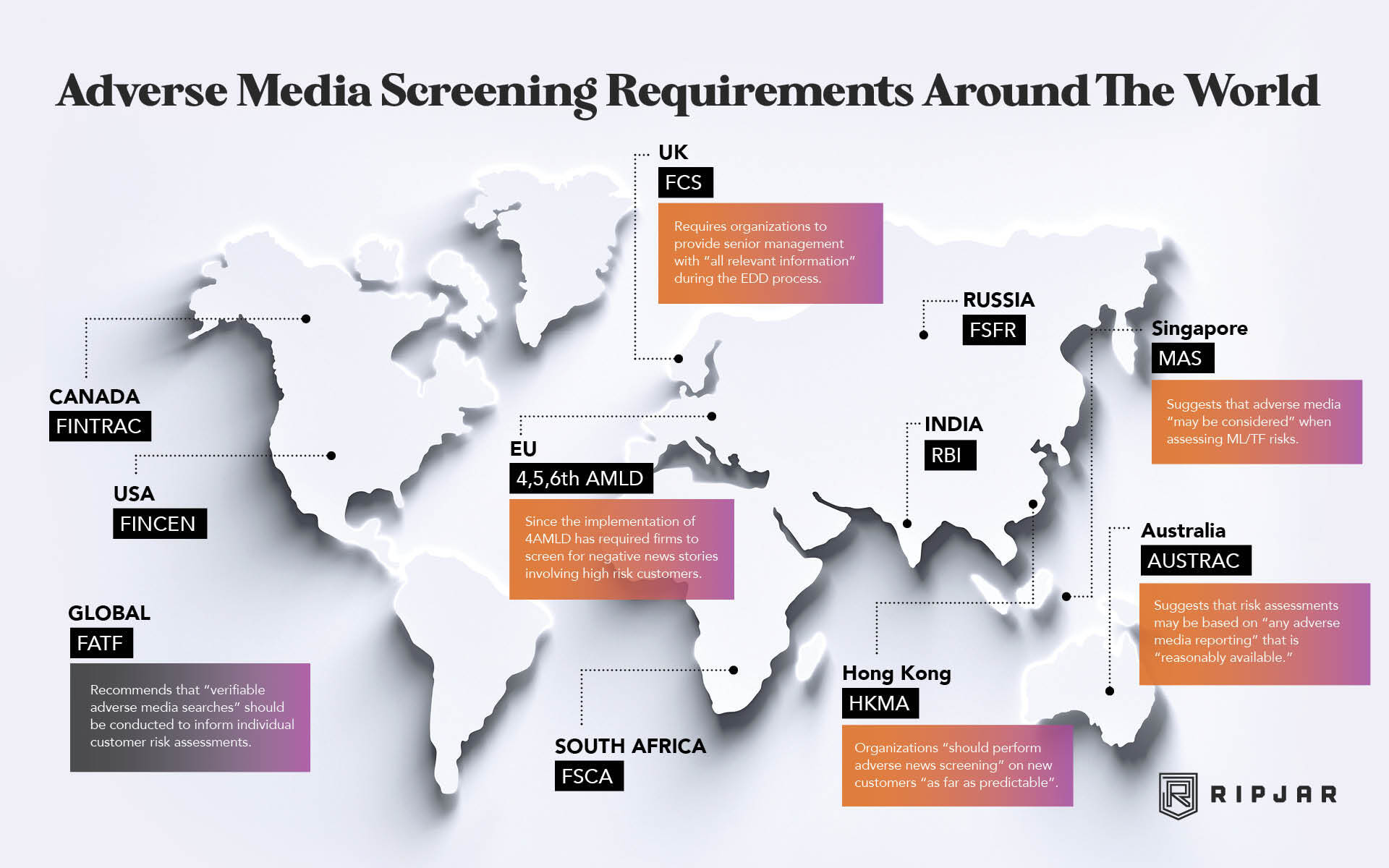
Adverse media screening features in financial compliance regulation in jurisdictions around the world. Who are the regulators that have set out adverse media recommendations and regulations – and how strictly are they applied?
Explore our illustrative map to learn more about the legal requirements and recommendations for adverse media screening in different countries around the world.
Global Adverse Media: FATF
The Financial Action Task Force (FATF) includes adverse media screening in its anti-money laundering guidance, as part of its recommendation that organizations implement a risk-based approach to compliance. Practically, the risk-based approach requires organizations to deploy a proportionate compliance response based on an assessment of the risk that individual customers and clients present. Accordingly, low risk customers may be subject to simplified AML/CFT customer due diligence measures, while higher risk customers should be subjected to enhanced due diligence which should include adverse media screening.
FATF adverse media screening guidelines suggest that organizations deploy “verifiable adverse media searches” in order to build out their client’s risk profiles and to understand the nature of the business in which they are engaged. The adverse media searches should involve the gathering of “sufficient… publicly available information” during the CDD and EDD processes.
FATF also requires organizations to establish whether customers have been subject to historic criminal investigations or regulatory penalties – which may involve historic adverse media screening. Historic actions against customers should inform their current risk categorization.
European Adverse Media: 6AMLD
The EU Parliament has mandated adverse media screening measures as part of its periodically-released Anti-Money Laundering Directives (AMLD) which member states must transpose into domestic law. The most recent of these directives is the sixth – usually known as 6AMLD – but previous directives also set out adverse media compliance requirements.
The Fourth Anti-Money Laundering Directive (4AMLD), which came into effect on 26 June 2017, included a requirement for screening against “open source” media, such as “reports in reputable newspapers”, as part of the EDD process. On 10 January 2020, 5AMLD came into effect and strengthened adverse media requirements by expanding the number of business sectors that were required to perform searches. 5AMLD also intensified the regulatory push towards compliance automation, including the use of automated adverse media screening technology. The Sixth Anti-Money Laundering Directive came into effect on 3 June 2021. Amongst 6AMLD’s regulatory changes was a codification of 22 money laundering predicate offences – with the addition of cybercrime and environmental crime to the list. Accordingly, under 6AMLD, adverse media screening solutions must be adjusted to account for the new predicate offences as risk liabilities.
UK Adverse Media: FCA
The UK’s Financial Conduct Authority, reflects the guidance of the FATF, stipulating that adverse media screening should be implemented when onboarding customers and during “periodic reviews” of customer relationships.
The FCA referenced the importance of adverse media screening in the UK in a letter sent to retail banks in May 2021. The letter detailed a range of transaction monitoring failures by UK banks, and emphasized a particular case in which a bank had failed to act on adverse media stories that revealed allegations about illegally-obtained funds. The FCA stated that the failure had put the bank “at significant risk of facilitating money laundering”.
APAC Adverse Media: MAS, HKMA, AUSTRAC
Adverse media screening is a feature of regulatory regimes across APAC. Following FATF guidance, the Monetary Authority of Singapore (MAS) requires organizations to put suitable screening measures in place when establishing business relationships, including “screening against ML/TF information sources” such as media outlets. In 2020, MAS released a guidance paper on ‘Effective AML/CFT Controls in Private Banking’, setting out the need for organizations to monitor “adverse news” as part of their approach to risk management.
Like MAS, the Hong Kong Monetary Authority (HKMA) has underlined the importance of adverse media screening as a way to inform customer risk profiles in financial contexts. In a January 2021 publication, MAS identified adverse media searches as “ideal candidates” for automation in a regtech-integrated AML solution, and recommended the use of news media databases to facilitate those searches. Adverse media screening features prominently in AML/CFT compliance guidance from the Australian Transaction Reports and Analysis Centre (AUSTRAC). In order to build accurate and effective customer risk profiles, AUSTRAC recommends adverse media screening as part of the CDD process during onboarding and then throughout a customer relationship in order to detect material changes in risk.
Want to learn how Ripjar can help with Adverse Media Screening? Please Get in touch.
Minimise Risk and Maximise Efficiency with the Combination of Best-in-Class Media Data and Advanced Next Generation Screening Technology
Sweet and sour. Bread and butter. Gin and tonic. Some things just go better together.
After two years of working together, when it comes to next generation adverse media screening we’re confident that the perfect combination is Dow Jones data and Ripjar screening technology. There are a number of important reasons why the fusion brings a multiplier effect and ultimately a critical advantage to users.
In our modern connected world, there are simply huge quantities of data out there. Industry experience confirms that is the best all round source of media data. It includes a huge array of high quality structured and unstructured data including licensed news sources.
With data, coverage is all important. As a Chief Risk Officer, you want to do everything you can to ensure you’re not missing risks that could prove devastating to your business.
However, making sense of large volumes of data provides a real challenge.
Ripjar’s screening approach uses sophisticated Natural Language Processing (NLP) and Machine Learning to look in-depth at the content of each and every media article. The processing algorithms identify which people and companies are referred to in each article, and which risks each article refers to.
Working in 19 different languages, the technology has been fine tuned and tested with multiple Tier 1 banks operating across many demanding regulatory regimes.
And how often should you check your customers against the data? The answer is continuously.
Real-time monitoring is complex, but it is the only way to avoid the risks that are inherent with scheduled monitoring. As new media articles are received they are immediately screened and generate alerts.
Maintaining the highest standards of compliance is extremely challenging, but sophisticated businesses around the world are realising the power of media data to evaluate client, vendor and supply chain risk. Modern solutions, such as Ripjar Labyrinth Screening, provide the ability to precisely calibrate and understand risks in real-time.
Since Dow Jones and Ripjar have partnered to deliver Dow Jones Advanced Adverse Media Media Screening two years ago, it’s been great to see the power of strong collaboration. Together we are looking forward to many more years of partnership to redefine the state of the art of name and media screening.
It is always interesting to look at the different words and metaphors that are used in different languages and cultures and the effect that they have. Specific phrases and symbols play an important role when it comes to our day-to-day thinking. Each and every subtlety alters the perceptions of all those using them.
For instance, when an English speaker might say “It’s all Greek to me” to mean that they don’t know what’s going on, a German speaker is more likely to say “Ich verstehe nur Bahnhof” or “I only understand the train station.” Train stations and Greek are wonderfully diverse metaphors for the same thing, and the difference skews the way we perceive the world.
I heard a witty take on the concept recently while watching TV coverage of the Olympic Games in Tokyo. One of the commentators joked “… if only the Germans had a word for Schadenfreude.” The serious point here is that without an in-built appreciation of the German word schadenfreude, it would be very complex for an English speaker to quickly convey that sentiment.
Sometimes, a metaphor can mean two quite different things in different languages. For an English speaker, the term ‘Swiss Army knife’ – a penknife with many different blades and capabilities- can metaphorically refer to myriad and fabulous tools (or even people) that are supremely versatile and can do many different things well. In German however, a Swiss Army knife is not a good thing. It is a tool that does nothing well.
When we think about monitoring adverse media at scale, we have found a one-size-fits-all approach is far from optimal.
Savvy Chief Risk Officers (CROs) know that screening their customers against different media sources provides a vital early warning of risk and enables their organisations to be ahead of the game. That’s true both for new and existing customers.
In the case of new customers, it can be very useful to cast a wide net and broaden the search for matching media profiles. When it comes to existing customers, a balanced approach is more important.
At Ripjar, we’ve found that it is really important to calibrate and fine-tune for both portfolios. We undertake detailed in-depth collaboration to ensure we have the correct balance of false positives compared to false negatives. Getting the approach right can make the difference between being massively under-resourced or accepting too much risk.
Another important factor for our biggest tier-1 clients is the ability to merge in additional private data sources to further improve matching and optimisation. That’s where the Ripjar approach comes into its own. While most of the heavy lifting of filtering and understanding media data is done in Ripjar’s cloud, our clients have a wide range of choices for their instance of our screening software. They can choose to use our public cloud – with a choice of locations, their own cloud (public or private) or deploy the software locally on-premise.
For clients who have particular constraints about customer data and for those who have specific requirements to their own data matching strategies we are able to devise and deploy bespoke solutions which balance flexibility with accuracy and speed of deployment. And for all clients we can enhance the results still further with specific tuning.
With so many dimensions to a problem as complex as adverse media screening, having a veritable ‘Swiss Army Knife’ which can be rapidly configured and adapted to meet our clients unique needs is essential. Each blade, saw, or even toothpick – if we want to complete the metaphor – must also be of exacting standards and be extremely specialised. We think we have both versatility and depth and we’d love to talk more with anyone who would like to find out more.
One of my favourite quotes from Joseph Heller’s Catch 22 is “Just because you’re paranoid doesn’t mean they aren’t after you.”
In the modern world, reputation is everything. Sophisticated CROs and compliance leaders at banks and large enterprises are supremely conscious of the multitude of client and counterparty risks that they face and the value of being proactive.
Within the framework of a comprehensive risk management strategy that means it is critical to review new and existing clients as well as companies in the supply chain and other vendors with well-executed adverse media (aka negative news) and watchlist checks.
I’m delighted to announce a game-changing innovation in the way that Ripjar’s Labyrinth Screening software helps address the challenge. Our Entity profiles organise and present data in a way which massively improves analyst efficiency and further enhances the ability for organisations to rapidly understand their risks.
Using powerful automated entity resolution, enhanced with machine learning and natural language processing (NLP), our new profile software is able to distinguish between millions of individuals and companies that feature in news and other media. Rather than matching your customer records to articles, we’re matching them to fully formed profiles.
As our systems continuously receive and read unstructured media articles from multiple sources at our data analytics hub, we mine the data to fully understand what risks are contained. Our algorithms read and parse data in 19 different languages to uncover not only the type of risk but also the severity and level of involvement. Using that data we collate and rank which are the most pertinent data points for any given profile.
The result for analysts is a massive step forward. When they review their clients and prospects who feature heavily in the news they no longer have to sift through mountains of articles to fully understand potential risks. Instead, they can quickly review just the most meaningful articles. And for clients and prospects who share a name with others, the transformation is even more substantial. Analysts can quickly zero in on just the right profile and only spend time reviewing truly pertinent news.
Profiles go even further. Alongside media articles, profiles show relevant watchlist matches and other pertinent data – date of birth, nationality, gender, aliases, relationships, and when the person or company first and last appeared in the media – which further helps analysts match profiles to their clients.
Entity profiles provide a step-change in the way organisations can leverage structured and unstructured data to understand risks. We’ve delighted to be able to enable customers to realise the power of profiles and look forward to bringing you further announcements about innovations to profiles as well as our data processing capabilities in upcoming months.
Please contact me if you’d like to arrange a demo or talk to us about how Ripjar can help you supercharge data to fight crime and protect your business.
The promise of adverse media screening has long been a holy grail for compliance and financial crime professionals. The wealth of data published every day in the news gives sophisticated companies a leading edge to protect themselves from reputational and criminal risk; from allegations of corruption and bribery, detailed accounts of embezzlement and environmental damage, to the trials and sentencing of organised criminal gangs for crimes including human trafficking and cybercrime.
With the wealth of potential risks out there, media searches may even provide the most valuable data source available during on-boarding or throughout the client lifecycle to spot risk or the leading indicators of criminal behaviour.
The challenges of exploiting the vast treasure trove of data are abundant. Every day, over 2 million articles are published in hundreds of different global languages. In the time between periodic review, this means potentially hundreds of millions of articles have to be searched for relevance or materiality.
Next, trying to search a client’s name, nicknames, aliases or its corporate identity in many different forms, many different abbreviations, contractions or permutations becomes an effort all in itself and fraught with inconsistencies between analysts.
Lastly, the vast amount of noise from non-related news articles about pop-culture, politics, advertising, horoscopes and other topics, all contribute to the fact that most adverse media searches either return nothing, or nothing but false positives.
Most adverse media searches either return nothing, or nothing but false positives.
Further adding to the complexity is the need to do this screening at scale. Searching tens of thousands or even millions of client identities every single day.
Simply, adverse media searching doesn’t work.
For the last 3 years, we have been working with leading European financial institutions to solve the problem. We want to fulfill the promise that adverse media can provide in completing the 360-degree view of client risk from all available data sources – both internal and external.
We have taken decades of combined experience working in the data intelligence industry and engineered a solution fit for the modern challenge of risk management from high-volume, high-noise data sources.
Using our own proprietary artificial intelligence techniques, we have taught machines to read the news like a human – at scale.
Our Labyrinth Screening platform takes the millions of articles of news published every single day in over a dozen languages – including Arabic, Russian, Spanish, French, Chinese, Japanese and Malay – and distills them down into thematic areas representing material criminal and reputational risk.
Entity extraction and entity resolution automatically join the dots on client names, automatically generating permutations and connections that a human analyst may miss. Machine translation completes the task, giving analysts a chance to see beyond the algorithmic selections that one might get from simply searching a traditional search engine for a client name or identity.
Automation like this scales. It can search all data sources continuously, and alert for new risks in real-time
Automation like this scales. It can search all data sources continuously, and alert for new risks in real-time. This means coverage of every single client, every single day. Small compliance teams can manage large volumes of client risks systematically and the promise of adverse media as a key part of the risk management cycle is fulfilled.
I’d love the opportunity to show this to you, so please get in touch if you’d like to hear more.
After the Nile, Amazon and Yangtze, the Mississippi ranks as both one of the longest and most evocative rivers in the world. At the heart of the American continent both in location and in stature, the 2320 miles of the Mississippi collects water from a colossal catchment area of over a million square miles, collecting most, if not all the water from 31 US states or 40% of the entire USA, before discharging half a million cubic feet of water every second, into the Gulf of Mexico. It’s story is just as vast as its dimensions, the steamboat-era of the 1930s best captured perhaps by Mark Twain in The Adventures of Huckleberry Finn, has cemented the river’s place in popular culture and imagination.
But it is the river’s economic value that has continually driven its significance. Even the sedentary pace of the 19th century paddle steamers was enough to develop the river as a key route for goods and passengers alike. Today the river transports more than 60% of the US agricultural output and is a critical shipping route for oil and coal throughout the country. The economic value is now estimated at over $400BN, as well as supporting millions of jobs both directly on the river and indirectly in the businesses that have come to rely on it.
It was not always like this. The meandering flow created by nature – the “Father of Waters” as the native Anishinabe people called it – did not lend itself well to its use as a shipping route. The 19th and early 20th century saw substantial attempts to shape, chisel and file off inconvenient curves, bends and other features less conducive to commerce; canals were dug to bypass impassable rapids, dams and levees were built to control flooding, and dredging meant the river could accommodate bigger and heavier ships.
These early attempts would prove disastrous in the long run. Throughout 1926 the rain had been unusually heavy, saturating the basin that fed the river for months. The rain however, did not stop. The spring of 1927 brought catastrophe. The river broke out of its banks in 145 places, and inundated 27,000 square miles to depths of more than 30 feet (9m). The flood left an estimated 750,000 people without food or shelter and created a humanitarian disaster the effects of which can still be seen today.
Those interventions – the attempts to tame the river – had not only had failed, but spectacularly backfired. Straight waterways channel water more efficiently. Deeper water flows more quickly and in greater volume. Levees and dams restrict the natural flow and increase the elevation of the water line. All combined to worsen the resultant flooding.
After the floods, the US Army Corp of Engineers were tasked to build the largest system of flood defences in the world. Taking over from the previous local and piecemeal approaches to flood defence, the Corps took a holistic approach looking at the entire region. Starting in 1928, in one of the largest public civil engineering projects ever devised, dozens of canals, locks and levees would be built to ensure the river could stay navigable for commerce, while allowing nature to take its course whenever the rains came. While new flooding has continued to refine the system, nothing like on the scale of 1927 has ever happened again.
The New Flood
While the Army Engineers were ushering in a revolution in how the great river Mississippi was managed, the 1920s also saw a different revolution in America. As a wave of prosperity surged through middle classes after WW1, new forms of entertainment in the form of tabloids, magazines, radio and motion pictures all captured the public appetite for modernity. These new forms of media ushered in profound cultural changes as new ideas could now freely proliferate, changing the very fabric of society. Time Magazine, Readers Digest, Amos and Andy, Charlie Chaplain; the 1920s set out the template for what would become billion-dollar media empires, movie studios and the liberal flow of knowledge and ideas.
For over 70 years these forms of media grew in popularity and influence, until a new flood occurred. This wasn’t a flood of water, but of information. The internet created an entire new way that media could be created and consumed. In 1996 the internet passed 100,000 websites and by 2000 there were more than 20 million websites; today there are well over a billion. Social media, which empowers anyone to become a publisher of information has created data orders of magnitude larger, with hundreds of millions of posts per day being broadcast on the top platforms.
Reducing the Noise
This blog has already talked about the value of intelligence gathering from open-source media (see Deciphering Risk from Adverse Media Reports) and the ways in which small pieces of information can even reveal information valuable to national security and countering financial crime. Technology has optimised the flow of information to create the most value for people sharing the latest news, but – just like the waters of the Mississippi – it has also created the pre-conditions for a flood.
When on-boarding clients within a financial services context, the flood becomes particularly tricky to navigate.
Using traditional search engines, an analyst may be looking for news articles, something in their history that betrays a risk, criminal activity or other potential regulatory issue. Typing in that client’s name into a search engine could result in a huge number of search results which can easily total many hundreds if not thousands of pages. Perhaps an interesting article detailing their involvement in bribery scandal appears on Page 27 of these search results. How many pages are you able and willing to scroll through to spot the risk? Perhaps, the client shares the same name as a famous sports or pop star and it is difficult to ascertain if the client is among the results at all. Perhaps the results return an article that indeed mentions the prospective clients name, but in the context of a family matter or unrelated business announcement.
This deluge of poor quality and irrelevant data often means that analysts neither have the time nor patience to wade through and find any potential risks. This has typically meant so-called adverse media or negative news searches are time consuming and rarely result in actionable intelligence as part of the on-boarding process.
Rudimentary approaches to solving this problem are widespread in the financial services industry. For instance, by adding the word “bribery” after their clients name “Acme Inc.” may help hone the results somewhat. Adding other words like “corruption”, “crime”, or “human trafficking” might expand the potential for discovering risk, but it is extremely limited as a crude attempt to shape and file off the rough corners of the mountain of data returned.
Simply, these keyword-based searches could never hope to match the range of nuance and variety in the language of news articles, webpages and other open-source data that might inform the intelligence picture around a client’s behaviour. Furthermore, limiting such keyword searches to a single language such as English reduces the likelihood of finding articles in any one of the global languages that make up the media landscape all over the world.
NLP: A Next Generation Approach to reducing Data Floods
Just like the new generations of levees and dams that were built on the Mississippi throughout the 20th century ushered in an entirely new, holistic approach to managing America’s greatest waterway, new technology is now doing the same for managing the flood of information that is inundating compliance analysts conducing adverse media checks.
Natural Language Processing (NLP) is an application of machine intelligence which can automatically read and understand unstructured text such news articles, documents, or any written material. Like many other techniques within the field of AI, this works by training an algorithm to recognise what a news article is about at a conceptual level, allowing to the machine to understand what ‘bribery and corruption’ looks like, in multiple languages and from multiple news sources. In fact, in order to train up a classifier for adverse news, we typically look for 10,000 examples to train the system to spot future, similar articles about that topic. Once trained, these algorithms can spot, instantaneously, the features of an article about bribery and corruption in dozens of languages over millions of articles of news.
Applying this within the context of adverse media searching means NLP has the following benefits:
News Articles are automatically grouped into topics of interest – Over 3 million news articles are published every day from news outlets all over the world. Properly trained NLP can group all of these into different categories before a human has even arrived at their desk. Articles about predicate crimes such as human trafficking, embezzlement, or narcotics can all be pre-selected by the system for searches and alerting without the need for elaborate sets of keywords and query terms.
Irrelevant or Useless articles are automatically removed from review – the overwhelming majority of news articles published every day are not relevant to making informed decisions about client risk. Specifically, we estimate that of the millions of articles published every day, less than 0.8% have any value for on-boarding or periodic review. NLP removes over 99% of the noise from adverse media searches meaning that results returned are more relevant and likely to be of value.
Duplication is reduced and similar news is grouped into stories – similar articles are published every day by multiple outlets. Some are even syndicated, word-for-word copies flood news desks on multiple publications. NLP cuts through this noise, automatically discounting identical articles, and grouping similar articles about the same story into an easy to review collection. This further reduces the analyst burden.
News articles can be grouped not just by keywords, but by phrases and complex combinations of linguistic patterns – going beyond simple keyword monitoring, NLP looks more deeply at the structure and patterns within news articles. This means groupings of topics are more accurate, resulting in better quality searches and data.
Articles in other languages are automatically searched for, identified, and translated – NLP topic classification can be done in any language, provided there is sufficient source of ground truth from which to base its decisions on. Training these topic classifiers in over 15 global languages means that risk is identified no matter where the media article has been published.
The Ripjar difference
It is impressive to imagine the engineers who designed the monumental programme of flood defences after the great flood in 1927, who did it all without any advanced modelling and simulation software, let alone a pocket calculator. All they had was their ingenuity and a slide-rule. However, their engineering was able to tame ‘Big Muddy’, and make it safe for those living and working on it, while respecting the natural processes which put it there in the first place.
We have combined state of the art NLP with Entity Resolution (see What is Entity Resolution?) to give intelligence analysts within financial institutions a world-leading adverse news capability. The colossal river of information that flows digitally around the world is measured not in gallons, but in terabytes. This torrent of information can be harnessed for many different purposes, including the effective screening of clients in financial services for risk and NLP is a critical tool in reducing the volume of this torrent to make it more efficient and effective to help institutions fight financial crime.
If you’d like to learn more about our adverse media or negative news screening capabilities, please read the whitepaper here, or contact us for a demonstration.
In the battle between global criminal gangs and the world of international espionage and intrigue, you are likely to imagine a hero, perhaps James Bond, at the bar of a 5-star hotel ordering his signature martini, travelling across far flung and exotic locations to find out critical information and conduct his vital intelligence work.
You are perhaps far less likely to imagine our hero, dinner jacket and all, sat behind a desk, scouring over stacks of newspapers in all the languages of the world, extracting clues and intelligence about the threat the world faces.
Yet, this is precisely how significant portions of intelligence have taken place throughout the 20th Century and have continued to evolve into large scale data analytics well into the 21st. In the run up to World War 2, the British government set up the Foreign Research and Press Service (FRPS) to review and understand open-source news published from across occupied territories (received via neutral countries) revealing a remarkably coherent picture of intelligence vital to the war effort. In 1943, it was formalised into FORD – the Foreign Office Research Department – a full blown intelligence agency that sifted the foreign press, concentrating on political and administrative subjects, for intelligence – past and current – to make inferences for Churchill and his policymakers to help the war effort.
Meanwhile over in the United States, the enigmatically named Office of Strategic Services (the prototype for what was to become the CIA or Central Intelligence Agency), were also combing through foreign newspapers and radio broadcasts for clues that could help the allies in their understanding. Despite restrictions on the press, especially in occupied countries, there was still immense value to be found if one looked hard enough. Speaking on this, William Donovan, the director of the OSS and founding father of the CIA wrote shortly after the war “even a well regimented press will again and again betray the national interest to a painstaking observer”. Citing success stories such as a society column in a local German newspaper inadvertently revealing the location of an army division they had been seeking, and another report which confirmed to the allies the existence of German submarine oil tankers even replete with a photograph of the tanker refuelling a submarine or U-boat at sea.
Over 75 years later, the value of open-source information and intelligence (OSINT) is now well understood within the financial sector too. Breaking news can indicate the impending collapse of a stock, or presage the merger or acquisition of successful (and some not so successful) companies. Crucially, it may also give leading indicators of warning – allegations of bribery and corruption, or the arrest, trials and allegations of the type of predicate offences that generate volumes of illicit wealth – embezzlement, narcotics, human trafficking and fraud.
Thus, financial regulators and the anti-money laundering community have a strong consensus that exploiting open-source news data is a critical step in assessing risk. Unlike the spies of the 1940s however, searching millions of articles of news has become as simple as typing a client’s name into a search box for so-called ‘adverse media’ or ‘negative news’. This largely well understood process for banks to add an additional step during the due diligence process and reduce the risk of on-boarding a potentially criminal entity.
The Signal in the Noise – Challenges of Adverse Media Screening
When conducting financial services on behalf of a person or organisation, the question may sound initially straightforward – have there been any media articles published which indicate that the client is involved in criminal activity or otherwise presents a risk to operations?
In practice, complexity emerges. From the volume of media reports available, the presence of poor quality and irrelevant data, the difficulty of resolving unique entities and the need to preserve privacy and accountability.
We see five key areas where compliance teams struggle to make sense of the growing deluge of data:
The growing scale of data – Ripjar’s access to news data from a variety of different data providers show the scale of the challenge. Since 1990 more than a billion news articles have been published and this is growing at a rate of 3-4 million per day in 2021 across thousands of publications in dozens of languages. Only a small fraction (less than 1%) of these articles will be relevant to the interests of anti-money laundering professionals – stories that relate to bribery, corruption, embezzlement, fraud and other risk topics.
Making it relevant – sifting through this mountain of data, even with modern search engines is fraught with ambiguity. Client names are often non-unique and search engines – optimised not for intelligence work but for commercial interests – typically favour popularity and recency over depth and historical completeness. Thus, the challenge of entity resolution (see our blog on that topic here) becomes critical to reduce the likelihood of false positives where too much irrelevant data is returned, and false negatives – a more dangerous case where relevant data on a risk or threat is missed altogether.
Keeping on top of the news – If only conducted at onboarding, negative news screening – even if done accurately – only presents a snapshot in time. With millions of new articles published daily, keeping on top usually requires periodic review and remediation exercises, but with resources stretched, often clients may go many years before another check is made to see if any adverse articles have been published.
Post-Truth and Fake News – While the digital age has given society unparalleled access to information about the world in which we live, it has increasingly polarised that information to such an extent that news may indeed present a doctored or biased version of the truth, or outright fabrications entirely. In the last 5 years, trust in media has been eroded, with a recent study in 2020 showing that over a third of UK adults trust the news less than previous years.
Security and automation – Concerns around data integrity and privacy are paramount. Client details may include some of the most sensitive data an institution has available to them. Yet, online databases of news articles and search engines exist in cloud-based regimes, with opaque data-retention and security models. Therefore, typing or uploading a client’s name into an online search box transmits data to a third party, often outside of the country, with no audit log of the search ever being conducted by the bank. Establishing a rigorous governance model around such searches can be exceptionally difficult and labour-intensive.
The Future of Adverse News Screening
While it was the secret intelligence deciphered at Bletchley Park by mathematicians like Alan Turing and early computer scientists Bill Tutte and Tommy Flowers that went on to inspire numerous books and movies, the open source intelligence analysts contributed hugely to the overall picture. Bletchley Park code breaker and official post-war historian of British intelligence Sir Harry Hinsley noted that ‘of the total number of reports (by the Enemy Branch of the Ministry of Economic Warfare) some three-fifths were based upon the Press, broadcasts and official statements’.
That being said, the cryptographic successes at Bletchley Park could not have been achieved without the technological breakthroughs that accompanied the mathematical ones. Automation of codebreaking using some of the world’s first computers was essential to break down the large number of possibilities into something a human could attempt to assimilate.
From the vantage point of the 2020’s, the intelligence analysts of the UK’s FORD and the USA’s OSS teams would likely scarcely believe that such automation could now be applied not to the mathematical structures of Enigma and Lorenz ciphers, but of human language itself, the written text as it was broadcast across a future global internet that would not be conceived of until decades later.
This type of automation – artificial intelligence (AI) – has been core to the approach we have taken at Ripjar to understand the millions of news articles that enter our database every day. We apply Natural Language Processing (NLP) to read the news like a human would, except tens of thousands of times a second; in doing so, we’ve created a brand new approach for looking for criminal and terrorist activity in news data and reporting that is more efficient and effective than legacy technologies.
NLP turns the torrent of data from global news outlets into a focused beam of articles that only relate to risks such as fraud, corruption or human trafficking even if it is originally written in Chinese, Russian or Polish. This removes huge amounts of noise in the data, from sports reports, movie reviews, horoscopes and other miscellany that fill column inches, but usually fill searches with false positives and useless distractions – hiding valuable insights.
Another type of AI – Name Entity Recognition (NER) then extracts and matches the names of people, organisations and locations in order to detect and alert if a client name appears in the news. Rather than wait for an analyst to search for a name in a search box, autonomous systems like Ripjar’s pre-emptively finds information of value and brings them to the attention of a compliance or intelligence analyst.
Lastly, the future of screening requires strict adherence to policy and control frameworks, how data was used in which locations, and how it was accessed and retained. Data governance, particularly when artificial intelligence is helping to sift through data more effectively and efficiently helps regulators and decision makers understand why decisions were made, at what time and with what evidence.
If you’d like to find out more about our vision for the future of adverse media screening you can download the whitepaper here, or get in touch with us for a discussion about our unique technology here.
Dow Jones Risk & Compliance has launched an advanced solution for adverse media screening, which will enable financial institutions to conduct realtime, automated risk-screening and monitoring.
The tool is powered by AI-enabled Natural Language Processing technology from Ripjar, a global leader in data intelligence software. The tool continuously monitors premium content from Dow Jones, including structured risk data and a collection of news articles from over 17,000 licensed sources available within Dow Jones Factiva. The integration of additional data sets is also supported, providing a significant advancement of financial institutions’ anti-money laundering, Know Your Customer (KYC), and third-party risk screening programs.
It enables continuous, real-time screening of customers against news relating to financial crime or reputational risk, as well as the identification of sanctions risk and politically exposed persons.
The application of Ripjar’s technology allows for faster assessment of the risks posed by individuals and entities, while reducing the occurrence of false positives that can waste time and resources.
Jeremy Annis, CEO of Ripjar, said: “Money laundering and terrorist financing are serious threats to financial institutions. Through this partnership with Dow Jones we can empower financial institutions to take a proactive role in preventing those crimes which exploit their vulnerabilities and carry the highest human cost. This is a critical partnership for Ripjar’s development and strategy of creating collaborations with leading global companies that can help us scale our business.”
ENDS
About Dow Jones Risk & Compliance
Dow Jones Risk & Compliance is a global provider of third party risk management and regulatory compliance solutions. Working with clients across the globe, it delivers research tools and outsourced services for on-boarding, vetting and investigation to help companies comply with anti-money laundering, anti-bribery, corruption and economic sanctions regulation in mitigating third party risk. The Dow Jones Risk & Compliance business grew 24% in Fiscal Year 2019, exceeding $130 million in revenues. Dow Jones is a division of News Corp (Nasdaq: NWS, NWSA; ASX: NWS, NWSLV).
About Ripjar
Ripjar is a data intelligence platform company whose mission is to accelerate the time for companies and institutions to identify and manage threats – from across the world.
Founded by former members of the UK’s Government Communications Headquarters (GCHQ), Ripjar develops software products that combine automation, artificial intelligence, and data visualisation to help companies solve the most complex risk and security management problems at scale.