One of my favourite quotes from Joseph Heller’s Catch 22 is “Just because you’re paranoid doesn’t mean they aren’t after you.”
In the modern world, reputation is everything. Sophisticated CROs and compliance leaders at banks and large enterprises are supremely conscious of the multitude of client and counterparty risks that they face and the value of being proactive.
Within the framework of a comprehensive risk management strategy that means it is critical to review new and existing clients as well as companies in the supply chain and other vendors with well-executed adverse media (aka negative news) and watchlist checks.
I’m delighted to announce a game-changing innovation in the way that Ripjar’s Labyrinth Screening software helps address the challenge. Our Entity profiles organise and present data in a way which massively improves analyst efficiency and further enhances the ability for organisations to rapidly understand their risks.
Using powerful automated entity resolution, enhanced with machine learning and natural language processing (NLP), our new profile software is able to distinguish between millions of individuals and companies that feature in news and other media. Rather than matching your customer records to articles, we’re matching them to fully formed profiles.
As our systems continuously receive and read unstructured media articles from multiple sources at our data analytics hub, we mine the data to fully understand what risks are contained. Our algorithms read and parse data in 19 different languages to uncover not only the type of risk but also the severity and level of involvement. Using that data we collate and rank which are the most pertinent data points for any given profile.
The result for analysts is a massive step forward. When they review their clients and prospects who feature heavily in the news they no longer have to sift through mountains of articles to fully understand potential risks. Instead, they can quickly review just the most meaningful articles. And for clients and prospects who share a name with others, the transformation is even more substantial. Analysts can quickly zero in on just the right profile and only spend time reviewing truly pertinent news.
Profiles go even further. Alongside media articles, profiles show relevant watchlist matches and other pertinent data – date of birth, nationality, gender, aliases, relationships, and when the person or company first and last appeared in the media – which further helps analysts match profiles to their clients.
Entity profiles provide a step-change in the way organisations can leverage structured and unstructured data to understand risks. We’ve delighted to be able to enable customers to realise the power of profiles and look forward to bringing you further announcements about innovations to profiles as well as our data processing capabilities in upcoming months.
Please contact me if you’d like to arrange a demo or talk to us about how Ripjar can help you supercharge data to fight crime and protect your business.
Serious and organised crime is big business. The often quoted figures are mind-boggling:
$2 trillion dollars of illicit finance are laundered annually;
The costs to the UK’s economy of at least £37 Billion
These figures hide the true cost of the threat. A chronic and corrosive force in our society that survives on the suffering of millions. Illegal narcotics damage lives, corruption diverts funds away from much needed projects, the trade in illegal wildlife damages our ecosystem and could foster the next worldwide pandemic.
The alarming rise in fraud and cybercrime continues at pace, and investigators – whether in law enforcement, AML investigations teams, Financial Intelligence Units (FIUs) and the other bodies that are set up to manage risk and spot the tell-tale signs of money laundering – are all struggling to make best use of precious resources.
The only way to succeed, is to painstakingly join the dots between internal and external data – from company records which might hide a shell company in the Carribean, news articles from an on-going embezzlement trial, and sensitive KYC/CDD internal records, transaction reports or data from other monitoring systems.
Manually sifting through this data, matching unstructured reports to structured client records takes extraordinary patience and time, often meaning the dark corners of criminality remain uninvestigated and have time to flourish unabated.
This is where Ripjar’s Labyrinth Investigations technology has transformed criminal intelligence and investigations work. This breakthrough data intelligence platform built from decades of experience in government, law enforcement and banking provides a framework for intelligence teams tackling criminality including human trafficking, smuggling, corruption, fraud and cybercrime.
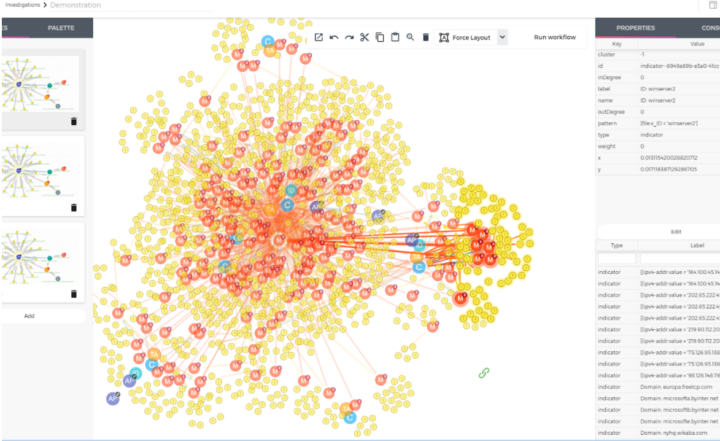
It turns flat and difficult-to-interpret two dimensional data into rich, connected and insightful visualisations – to see criminal networks holistically from all data sources, in three-dimensions.
There are three founding principles that our Investigations platform is built on:
Data Fusion – our powerful workflow engine allows data engineers and data scientists to rapidly iterate and integrate any data source available that might help fight crime or manage risk. Existing data warehouses, clouds or external data sources which all might have their own security, policy controls or limitations to all be integrated into a single seamless 360 degree view of client or criminal risk.
As criminality evolves, so too does Labyrinth Investigations . New data sources, analytics or visualisations can be added quickly with support for common components and services and allow investigators to always stay one step ahead.
AI and Machine Learning – In its quest to tackle on-going criminality, Ripjar has developed some of the world’s most advanced NLP (Natural Language Processing) and NER (Named Entity Recognition) for processing unstructured documents such as news articles, intelligence reports and other text.
Covering dozens of global languages, the technology allows investigators – often for the first time – to see and understand the hidden linkages between structured data, spreadsheets and other traditional data sources, and the vast quantities of unstructured text that is available in the public domain.
At the heart of this approach is our breakthrough in entity resolution which uses a database of millions of observed names to provide unprecedented accuracy in uniquely identifying people, organisations and locations from vast quantities of unstructured and structured data. This fused view of entities, allows Labyrinth Investigations to build a continuous knowledge graph of client profiles and their links to others – a game changer for understanding risk.
Investigations and Knowledge Management – When usingAI tools like Ripjar assess client risk or investigating serious and organised crime, it is essential to have powerful visualisation tools.
Labyrinth Investigations provides state of the art link analysis software giving investigators new ways of exploring their data, following leads and finding hidden patterns. Linking to a secure centralised database of knowledge, Labyrinth Investigations gives teams working across the world the ability to collaborate, breaking down institutional silos and creating a single and complete view of the investigation that can be accessed in the future.
Exposing these technologies to KYC/CDD, AML and international law enforcement teams, we’re continually enhancing our platform to service wider market needs for investigations and risk analysis. I’d be delighted to speak with any professionals working in this space and talk more about what Ripjar can offer.
Gabriel Hopkins, Chief Product Officer, Ripjar Contact Us
The promise of adverse media screening has long been a holy grail for compliance and financial crime professionals. The wealth of data published every day in the news gives sophisticated companies a leading edge to protect themselves from reputational and criminal risk; from allegations of corruption and bribery, detailed accounts of embezzlement and environmental damage, to the trials and sentencing of organised criminal gangs for crimes including human trafficking and cybercrime.
With the wealth of potential risks out there, media searches may even provide the most valuable data source available during on-boarding or throughout the client lifecycle to spot risk or the leading indicators of criminal behaviour.
The challenges of exploiting the vast treasure trove of data are abundant. Every day, over 2 million articles are published in hundreds of different global languages. In the time between periodic review, this means potentially hundreds of millions of articles have to be searched for relevance or materiality.
Next, trying to search a client’s name, nicknames, aliases or its corporate identity in many different forms, many different abbreviations, contractions or permutations becomes an effort all in itself and fraught with inconsistencies between analysts.
Lastly, the vast amount of noise from non-related news articles about pop-culture, politics, advertising, horoscopes and other topics, all contribute to the fact that most adverse media searches either return nothing, or nothing but false positives.
Most adverse media searches either return nothing, or nothing but false positives.
Further adding to the complexity is the need to do this screening at scale. Searching tens of thousands or even millions of client identities every single day.
Simply, adverse media searching doesn’t work.
For the last 3 years, we have been working with leading European financial institutions to solve the problem. We want to fulfill the promise that adverse media can provide in completing the 360-degree view of client risk from all available data sources – both internal and external.
We have taken decades of combined experience working in the data intelligence industry and engineered a solution fit for the modern challenge of risk management from high-volume, high-noise data sources.
Using our own proprietary artificial intelligence techniques, we have taught machines to read the news like a human – at scale.
Our Labyrinth Screening platform takes the millions of articles of news published every single day in over a dozen languages – including Arabic, Russian, Spanish, French, Chinese, Japanese and Malay – and distills them down into thematic areas representing material criminal and reputational risk.
Entity extraction and entity resolution automatically join the dots on client names, automatically generating permutations and connections that a human analyst may miss. Machine translation completes the task, giving analysts a chance to see beyond the algorithmic selections that one might get from simply searching a traditional search engine for a client name or identity.
Automation like this scales. It can search all data sources continuously, and alert for new risks in real-time
Automation like this scales. It can search all data sources continuously, and alert for new risks in real-time. This means coverage of every single client, every single day. Small compliance teams can manage large volumes of client risks systematically and the promise of adverse media as a key part of the risk management cycle is fulfilled.
I’d love the opportunity to show this to you, so please get in touch if you’d like to hear more.
“Anyone can deceive us …. for a time” Tom Clancy, Cardinal of the Kremlin
The spy novels of the cold war perhaps provide some of the most evocative and enduring imagery of espionage. A world of dark alleys and trench coats, meetings at train stations, sleeper agents, deception and secret cameras and bugs. The world of Le Carré, Fleming and Clancy has been endlessly repeated – and of course parodied – deep into our collective consciousness.
Espionage and counter-intelligence in their modern forms continue to shape the world in which we live, as hostile actors vie for information superiority; gaining economic or political advantage, or use the same covert networks to exert malign influence within a greater goal of soft power.
Well-resourced nation states can spend years positioning undercover human agents into a foreign country to collect intelligence, or develop complex technical cyber attacks to acquire gigabytes of valuable intellectual property on the latest advances in vaccine development, aerospace and material science, or policy making – without setting foot in a country at all.
Some are even known to routinely use these capabilities to acquire compromising or embarrassing material – so called ‘Kompromat’ on their adversaries – which they can leak on the web or to an unwitting press at the right time to exert their influence.
Not since the cold war have intelligence agencies been so necessary to protect the national advantage and monitor emerging threats from hostile intelligence gathering operations. Increasingly aggressive actors including traditional nation states, emerging powers, terrorist groups, organised crime and lone actors increasingly use these methods to scale up their understanding of the world, threatening economic wellbeing and global security and eroding our national advantage,
As the number of these groups has broadened and the array of technology at their disposal to carry out espionage and covert intelligence gathering has expanded, so too must the response from those who seek to defend against it.
This is not just a matter for shadowy government agencies. Spies from hostile entities have interest in all manner of civilian and private networks. Almost no public or private sector entity is exempt from the possibility of infiltration by hostile foreign agents. Critical infrastructure can be targeted as part of an attack to undermine resources. Supply chains are at risk – particularly during an emergency pandemic responses. High growth technology companies producing new advances in artificial intelligence or robotics are an attractive target. And so too is personal data of any staff member with access to privileged or sensitive data systems.
As the number of these groups has broadened and the array of technology at their disposal to carry out espionage and covert intelligence gathering has expanded, so too must the response from those who seek to defend against it.
Even your and your parents’ social media accounts may not be safe – as intelligence agencies are increasingly tasked with online propaganda and misinformation campaigns to interfere with foreign elections, democractic processes and exacerbate political divisions.
The solution to this new wave of espionage is to equip government agencies, global companies and financial institutions with new tools that enable the identification of these threats, providing a holistic, joined-up view of the intelligence threat so that defensive measures can be implemented.
We have deployed Ripjar’s Labyrinth Investigations platform to intelligence analysts all around the world, to enhance the integration of counter intelligence, security and cyber data feeds so that investigators can see a more complete view of how systems or networks have been potentially compromised by hostile actors. This type of data fusion is essential to the future of counter-intelligence work where groups operate seamlessly between the real and virtual worlds.
Using technology pioneered in the banking sector, such as entity resolution – uniquely identifying individuals in large volumes of data – we can help spot the tell-tale signs of an undercover alias, suspicious entities who have entered the country under different names, or have opened multiple bank accounts by the same person.
Additionally, by curating threat intelligence and knowledge over time from multiple cyber attacks, analysts within large Managed Security Service Providers (MSSPs) and Security Operations Centres (SOCs) can use our data fusion platform to reveal the patterns and clues to identify and attribute hostile adversaries who have penetrated secure networks and ensure remedial steps can be taken.
Lastly, at the strategic level, we are working with intelligence, law enforcement and financial bodies to enforce international sanctions which are playing an increasing role in the range of countermeasures against hostile espionage activity and helping enforce international norms of behaviour. Throughout 2019 and 2020 sanctions placed against the Russian intelligence agency, the GRU, or ‘Sandworm’ and the North Korean Reconnaissance Bureau or ‘Lazarus Group’ have meant specific individuals are placed on rigorously enforced watchlists. Unable to use international travel, infrastructure or access to finance, these sanctions have a powerful deterrence effect for future behaviour. This enforcement is also bolstered by state of the art technology produced by Ripjar – with real time alerts to any sanctioned entity being issued by our artificial intelligence when an accurate match is found.
The secret to uncovering deception is both patience and meticulous attention to detail. With new capabilities and data fusion technology such as Ripjar, we are ensuring that analysts can scale to meet the challenges of operating in the digital age.