58% of banks still relying on manual adverse media searches, Ripjar finds
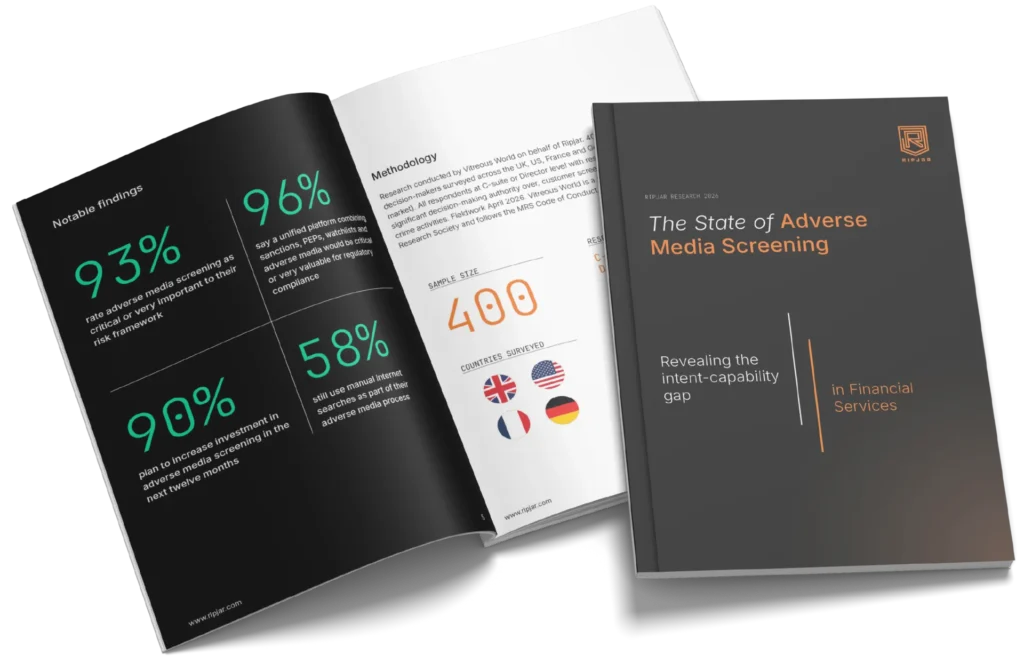
- 93% of financial services leaders say adverse media screening is critical, but only 77% conduct it
- 58% still use manual internet searches, rising up to 70% in the US
- 90% plan to increase investment in the next year
London, 1 June 2026 – New research from Ripjar, the AI-native provider of smarter screening solutions, reveals that financial services decision-makers rate adverse media screening as one of the most critical disciplines in their risk frameworks today. 93% of leaders rate is as critical, but only 77% actually conduct it, and 58% still rely on manual internet searches.
The report, ‘The State of Adverse Media Screening 2026’, reveals an intent-capability gap exposing financial institutions to an evolving and accelerating risk landscape. Based on a survey of 400 senior decision-makers in financial services across the UK, US, France and Germany, the findings show that 96% of leaders want adverse media screening combined with sanctions, PEPs and watchlists in a single unified platform, and 90% plan to increase investment in the next twelve months.
However, 58% still rely on manual internet searches as part of their adverse media process, jumping to 70% of US institutions. Overall, 28% on financial institutions are not yet operating on continuous monitoring. The numbers reveal a gap between what compliance leaders want to do and what their current screening tools actually deliver, which is further exacerbated by a 51% gap between AI investment (79%) and full AI deployment (28%).
Matt Mills, Chief Executive Officer at Ripjar, said: “There’s a clear direction of travel in financial institutions when it comes to adverse media. With so many decision-makers viewing it as critical, adverse media screening is the first line of defence against crime and reputation risk. But what the research also reveals is that there are big differences across countries, and many are unprepared to run it in the way today’s market demands: systematically and at scale. Some of the best banks in the world are already doing this but it’s clear that the rest of the market needs to unify adverse media with sanctions, watchlists and PEPs screening if financial institutions are to adapt successfully to the new risk landscape.”
The financial cost of gaps in screening has seen financial institutions pay more than $69 billion in AML enforcement actions globally since the 2007 financial crisis. In 2024, penalties against banks worldwide jumped 522% year-on-year to $3.65 billion. The pattern across the largest recent cases shows that adverse media signals often exist well before enforcement lands, and that financial institutions need to be able to surface this data continuously and act on it in rapidly to avoid both regulatory and reputational damages.
The full report is available here: https://ripjar.com/resources/adverse-media-screening-research-2026/
ENDS.
Notes to editors
About the research
The 2026 State of Adverse Media Screening was conducted by Vitreous World on behalf of Ripjar. 400 financial services decision-makers were surveyed across the UK, US, France and Germany (n=100 per market). All respondents were at C-suite or Director level with responsibility for, or significant decision-making authority over, customer screening, AML or financial crime activities. Fieldwork was conducted in April 2026. Vitreous World is a member of the Market Research Society and follows the MRS Code of Conduct.
Additional findings available on request
• Regional breakdown across UK, US, France and Germany
• Comparison by job role, institution size, and primary screening domain
• The five-point framework for closing the intent-capability gap
About Ripjar
Founded in 2013, Ripjar enables financial institutions and enterprises to transform anti-money laundering (AML) compliance and combat financial crime with smarter screening and an integrated, dynamic view of risk.
Built on National Security grade technology, Ripjar improves the accuracy and efficiency of screening operations in one enterprise-ready platform with specialised, explainable AI. Its platform is proven to address large-scale challenges and is trusted by financial services and enterprise organisations of all sizes. Ripjar serves more than 300 businesses, including tier 1 banks and large corporations around the world.
The company was founded by former members of the UK’s Government Communications Headquarters (GCHQ) and operates globally with headquarters in the UK.
For more information, visit ripjar.com and follow @Ripjar on LinkedIn.
Media contact:
Cat Lenheim, ThoughtLDR