Global Fincrime: 2025 Regulatory Changes and 2026 Outlook
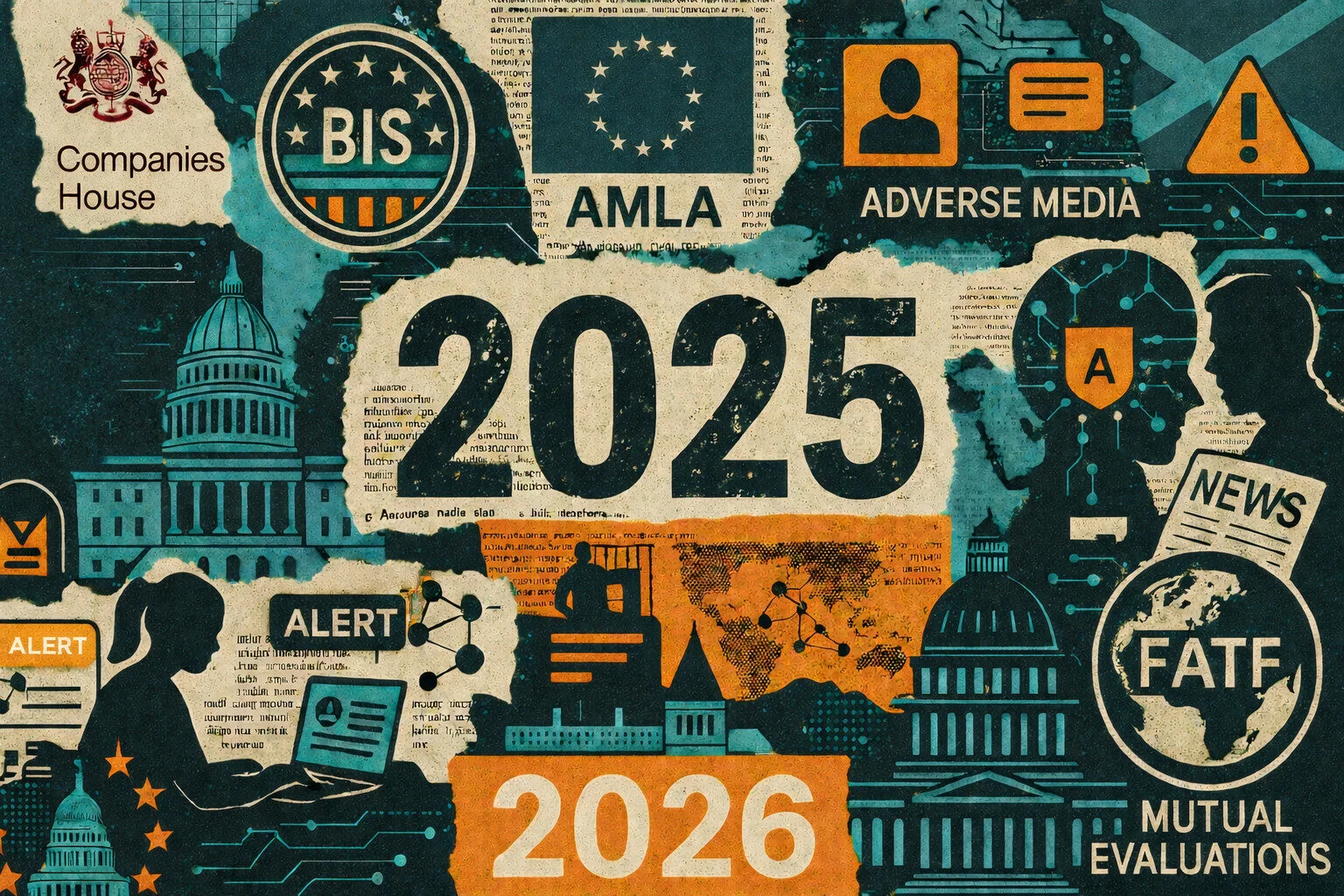
In 2025, several key trends defined the fincrime landscape, including a push for increased corporate transparency, a tightening of corporate ownership rules, and stronger cross-border coordination between national regulators.
Governments pursued a variety of legislative objectives focused on those goals, while global compliance teams kept pace. As we reach the end of 2025, both regulators and businesses are looking to the horizon. But now is also a great moment to take stock of the developments of the past 12 months, as well as what we need to be ready for in 2026.
To help your organisation do that, and stay ahead of regulatory change, we’ve put together a high-level guide to 2025’s key global fincrime developments.
The United States:
The BIS 50% Rule
In September 2025, the United States’ Bureau of Industry and Security (BIS) announced that it was expanding the scope of its Entity List. Under the previous regime, BIS’ export controls, focused on preventing military end use of goods, applied only to entities specifically named on the list, even though they may have had extensive business or financial connections to those named entities.
Under the new regime, known as the “Affiliates Rule” or the “50% Rule”, that loophole will be closed. BIS guidance states that “any entity that is at least 50% owned by one or more entities” on the Entity List now falls under the scope of the export controls.
On 1 November 2025, the White House announced that it would be temporarily suspending implementation of the Affiliates Rule. The suspension is scheduled to run from 10 November 2025 to 10 November 2026 and is currently in effect.
Regardless of the pause, the Affiliates Rule remains a paradigm shift in US policy. In practice, that will mean more extensive beneficial ownership checks on BIS-listed entities, and the application of appropriate risk-based anti-money laundering (AML) and counter-financing of terrorism (CFT) screening standards.
The rule highlights the need to shift screening focus away from single-target resolution, and towards a network-focused approach that clarifies corporate links between organisations.
The United Kingdom:
Economic Crime and Corporate Transparency Act
Introduced in 2023, the Economic Crime and Corporate Transparency Act (ECCTA) is transforming the way that the UK tackles corporate financial crime. In 2025, ECCTA implementation continued, with key developments including:
- Authorised Corporate Service Provider (ACSP) status, enabling certain professional service providers to verify clients for UK registration.
- Expedited disqualification process for fraudulently registered companies.
- Voluntary identity verification for individuals registering as companies.
- Access to certain trust information on the Register of Overseas Entities.
Compulsory identity verification for new directors and people with significant control (PSC) will also arrive in 2025. It will expand to the existing 7 million directors and PSC in 2026.
ECCTA’s focus on ultimate beneficial ownership (UBO) checks means that firms will need to cross-reference public and private sector data, and initiate enhanced compliance against customers that fall short of satisfactory identity verification.
The European Union
AMLA
Although it has not yet assumed its direct supervisory role over EU entities, the EU’s Anti-Money Laundering Authority (AMLA) became operational on 1 July 2025. Since then, it has been working to develop operational infrastructure, and design its regulatory framework.
While there were no significant AMLA developments in 2025, EU member states continued to interpret the law and make changes to domestic AML/CFT legislation in order to align with the broader EU framework as it currently is.
Adverse media screening
AMLA will significantly increase the need for firms to practice effective adverse media screening. As AMLA expands operationally, firms will seek to elevate their adverse media screening solutions, and compliance teams will need to explore and integrate new tools capable of identifying entities efficiently on a global media landscape.
AI Regulation
The EU is building its regulatory focus on the use and safety of artificial intelligence (AI). To that end, the implementation of key legislation continued in 2025:
- The EU AI Act: Introduced in July 2024, the EU AI Act will come into effect in August 2026. The Act requires firms to consider how they implement AI within their infrastructure and take appropriate compliance steps.
- DORA: The Digital Operational Resilience Act (DORA) came into full effect across the EU in January 2025. The regulation requires firms to put appropriate protections in place against cyberattacks.
Financial Action Task Force
Plenary Session
The Financial Action Task Force (FATF) also focused on corporate transparency, regulator responsibility, and international cooperation in 2025. In October, the FATF published the outcomes of its most recent Plenary session, held in Paris, France. Key outcomes included:
- The announcement of new time-bound and risk-based Mutual Evaluation processes, which place greater value on regulatory outcomes.
- The expansion of the Guest Initiative, a programme for non-member states to share views on fincrime challenges, inform FATF strategy, and strengthen global AML/CFT cohesion.
- New guidance for members regarding asset recovery and the confiscation of criminal assets. The guidance, scheduled for publication in November 2025, aims to address low levels of global asset recovery, and the rise in proliferation financing.
National Risk Assessment Toolkit
In August 2025, the FATF launched its National Risk Assessment toolkit. Highlighting the threat of cross-border money laundering, the toolkit is designed to help countries assess their money laundering threats and eliminate regulatory gaps. It sets out a range of insights, including cross-border crime figures, proceeds of crime estimates, and the most common types of predicate crimes.
2026 and Beyond
Most of 2025’s key developments are events within patterns of ongoing regulatory change, or specific milestones set out in legislation. That means compliance teams need to adjust their solutions, and their postures, with an eye on 2026 and the future.
In the UK, for example, the implementation of ECCTA is expected to continue until 2027, and include the expansion of compulsory identity verification measures, more stringent ACSP registration requirements, and stronger business prohibitions for disqualified persons.
Similarly, in the EU, AMLA’s phased introduction will see 40 obliged entities come under the regulator’s direct supervision in 2027. AMLA is expected to achieve full operational capacity in 2028; firms should have taken the relevant steps to align with the new regime by then, including integrating effective adverse media screening solutions.
In the US, FinCEN AML updates are likely. In early 2026, the regulator is expected to expand AML/CFT screening requirements to registered investment advisers (RIAs) and exempt reporting advisers (ERAs).
Key Takeaway: What 2025 Tells Us About 2026
2025 reinforced the notion that global compliance focus will move further towards transparency and data quality in 2026.
It also emphasised the importance of compliance teams’ ability to understand risk across interconnected networks. The BIS 50% rule, for example, is a US regulation, but has a global impact, and many international data providers and screening platforms are already working to ensure they interpret it accurately.
The same can be said for FinCEN and AMLA in the EU: the global impact of regulations requires compliance teams around the world to not only be aware of incoming changes to their threat environment, but be ready to adapt in 2026.
The good news is that Ripjar provides firms around the world with the power and flexibility to do that. Our platform leverages advanced analytics to cut straight through data complexity and noise, and stay ahead of AML risk, now and in the future.
Talking of the future, stay tuned for our upcoming 2026 Outlook which will go into more detail on what to look out for on the fincrime horizon.